1010Computers | Computer Repair & IT Support

SevenRooms raises $50M to double down on reservations, ordering and other tools for hospitality businesses

Restaurants, hotels and other public venues where we spend leisure and business time have started to reopen in many parts of the world after a period of going dark to try to slow down the spread of the coronavirus pandemic. Now, a startup called SevenRooms, which builds software to help those venues with their guest management, is announcing a growth round of $50 million — to double down on providing tools for venues that now have to handle a whole new layer of management to implement social distancing and more.

The funding, a Series B, is coming from a single investor, Providence Strategic Growth, the company tells me. SevenRooms has some notable backers on its cap table already: Amazon (which invested via its Alexa Fund and directly), Comcast (via Comcast Ventures) and BoxGroup, along with a number of individuals.

The company has now raised about $75 million in total and it’s not disclosing its valuation, but CEO Joel Montaniel (who co-founded the company with Allison Page, CPO; and Kinesh Patel, CTO) said in an interview that it’s a significant up round. (PitchBook estimates that its previous valuation was a modest $28 million.)

SevenRooms serves restaurants, hotels and other venues, although food service establishments account for about 95% of its business in terms of customers and revenues. Another new opportunity has emerged out of the need for a lot of other in-person venues, like shops, needing to consider how to implement reservations to help with social distancing.

Today, it counts a number of large chains, including 70% of the restaurants along the Las Vegas Strip (because MGM is a customer), among its users. In all some 500 million bookings globally have been made through its software since it was founded in 2011, and other customers include Bloomin’ Brands, Mandarin Oriental Hotel Group, Wolfgang Puck, Michael Mina, D&D London, Corbin & King, Jumeirah Group, Black Sheep Restaurants, Zuma and Topgolf.

Montaniel described the last three months of business as something like a “tale of two cities” — a reference to the Charles Dickens novel, which starts out with the famous line, “It was the best of times, it was the worst of times…”

In the context of SevenRooms, that has played out as a big drop in its mainstay business, which was focused around reservations, customer loyalty and other services sold as white-label services directly to the venues (or the operators, as Montaniel calls them), which in turn customised them for their customers, and created experiences across multiple platforms, including their own sites and apps, as well as Google Maps.

“It’s been really tough to see the industry go through the pandemic,” he said. “A lot of operators closed doors overnight. It created a lot of challenges for businesses.”

On the other side of the issue, necessity has been the mother of invention for SevenRooms and its customers. The company has built out a new tool for letting its customers take online orders for delivery — something it had been planning to launch later in the year but decided to launch earlier, given the state of things. It’s sold with a licensing fee, with no commission to SevenRooms, and links in with SevenRooms’ marketing and loyalty tools; it has done well, so much so that Montaniel said it and the longer-term customer relationships it’s building offset the drop in its other business.

“Delivery and pickup grew like crazy,” Montaniel said. And like some of the other “digital transformation” we’ve seen where retailers have accelerated their e-commerce strategies simply to stay in business, he believes that the switches and packages generated tens of thousands per month of savings. 

There are a lot of companies that have built out tools to serve the hospitality industry, and specifically to help with bookings, with some of the bigger names including OpenTable and Yelp. Montaniel believes that SevenRooms stands out because of its focus primarily on its operators, rather than providing a business in being the interface between operators and their customers, and on how it views its role in not just helping perform functions but expanding the wider business, by way of data that it can use to help grow customer loyalty and help people who are regulars feel like it.

There remain a lot of potential competitors who are also sometimes partners. Google, and Google Maps, is perhaps the most obvious, although these days Montaniel says Google Maps and the entry point it gives to discovering restaurants is a great boost to its business.

“Google is a company that every company in the world thinks about and talks about in their strategy sessions,” he said. “But there are others too. Big companies always can be competition: they do so many things so well, and they are a team away and a cash infusion away from competing with you, and those who don’t think they are are rivals are not thinking big enough.”

All the same, there are also two potential allies in SevenRooms’ corner that make this bet a little more interesting.

Amazon’s Alexa Fund is about strategic investments: SevenRooms used the backing to build out an Alexa integration into its white-label tools. But there are other ways in which that connection might potentially develop. The company has dabbled in travel services (including bookings) in the past, via Amazon Destinations, and although that was short-lived, the company continues to serve a number of hospitality and travel businesses via AWS, and frankly you can’t really count Amazon out of any vertical with an online component, which is to say, you can’t really count Amazon out of any vertical at all.

Meanwhile, Comcast has been making a number of investments into the kinds of services that it could potentially resell as part of larger business connectivity packages, which includes a focus on local businesses, spelling out another opportunity for how SevenRooms might expand.

Interestingly, SevenRooms is already close to profitability, and it didn’t need this funding — in contrast to a lot of other startups that have found it hard to make ends meet in these difficult months. Montaniel said that it raised because it had a list of “seven things we wanted to do, and without the extra cash we could only do three of them,” without elaborating on what those product features will be.

It’s a big area, though, and now that so much activity has been cut off for so many of us, we’re only now starting to realise how critical it can be, one reason why investors were interested.

“SevenRooms is a category-defining company that provides a vital solution to hospitality operators worldwide,” said Adam Marcus, managing director at PSG. “Joel and the talented SevenRooms management team have built the only vertically integrated solution in the hospitality industry, which has enabled them to scale into a global powerhouse. SevenRooms is uniquely positioned, and we are excited to partner with the team to support their next phase of growth.”

Powered by WPeMatico

Zoom founder and CEO Eric Yuan will speak at Disrupt 2020

The coronavirus pandemic has bruised and battered many technology startups, but it has also boosted a small few. One such company is Zoom, which has shouldered the task of keeping us connected to one another in the midst of remote work and social distancing.

So, of course, we’re absolutely thrilled to have the chance to chat with Zoom founder and CEO Eric Yuan at Disrupt 2020 online.

Yuan moved to Silicon Valley in 1997 after being rejected for a work visa nine times. He got a job at WebEx and, upon the company’s acquisition by Cisco, became VP of Engineering at the company. He pitched an idea for a mobile-friendly video conferencing system that was rejected by his higher-ups.

And thus, Zoom was born.

Zoom launched in 2011 and quickly became one of the biggest teleconferencing platforms in the world, competing with the likes of Google and Cisco. The company has investors like Emergence, Horizon Ventures and Sequoia, and ultimately filed to go public in 2019.

With some of the most reliable video conferencing software on the market, a tiered pricing structure that’s friendly to average users and massive enterprises alike, and a lively ecosystem of apps and bots on the Zoom App Marketplace, Zoom was well poised to be a public company. In fact, Zoom popped 81% in its first day of trading on the Nasdaq, garnering a valuation of $16 billion at the time.

But few could have prepared the company for the explosive growth it would see in 2020.

The coronavirus pandemic necessitated access to reliable and user-friendly video conferencing software for everyone, not just companies moving to remote work. People used Zoom for family dinners, cocktail hours with friends, first dates and religious gatherings.

In fact, Zoom reported 300 million daily active participants in April.

But that growth led to increased scrutiny of the business and the product. The company was beset by security issues and had to pause product innovation to focus its energy on resolving those issues.

We’ll talk to Yuan about the growing pains the company went through, his plans for Zoom’s future, the acceleration in changing user behavior and more.

It’ll be a conversation you won’t want to miss.

Disrupt 2020 runs from September 14 to September 18, and the show will be completely virtual. That means it’s easier than ever to attend and engage with the show. There are just a few Digital Pro Passes left at the $245 price — once they are gone, prices will increase. Discounts are available for current students and nonprofit/government employees. Or if you are a founder, you can exhibit at your virtual booth for $445 and be able to generate leads even before the event kicks off. Get your tickets today.

Powered by WPeMatico

Why AWS built a no-code tool

AWS today launched Amazon Honeycode, a no-code environment built around a spreadsheet-like interface that is a bit of a detour for Amazon’s cloud service. Typically, after all, AWS is all about giving developers all of the tools to build their applications — but they then have to put all of the pieces together. Honeycode, on the other hand, is meant to appeal to non-coders who want to build basic line-of-business applications. If you know how to work a spreadsheet and want to turn that into an app, Honeycode is all you need.

To understand AWS’s motivation behind the service, I talked to AWS VP Larry Augustin and Meera Vaidyanathan, a general manager at AWS.

“For us, it was about extending the power of AWS to more and more users across our customers,” explained Augustin. “We consistently hear from customers that there are problems they want to solve, they would love to have their IT teams or other teams — even outsourced help — build applications to solve some of those problems. But there’s just more demand for some kind of custom application than there are available developers to solve it.”

Image Credits: Amazon

In that respect then, the motivation behind Honeycode isn’t all that different from what Microsoft is doing with its PowerApps low-code tool. That, too, after all, opens up the Azure platform to users who aren’t necessarily full-time developers. AWS is taking a slightly different approach here, though, but emphasizing the no-code part of Honeycode.

“Our goal with honey code was to enable the people in the line of business, the business analysts, project managers, program managers who are right there in the midst, to easily create a custom application that can solve some of the problems for them without the need to write any code,” said Augustin. “And that was a key piece. There’s no coding required. And we chose to do that by giving them a spreadsheet-like interface that we felt many people would be familiar with as a good starting point.”

A lot of low-code/no-code tools also allow developers to then “escape the code,” as Augstin called it, but that’s not the intent here and there’s no real mechanism for exporting code from Honeycode and take it elsewhere, for example. “One of the tenets we thought about as we were building Honeycode was, gee, if there are things that people want to do and we would want to answer that by letting them escape the code — we kept coming back and trying to answer the question, ‘Well, okay, how can we enable that without forcing them to escape the code?’ So we really tried to force ourselves into the mindset of wanting to give people a great deal of power without escaping to code,” he noted.

Image Credits: Amazon

There are, however, APIs that would allow experienced developers to pull in data from elsewhere. Augustin and Vaidyanathan expect that companies may do this for their users on tthe platform or that AWS partners may create these integrations, too.

Even with these limitations, though, the team argues that you can build some pretty complex applications.

“We’ve been talking to lots of people internally at Amazon who have been building different apps and even within our team and I can honestly say that we haven’t yet come across something that is impossible,” Vaidyanathan said. “I think the level of complexity really depends on how expert of a builder you are. You can get very complicated with the expressions [in the spreadsheet] that you write to display data in a specific way in the app. And I’ve seen people write — and I’m not making this up — 30-line expressions that are just nested and nested and nested. So I really think that it depends on the skills of the builder and I’ve also noticed that once people start building on Honeycode — myself included — I start with something simple and then I get ambitious and I want to add this layer to it — and I want to do this. That’s really how I’ve seen the journey of builders progress. You start with something that’s maybe just one table and a couple of screens, and very quickly, before you know, it’s a far more robust app that continues to evolve with your needs.”

Another feature that sets Honeycode apart is that a spreadsheet sits at the center of its user interface. In that respect, the service may seem a bit like Airtable, but I don’t think that comparison holds up, given that both then take these spreadsheets into very different directions. I’ve also seen it compared to Retool, which may be a better comparison, but Retool is going after a more advanced developer and doesn’t hide the code. There is a reason, though, why these services were built around them and that is simply that everybody is familiar with how to use them.

“People have been using spreadsheets for decades,” noted Augustin. “They’re very familiar. And you can write some very complicated, deep, very powerful expressions and build some very powerful spreadsheets. You can do the same with Honeycode. We felt people were familiar enough with that metaphor that we could give them that full power along with the ability to turn that into an app.”

The team itself used the service to manage the launch of Honeycode, Vaidyanathan stressed — and to vote on the name for the product (though Vaidyanathan and Augustin wouldn’t say which other names they considered.

“I think we have really, in some ways, a revolutionary product in terms of bringing the power of AWS and putting it in the hands of people who are not coders,” said Augustin.

Powered by WPeMatico

IPOs that could happen soon, cannot happen soon enough

Earlier today we took a look at two companies that have filed to go public, nCino and GoHealth. The pair join Lemonade in a march toward the public markets.

But those three firms are hardly alone. We know that DoorDash filed privately earlier this year (it also raised a pile of cash lately, so its IPO may not be in a hurry), and Postmates filed privately last year.

Even more, there are a number of companies whose IPOs we anticipate in short order. So, what follows is our incredibly scientific survey of impending IPOs, starting with those closest to the gate. This list is focused on companies that were at one point venture-backed startups, even if they have become behemoths in the intervening years.

We’ll start with companies that have filed and are moving toward debuts in the next few weeks:

  • nCino: This SaaS company is growing nicely, and has pretty good overall economics. We covered its financial history here. Its debut will be a win for North Carolina.
  • GoHealth: A Chicago success story that was swallowed by private equity last year, GoHealth is now an incredibly complicated company and offering that features lots of long-term indebtedness. But, its exit should provide reasonable returns to its current owner’s backers, who held onto the firm for less than a year before trying to flip it.
  • Lemonade: Lemonade’s IPO is an important moment for a number of modern insurance companies like Root, MetroMile, Kin and others. Not that they all sell the same type of insurance, mind, they don’t. Lemonade does rental and home insurance, while Root and MetroMile are focused on autos, for example. But if Lemonade manages a strong offering, it could provide tailwind to its fellow neo-insurance providers all the same.
  • Agora: We’re catching up on the Agora debut. The China-based company’s IPO filing details a company that provides other companies and developers the ability to “embed real-time video and voice functionalities into their applications without the need to develop the technology or build the underlying infrastructure themselves” via APIs. This sounds a bit like what Daily.co is building, if you recall that round. Agora is a company that has good operating income and net income before “accretion on convertible redeemable preferred shares to redemption value.” With that in hand, the company’s earnings are sharply negative. Read that how you want. Agora wants to raise between $280 million and $315 million.

And, next, companies that have filed privately but are still hanging back:

And here are companies that are making the sort of noise that one might make before finally going public:

All of the above is a jam, and I am stoked to dig through the S-1 trenches with you.

Powered by WPeMatico

Demand for fertility services persists despite COVID-19 shutdowns

In 2019, the global fertility services industry was estimated to be worth $14.8 billion with demand driven by the significant growth in the median age of first-time mothers, according to a Research & Markets report.

Gina Bartasi, founder and CEO of NYC-based fertility center Kindbody, has pointed to macroeconomic trends responsible for the industry’s consistent growth, such as the increase in single mothers by choice and the fact that “heterosexual couples are waiting to have children and waiting to get married, and more and more same-sex couples are having children, which is relatively new.”

Regardless of the increasing demand, disasters can disrupt fertility services: On March 17, the American Society for Reproductive Medicine directed U.S.-based fertility clinics to avoid initiating new treatments, push back nonemergency surgeries and shift care to telemedicine.

Now reopened, it’s undeniable that COVID-19’s national impact could alter the space as different types of crises have in the past. In looking back, we can find a better understanding of what the future holds.

After the terror attacks on September 11, 2001, a University of Louisville study found that there was “a prompt and significant increase in births and birthrates in the post-9/11 period” in New York City. Relatedly, when Hurricane Katrina hit New Orleans in August 2005 and created the nation’s costliest natural disaster, it was also one of five times since 1987 that frozen embryos were evacuated and protected during a natural disaster.

According to a study done by University of Wisconsin, “following Katrina, displacement contributed to a 30% decline in birth cohort size. Black fertility fell, and remained 4% below expected values through 2010. By contrast, white fertility increased by 5%.” The communities were so ravaged that the area’s Black population has remained substantially smaller.

Powered by WPeMatico

AWS launches Amazon Honeycode, a no-code mobile and web app builder

AWS today announced the beta launch of Amazon Honeycode, a new, fully managed low-code/no-code development tool that aims to make it easy for anybody in a company to build their own applications. All of this, of course, is backed by a database in AWS and a web-based, drag-and-drop interface builder.

Developers can build applications for up to 20 users for free. After that, they pay per user and for the storage their applications take up.

Image Credits: Amazon/AWS

“Customers have told us that the need for custom applications far outstrips the capacity of developers to create them,” said AWS VP Larry Augustin in the announcement. “Now with Amazon Honeycode, almost anyone can create powerful custom mobile and web applications without the need to write code.”

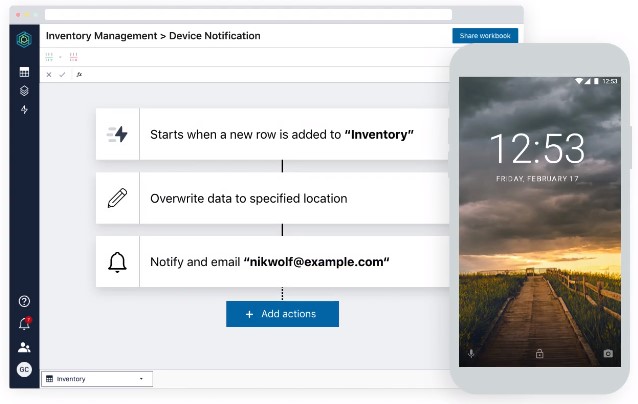
Like similar tools, Honeycode provides users with a set of templates for common use cases like to-do list applications, customer trackers, surveys, schedules and inventory management. Traditionally, AWS argues, a lot of businesses have relied on shared spreadsheets to do these things.

“Customers try to solve for the static nature of spreadsheets by emailing them back and forth, but all of the emailing just compounds the inefficiency because email is slow, doesn’t scale, and introduces versioning and data syncing errors,” the company notes in today’s announcement. “As a result, people often prefer having custom applications built, but the demand for custom programming often outstrips developer capacity, creating a situation where teams either need to wait for developers to free up or have to hire expensive consultants to build applications.”

It’s no surprise then that Honeycode uses a spreadsheet view as its core data interface, which makes sense, given how familiar virtually every potential user is with this concept. To manipulate data, users can work with standard spreadsheet-style formulas, which seems to be about the closest the service gets to actual programming. ‘Builders,” as AWS calls Honeycode users, can also set up notifications, reminders and approval workflows within the service.

AWS says these databases can easily scale up to 100,000 rows per workbook. With this, AWS argues, users can then focus on building their applications without having to worry about the underlying infrastructure.

As of now, it doesn’t look like users will be able to bring in any outside data sources, though that may still be on the company’s roadmap. On the other hand, these kinds of integrations would also complicate the process of building an app and it looks like AWS is trying to keep things simple for now.

Honeycode currently only runs in the AWS US West region in Oregon but is coming to other regions soon.

Among Honeycode’s first customers are SmugMug and Slack.

“We’re excited about the opportunity that Amazon Honeycode creates for teams to build apps to drive and adapt to today’s ever-changing business landscape,” said Brad Armstrong, VP of Business and Corporate Development at Slack in today’s release. “We see Amazon Honeycode as a great complement and extension to Slack and are excited about the opportunity to work together to create ways for our joint customers to work more efficiently and to do more with their data than ever before.”

Powered by WPeMatico

Sony will now pay researchers $50,000+ for critical PS4 bugs

Think you’ve found a way to consistently brick someone’s PS4, or make it run code that it shouldn’t? Sony wants to know — and now they’re willing to pay.

This morning Sony announced that it’s opening its bug bounty program to the public, and will pay for newly discovered bugs and exploits that impact either the PlayStation 4 or their online PlayStation Network.

Sony is pretty explicit about what kind of bugs they’re looking for: anything that hits “the PlayStation 4 system, operating system, accessories” in its current and/or beta form, or that impacts any of a handful of PlayStation Network domains/APIs. Tactics like socially engineering Sony employees or DDoSing their servers, meanwhile, aren’t allowed.

Bugs found in the PlayStation Network will have base bounties of $100-$3,000 or more (depending on severity), while critical bugs found related to the PS4 itself will pay $50,000 or more. You can see Sony’s breakdown, including what’s in/out of the program’s scope, right here.

(Note the focus on PlayStation 4. Finding a new way to break the ol’ PS2 is cool and all, but Sony won’t be dishing out any money for it.)

In a blog post announcing the bug bounty program, Sony notes that they’ve actually been running this program quietly with a handful of researchers for a while now — today, though, they’re opening it up to anyone with the skill and interest. The program’s HackerOne page says Sony has already paid out over $170,000 to researchers, with an average bounty of around $400.

Microsoft launched a similar bug bounty program for Xbox Live earlier this year.

Powered by WPeMatico

Dell’s debt hangover from $67B EMC deal could put VMware stock in play

When Dell bought EMC in 2016 for $67 billion it was one of the biggest acquisitions in tech history, and it brought with it a boatload of debt. Since then Dell has been working on ways to mitigate that debt by selling off various pieces of the corporate empire and going public again, but one of its most valuable assets remains VMware, a company that came over as part of the huge EMC deal.

The Wall Street Journal reported yesterday that Dell is considering selling part of its stake in VMware. The news sent the stock of both companies soaring.

It’s important to understand that even though VMware is part of the Dell family, it runs as a separate company, with its own stock and operations, just as it did when it was part of EMC. Still, Dell owns 81% of that stock, so it could sell a substantial stake and still own a majority of the company, or it could sell it all, or incorporate into the Dell family, or of course it could do nothing at all.

Patrick Moorhead, founder and principal analyst at Moor Insights & Strategy, thinks this might just be about floating a trial balloon. “Companies do things like this all the time to gauge value, together and apart, and my hunch is this is one of those pieces of research,” Moorhead told TechCrunch.

But as Holger Mueller, an analyst with Constellation Research, points out, it’s an idea that could make sense. “It’s plausible. VMware is more valuable than Dell, and their innovation track record is better than Dell’s over the last few years,” he said.

Mueller added that Dell has been juggling its debts since the EMC acquisition, and it will struggle to innovate its way out of that situation. What’s more, Dell has to wait on any decision until September 2021 when it can move some or all of VMware tax-free, five years after the EMC acquisition closed.

“While Dell can juggle finances, it cannot master innovation. The company’s cloud strategy is only working on a shrinking market and that ain’t easy to execute and grow on. So yeah, next year makes sense after the five-year tax-free thing kicks in,” he said.

In between the spreadsheets

VMware is worth $63.9 billion today, while Dell is valued at a far more modest $38.9 billion, according to Yahoo Finance data. But beyond the fact that the companies’ market caps differ, they are also quite different in terms of their ability to generate profit.

Looking at their most recent quarters each ending May 1, 2020, Dell turned $21.9 billion in revenue into just $143 million in net income after all expenses were counted. In contrast, VMware generated just $2.73 billion in revenue, but managed to turn that top line into $386 million worth of net income.

So, VMware is far more profitable than Dell from a far smaller revenue base. Even more, VMware grew more last year (from $2.45 billion to $2.73 billion in revenue in its most recent quarter) than Dell, which shrank from $21.91 billion in Q1 F2020 revenue to $21.90 billion in its own most recent three-month period.

VMware also has growing subscription software (SaaS) revenues. Investors love that top line varietal in 2020, having pushed the valuation of SaaS companies to new heights. VMware grew its SaaS revenues from $411 million in the year-ago period to $572 million in its most recent quarter. That’s not rocketship growth mind you, but the business category was VMware’s fastest growing segment in percentage and gross dollar terms.

So VMware is worth more than Dell, and there are some understandable reasons for the situation. Why wouldn’t Dell sell some VMware to lower its debts if the market is willing to price the virtualization company so strongly? Heck, with less debt perhaps Dell’s own market value would rise.

It’s all about that debt

Almost four years after the deal closed, Dell is still struggling to figure out how to handle all the debt, and in a weak economy, that’s an even bigger challenge now. At some point, it would make sense for Dell to cash in some of its valuable chips, and its most valuable one is clearly VMware.

Nothing is imminent because of the five-year tax break business, but could something happen? September 2021 is a long time away, and a lot could change between now and then, but on its face, VMware offers a good avenue to erase a bunch of that outstanding debt very quickly and get Dell on much firmer financial ground. Time will tell if that’s what happens.

Powered by WPeMatico

How first-time fund managers are de-risking

After what felt like winter, investors say startup deals are back on — although the numbers suggest they never stopped. As Semil Shah of Haystack VC phrased it in a blog post, “It’s game on, pandemic or bust.”

This is good news for founders and big funds, but the investment landscape becomes more complicated when it comes to up-and-coming venture capitalists. “My impression of the current mood amongst traditional limited partners is that most have slowed down considerably in terms of net new investments, new relationships,” Shah told TechCrunch.

So rebound or not, we’re in a volatile time, and first-time fund managers are looking for unique ways to de-risk themselves.

One route: Put liquidity up high in your pitch deck. Moore Ventures, a new fund focused on investing in diverse teams working on sustainability, is experimenting with an unconventional fund structure. Instead of traditional ventures where returns come from multiple rounds of financing and an exit either through acquisition or IPO, Moore is concentrating on successful liquidity strategies throughout a portfolio company’s life.

Constant commercialization, if it works, could be music to a limited partner’s ears.

“Some will fall into the licensing model, some will be developing the product and then selling the design and manufacturing process to an existing company before expanding marketing and sales. Only if a company has the ability to expand its product base and scale will we plan to commercialize through the traditional company development process,” said Darius Sankey, a general partner at Moore Ventures.

Powered by WPeMatico

Register for next week’s Pitches & Pitchers session

Does your elevator pitch lack traction? Could it do with a serious makeover? We’re here to help. Tune into Pitchers & Pitches, an interactive pitch-off and feedback session, on July 1 at 4 p.m. ET / 1 p.m. PT. This event is 100% free — simply register here to attend.

Pitchers & Pitches — part pitch-off, part masterclass — features startups (all exhibitors in Digital Startup Alley during Disrupt 2020) delivering their best 60-second pitch to a panel of judges. The panel for this session consists of two TechCrunch editors — Jordan Crook and Kirsten Korosec — and two VCs — Matthew Hartman of Betaworks Ventures and Dayna Grayson of Construct Capital.

The panel will critique each presentation, offer advice and suggest ways to forge a pitch for the ages. Take their tips, adapt them your specific situation and get ready to super charge your elevator pitch.

Note: The Pitchers & Pitches webinar series is free and open to all, but only companies that purchased a Disrupt Digital Startup Alley Package are eligible to pitch. We randomly chose these startups to compete on July 1st:

Cognidna – provides DNA insights on cognitive traits, helping parents make more informed educational decisions for their children.

Munch a digital platform for restaurants designed to create better customer experiences.

Flexlane – an online wholesale marketplace that transforms the way local retailers in Asia buy for their stores.

Bitsensing – aims to design future safety in the era of Autonomous Vehicles.

What’s a pitch-off without a prize? One pitching startup will win a consulting session with cela. cela connects early-stage startups to accelerators and incubators that can help them scale their businesses.

And while the judges evaluate and provide feedback, it’s the virtual audience (i.e. you) who determines the ultimate winner. That said, everyone who attends the event comes away with a stronger pitch and stands a greater chance of catching investor attention. Win-win.

Keep your startup focused and on track. Register for Pitches & Pitchers and join us next week, July 1 at 4 p.m. ET / 1 p.m. PT. If you want to be eligible to pitch your startup at Pitchers & Pitches, purchase your Digital Startup Alley ticket and opt in to being considered for our fourth installment of Pitchers & Pitches.

Is your company interested in sponsoring or exhibiting at Disrupt 2020? Contact our sponsorship sales team by filling out this form.

Powered by WPeMatico