1010Computers | Computer Repair & IT Support

Newzoo forecasts 2020 global games industry will reach $159 billion

Games and esports analytics firm Newzoo released its highly cited annual report on the size and state of the video gaming industry yesterday. The firm is predicting 2020 global game industry revenue from consumers of $159.3 billion, a 9.3% increase year-over-year. Newzoo predicts the market will surpass $200 billion by the end of 2023.

Importantly, the data excludes in-game advertising revenue (which surged +59% during COVID-19 lockdowns, according to Unity) and the market of gaming digital assets traded between consumers. Advertising within games is a meaningful source of revenue for many mobile gaming companies. In-game ads in just the U.S. drove roughly $3 billion in industry revenue last year, according to eMarketer.

To compare with gaming, the global markets for other media and entertainment formats are:

Counting gamers

Of 7.8 billion people on the planet, 4.2 billion (53.6%) of whom have internet connectivity, 2.69 billion will play video games this year, and Newzoo predicts that number to reach three billion in 2023. It broke down the current geographic distribution of gamers as:

  • 1,447 million (54%) in Asia-Pacific
  • 386 million (14%) in Europe
  • 377 million (14%) in Middle East & Africa
  • 266 million (10%) in Latin America
  • 210 million (8%) in North America

Powered by WPeMatico

Agora starts life as a public company by more than doubling to $50 a share

Shares of Agora, a China and U.S.-based “real-time engagement” API company, soared today after it went public.

Yesterday Agora priced 17.5 million shares at $20 apiece, up from its target range of $16 to $18 per share. The firm raised $350 in its debut, or around 10 times its Q1 2020 revenue and is now amply capitalized and has runway for effectively forever, given its modest cash consumption as an ongoing concern.

But while the debut was a success, seeing Agora’s share price rise as quickly as it did was not universally popular. Regular critic of the traditional IPO process Bill Gurley — a venture capitalist, so someone with a stake in this particular gambit — weighed in:

Pretty amazing that there is a financial exercise on this planet involving hundreds of millions of dollars where its OK to not even get to 50% of the actual end result. The process is so rigged/broken at this point. They missed by more than the original guess. #marketpricing pic.twitter.com/MqmmYRw3ZM

Bill Gurley (@bgurley) June 26, 2020

Let me translate. Gurley is irked — rightly, to at least some degree — that as Agora opened at $45 per share, the company’s IPO was awfully priced. By that we mean that the company should have sold its IPO shares not at $20, but at $45, the value at which the market quickly repriced them.

As $45 is more than twice $20, its bankers “missed by more than [their] original guess.” Given the number of shares the company sold, the mis-pricing could be worth up to $437.5 million!

There’s merit to this argument, but it’s not as complete a slam dunk as it might appear. Chat with CEOs of public companies and they will tell you about how important it is to have steady, stable, long-term shareholders of their equity. Those you might, say, meet on a roadshow and get to invest in your IPO shares.

Those groups — the long-term investors that tech folks claim to love so dearly — are likely a bit more price conscious than the momentum traders eager to find upside in recent debuts. That is, folks more likely to hold onto shares for a shorter period of time.

So, if you want long-term shareholders, you may have to price you IPO under the price the market may initially bear once trading begins.


Still, holy shit $20 per share is not close to $45. Gurley has a point.

The future

Change may be coming. The Agora news rotates back to what the NYSE, an American exchange, is doing. Namely trying to come up with a way to let companies direct list (to just start trading, sans pricing or raising new capital), and raise capital. This gets rid of the issues that Gurley highlighted above. At least in theory.

Obviously, if that model becomes possible and long-term investors are willing to pay for shares in a slightly different manner, the new method will be far superior than the old for companies that are great. What sort of companies get burned from first-day pops the most? I reckon it’s the most attractive, or hyped companies.

The companies that would make the most attractive IPOs would use the new method, leaving — what? The detritus to go out the old-fashioned way? Signaling issues abound!

Anyway, it was a zany first day for Agora.

Powered by WPeMatico

Airvet, a telehealth veterinary platform, just clawed its way to a $14 million Series A round

Telemedicine is becoming more widely embraced by the day — and not just for humans. With a pet in roughly 65% of U.S. homes, there is now a dizzying number of companies enabling vets to meet with their furry patients remotely, including Petriage, Anipanion, TeleVet, Linkyvet, TeleTails, VetNOW, PawSquad, Vetoclock and Petpro Connect.

One of these — a two-year-old, 13-person, LA-based startup called Airvet — unsurprisingly thinks it is the best among the bunch, and it has persuaded investors of as much. Today, the company is announcing $14 million in Series A funding led by Canvas Ventures, with participation by e.ventures, Burst Capital, Starting Line, TrueSight Ventures, Hawke Ventures and Bracket Capital, as well as individual investors.

The pandemic played a role in Canvas’s decision, as did a smart model, suggests general partner Rebecca Lynn, who says she has looked at many telemedicine startups over the last 11 years and that she fell for Airvet after using the service for the animals that live on her own small farm. While vets were initially slow to embrace the shift to more telehealth visits, Airvet has “solved” some of the “objections unique to the space,” she says. Plus, “COVID has been a massive accelerant to adoption.”

We asked Airvet’s founder and CEO, Brandon Werber, to make the company’s case to us separately.

TC: Why start the company?

BW: My dad is one of the most well-known vets in the U.S. — celebrity vet Dr. Jeff Werber. We saw the impact that telehealth was making in the human world and wanted to bring the same access and level of care we get for ourselves to our pets. Since I grew up in the pet space, I know it intimately and recognized a lot of inefficiencies in the delivery of care and how vets have been unable to meet the evolving expectations of pet owners.

TC: How are you connecting vets with their pet patients?

BW: We have two apps. One is for pet-owners to download to talk with a vet, and one is for vets to download to organize workflows and talk to their clients. We do not usurp any existing vet relationships. Instead, we partner with vet clinics and enable them to conduct telehealth visits and simultaneously enable pet-owners to have access to vets 24/7, even if they don’t live nearby a vet hospital.

A huge portion of pet owners in the U.S. don’t even have a primary vet. For serious health issues like surgery, animals still need to go in-person, and network vets can even refer them. We’ve also seen Airvet used as curbside check-in, where pet-owners can chat and follow their pet’s in-person vet appointment via live video from the parking lot.

TC: I see there is a minimum charge of $30 per visit. How do you make this model work financially for vets?

BW: Vets view us as an additional revenue-generating tool on top of their base income. We don’t hire vets. Our network of 2,600+ vets are largely the same vets who use Airvet within their own hospital. They can decide at will, like an Uber driver, to swipe online to be part of the on-demand network and take calls from pet parents anywhere in the country to generate additional income.

TC: What have you learned from startups that tried this model before?

BW: All the startups that came before us are not consumer-first and are just focused on building tools for vets, so their platforms cannot be used by every pet owner. Instead, they can only be used by pet owners whose own vets use that specific platform, which is a tiny fraction of vets and therefore a tiny fraction of pet parents.

TC: Do you have ancillary businesses? Beyond these vet visits, are you selling anything else?

BW: For now, just the vet visits, which range from a $30 minimum to higher, based on the vet and specialty. Over time, we have plans and partnerships lined up to expand into other pet health verticals.

A projected $99 billion will be spent on pets in the U.S. alone in 2020, and for us, telemedicine is only the beginning.

TC: Does Airvet involve specific practice management software?

BW: No. We provide the workflow layer enabling vets to schedule virtual appointments, which will soon be able to be fully integrated with their existing systems and workflows.

TC: When a customer calls a vet for $30, is there a time limit?

BW: There is no time limit and cases will usually stay open for three full days, so pet parents can continue to access the vet via chat for any follow-up questions or concerns.

TC: Are you competing at all on pricing?

BW: Our goal is to work alongside the hospitals, not to compete with them or replace them. You can’t take blood virtually or feel a tumor or do a dental. People always will need to go to the vet.

What we want to do is help [pet owners] understand when [to come in]. The average pet parent only goes to the vet 1.5 times a year. A huge segment of users on Airvet have already connected with a vet six times more than that and save time and stress in doing so.

It’s not about competing for us, it’s about being the provider of care in between office visits [and helping] pet parents who have used our service ultimately avoid an unnecessary emergency visit.

Powered by WPeMatico

Who really benefits from reskilling?

Nearly 40 million Americans are unemployed, and a recent study that examined more than 66,000 tech job layoffs found that sales and customer success roles are most vulnerable amid COVID-19. In response, some quarters of Silicon Valley are abuzz about a long-standing technology: reskilling, or training individuals to adopt an entirely new skillset or career for employment.

As millions look for a way to reenter the workforce, the question arises: Who really benefits from reskilling technology?

That depends on how you look at it, said Jomayra Herrera, a senior associate at Cowboy Ventures. Reskilling for a well-networked manager looks a lot different than it does for someone who doesn’t have as much leverage, and the vast majority of people fall into the latter. Not everyone has a friend at Google or Twitter to help them skip the online application and get right to the decision-makers.

Beyond the accessibility offered by live online classes, she pointed to the difference between assets and opportunities.

“You can give someone access to something, but it’s not true access unless they have the tools and structure to really engage with it,” Herrera said. In other words, how useful is content around reskilling if the company doesn’t support job placement post-training.

Herrera said companies must give individuals opportunities to test skills with real work and navigate the career path. Her mother, who did not go to college and speaks English as a second language, is looking to pursue training online. Before she can proceed, however, she has to surmount hurdles like language support, resume creation, job search and other challenges.

All of a sudden, content feels like a commodity, regardless of if it has active and social learning components. It’s part of the reason that MOOCs (massive open online courses) feel so stale.

Udacity, for example, was almost out of cash in 2018 and laid off more than half of its team in the past two years, according to The New York Times. Now, like other edtech companies, it is facing surges in usage.

Powered by WPeMatico

YC to cut the size of its investment in future YC startups

In a blog post this Friday afternoon, Y Combinator’s president Geoff Ralston said that the accelerator would make two changes to its terms for startups.

The first would see the size of the standard deal for YC startups decline from $150,000 for 7% (roughly a $2.1 million post-money valuation) to $125,000 for the same equity (or roughly a $1.79 million post-money valuation). The deal will continue to be offered using a SAFE, which YC and a group of others pioneered as a simpler investment option compared to convertible notes.

Interestingly, the firm is always writing into its terms that it will only take pro rata up to 4% of a subsequent round’s size, which is obviously smaller than the 7% ownership that the company is buying in its financing. That 4% number is a ceiling — in cases where the accelerator has less ownership than 4%, the smaller percentage applies. Full terms of Y Combinator’s deal are available on its website.

The new deal will apply to startups who join Y Combinator in the Winter 2021 batch, and doesn’t include startups in the current summer batch (who have already presumably been funded)

YC’s deal has varied over the years. When it first launched more than a decade ago, it offered terms of $20,000 for 6%.

A Y Combinator spokeswoman said that the change was in line with the fundraising and budget realties of the accelerator going forward. “The future of the economy is unpredictable, and we feel it is prudent during these times to switch to a leaner model,” she said. “In our case, we want to be set up to fund as many great founders as possible — especially during a time that is creating an unprecedented change to consumer and business behavior; with these changes comes endless opportunities for startups. And with the changes made to our standard deal, we can fund as many as 3000 more companies.”

Outside of budget, at least a couple of factors are potentially at work here. One is the increased use of Work From Anywhere, which presumably can help lower some of the running costs of a startup, particularly in its earliest days (e.g., no need to pay for that WeWork flex desk).

Y Combinator has also invested more of its funds into emerging markets startups, which can have dramatically lower costs of development given prevailing wages for talent in local markets.

Yet, the cutback is also a sign that the flood of capital entering the Valley in recent years has receded — if ever so slightly — in the wake of COVID-19. Valuations are depressing, and while $25,000 is not a massive loss considering the scale of later venture financings, the 16% valuation haircut is in line with other numbers we have seen in the Valley in recent weeks.

Powered by WPeMatico

Only 12 hours left to apply for Startup Battlefield at Disrupt 2020

It’s now o’clock, founders. A mere 12 hours stands between you and a chance to compete in Startup Battlefield and launch your pre-Series A startup during Disrupt 2020 — in front of the world’s influential technorati.

You won’t find a bigger launching pad, and this window of extraordinary opportunity slams shut on June 26 at 11:59 pm (PT). Apply to Startup Battlefield right here, right now.

This year’s legendary pitch competition is virtual, but the benefits and opportunity that comes from competing are very real and often life changing — for all participants not just the ultimate winner. Let’s explore that a bit more.

The top prize — $100,000 equity free cash — will do wonders for your bottom line. The TechCrunch feature article – brings you into the league of legends. The Disrupt cup and the acclaim that comes with winning, well, who doesn’t love bragging rights? But it’s the huge exposure — on a global scale — to media, investors, potential customers and big tech players looking to acquire promising startups, that can take Battlefield competitors on a whole new trajectory.

Here’s a quick look at how Startup Battlefield works. We accept applications from founders of any background, geography and industry as long as your company is early stage, has an MVP with a tech component (software, hardware or platform) and hasn’t received much major media coverage.

Our editors screen every application and will choose only startups they feel possess that certain je ne sais quoi. The epic pitch-off takes place during Disrupt 2020, which runs from Sept. 14 – 18. Note: This opportunity is 100 percent free. TechCrunch does not charge any application or participation fees or take any equity.

You’ll receive six weeks of free pitch coaching from TC editors to whip you into prime fighting trim. Plus a virtual webinar series with industry experts. You’ll have just 6 minutes to pitch and demo to the judges — a panel of expert VCs, entrepreneurs and TechCrunch editors. Then you’ll answer their questions — and they’ll have plenty.

Founders who survive the first round move to the finals on the last day of Disrupt. It’s lather-rinse-repeat as you pitch to a fresh set of judges. Then it’s time for the big reveal: one startup takes the title, the Disrupt cup and the $100,000.

Have you clicked the application link yet? No? Here are more reasons to apply. If you earn a spot in the competition, you get a Disrupt Digital Pro pass and you get to exhibit to people around the world in Digital Startup Alley — for free.

You’ll network with CrunchMatch, our AI-powered platform, to set up virtual 1:1 meetings with investors, media, potential customers and the throngs of folks eager to meet a Battlefield competitor.

Need more perks? We got you covered.

  • A launch article featuring your startup on TechCrunch.com
  • Access to Leading Voices Webinars: Hear top industry minds share their strategies for adapting and thriving during and after the pandemic
  • A YouTube video promoted on TechCrunch.com
  • Free subscription to Extra Crunch
  • Free passes to future TechCrunch events

This no-cost, perk-packed opportunity disappears in just 12 hours. Do whatever it takes to keep your startup moving forward. Apply to compete in Startup Battlefield before the deadline expires on June 26 at 11:59 pm (PT).

Is your company interested in sponsoring or exhibiting at Disrupt 2020? Contact our sponsorship sales team by filling out this form.

Powered by WPeMatico

Fleetsmith customers unhappy with loss of third-party app support after Apple acquisition

When Apple confirmed it had acquired Fleetsmith, a mobile device management vendor, on Wednesday, it seemed like a straightforward purchase, but Fleetsmith customers quickly learned a key piece of functionality had stopped working  — and many weren’t happy about it.

Apple systems administrators began complaining on social media on the morning of the acquisition announcement that the company was no longer allowing them to connect to third-party applications.

“Primarily Fleetsmith maintained a third-party app catalog, so you could deploy things like Chrome or Zoom to your Macs, and Fleetsmith would maintain security updates for those apps. This was the main reason we purchased Fleetsmith,” a Fleetsmith customer told TechCrunch.

The customer added that the company described this functionality as a major feature in a company blog post:

For apps like Chrome, which are managed through the Fleetsmith Catalog, we handle all aspects of testing, packaging, triage, and deployment automatically. Whenever there’s an update (including security patches), we quickly add them to the Catalog so that our customers can enforce the latest version. In this case, we had the Chrome 78.0.3904.87 patch up within a couple hours of the update dropping.

As one system administrator pointed out, being able to manage Chrome browser security in an automated way was a huge part of this, and that was also removed along with third party app support.

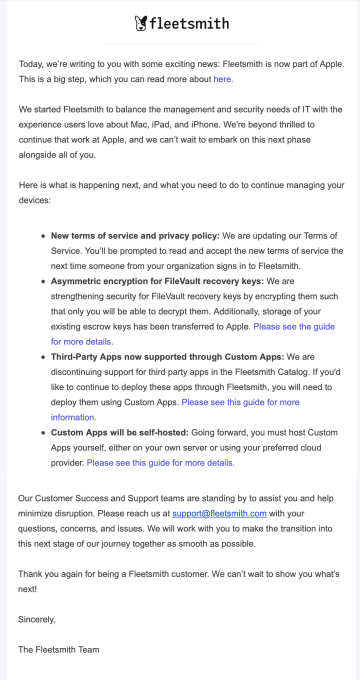
As it turned out, Apple had made it clear that it was discontinuing this feature in an email to Fleetsmith customers on the day of the transition. The email included links to several help articles that were supposed to assist admins with the transition. (The email is included in full at the end of this article.)

The general consensus among admins that I spoke to was that these articles were not terribly helpful. While they described a way to fix the issues, they said that Apple has turned what was a highly automated experience into a highly manual one, effectively eliminating the speed and ease of use advantage of having the update feature in the first place.

Apple did confirm that it had responded to some help ticket requests after the changes this week, saying that it would soon restore some configurations for Catalog apps, and was working with impacted customers as needed. The company did not make clear, however, why they removed this functionality in the first place.

Fleetsmith offered a couple of key features that appealed to Mac system administrators. For starters, it let them set up new Macs automatically out of the box. This allows them to ship a new Mac or other Apple device, and as soon as the employee powers it up and connects to Wi-Fi, it connects to Fleetsmith, where systems administrators can track usage and updates. In addition, it allowed System Administrators to enforce Apple security and OS updates on company devices.

What’s more, it could also do the same thing with third-party applications like Google Chrome, Zoom or many others. When these companies pushed a new update, system administrators could make sure all users had the most recent version running on their machines. This is the key functionality that was removed this week.

It’s not clear why Apple chose to strip out these features outlined in the email to customers, but it seems likely that most of this functionality isn’t coming back, other than restoring some configurations for Catalog apps.

Email that went out to Fleetsmith customers the day of the acquisition outlining the changes:


Attempts to reach Fleetsmith founders for comment were unsuccessful. Should that change we will update the article.

Powered by WPeMatico

Tim O’Reilly makes a persuasive case for why venture capital is starting to do more harm than good

Tim O’Reilly has a financial incentive to pooh-pooh the traditional VC model, wherein investors gamble on nascent startups in hopes of seeing many times their money back. Bryce Roberts, who is O’Reilly’s longtime investing partner at the early-stage venture firm O’Reilly AlphaTech Ventures (OATV), now actively steers the partnership away from these riskier investments and into companies around the country that are already generating revenue and don’t necessarily want to be blitzscaled.

Yet in an interview with O’Reilly last week, he nonetheless argued persuasively for why venture capital, in its current iteration, has begun to make less sense for more founders who genuinely want to build sustainable businesses. The way he sees it, the venture industry is no longer as focused on finding small companies that might one day change the world but more on creating financial instruments for the wealthy — and that shift has real consequences.

Below, we’re pulling out parts of that conversation that may be of interest to readers who are either debating raising venture capital, debating raising more venture capital, and even those who have been turned away from VCs and perhaps dodged a bullet in the process. At a minimum, O’Reilly — who bootstrapped his own company, O’Reilly Media, 42 years ago and says it now produces “a couple hundred million dollars in revenue” yearly — provides a lot of food for thought.

TechCrunch: A lot of companies celebrated Juneteenth this year, which is a big deal. There’s been a lot of talk about making the venture industry more inclusive. How far — or not — do you think we’ve come in the venture industry on this front?

Tim O’Reilly: The thing that I would say about VC and about really everything in tech is, this concept of structural racism [is really the problem]. People think that all it matters is, ‘Well, my values are good, my heart’s in the right place, I donate to charities,’ and we don’t actually fix the systems that cause the problems.

With VCs, the networks from which they’re drawing entrepreneurs are not that different [than they have been historically]. But more importantly, the goals of the VC model are not that different. The industry sets a goal, and it has a certain kind of financial shape, which is inherently exclusionary.

How so?

The typical VC model is looking for this high-growth company with exit potential, because it’s looking for this big financial return from an IPO or acquisition, and that selects for a certain type of founder. My partner Bryce decided two funds ago [to] look for companies that are kind of disparaged as lifestyle companies that are trying to build sustainable businesses with cash flow and profits. They’re the kind of small businesses, and small business entrepreneurs, that have vanished from America, partly because of the VC myth, which is really about creating financial instruments for the wealthy.

He came up with a version of a SAFE note that allows the founders to buy out the VC at a predetermined amount if they ever become sufficiently profitable, but also gives them the optionality, because periodically, some of them do end up becoming a rocket ship. But the founder is not on the treadmill of: You have to get out.

When you start saying, ‘Okay, we’re going to look for sustainable businesses,’ you look all over the country, and Bryce ended up [with a portfolio] that’s made up of more than 50% women founders and 30% people of color, and it has been an incredible investment strategy.

That’s not to say that people who are African American or women can’t also lead companies that are part of the high-growth VC model that’s typical of Silicon Valley.

No, of course not. Of course they could lead. The talent pool is just much greater [when you look outside of Silicon Valley]. There’s a certain kind of bro culture in Silicon Valley and if you don’t fit in, sure [you could find a way], but there are a lot of impediments. That’s what we mean by structural racism.

To your point about insular networks, a prominent Black VC, Charles Hudson, has noted that a lot of [traditional VCs] just don’t have regular or professional associations with Black people, which hampers how they find companies. How has Bryce fostered some of these connections? Because it does feel like traditional VCs are right now trying to figure out how to better do this.

It’s breaking the geographic isolationism of Silicon Valley. It’s breaking the business model isolationism of Silicon Valley that says: Only things that fit this particular profile are worth investing in. Bryce didn’t go out there and say, ‘I want to go find people of color to invest in.’ What he said was, ‘I want to have a different kind of investment in different places in the United States.’ And when he did that, he naturally found entrepreneurs who reflect the diversity of America.

That’s what we have to really think about. It’s not: How do we get more Black and brown founders into this broken Silicon Valley model? It’s: How do we go figure out what the opportunities are helping them to grow businesses in their communities?

Are LPs interested in this kind of model? Does it have the kind of growth potential that they need to service their endowments?

It was a bit of a struggle when we did fund four, which was focused on [this newer model]. It was about a third of the size of fund three. But for fund five, the fundraising is [going] like gangbusters. Everybody wants in because the model has proven itself.

I don’t want to name names, but there are two companies [in the portfolio] that are kind of in similar businesses. One was in our third fund and was sort of a traditional Silicon Valley-style investment. And the other was an investment in Idaho, of all places. The first company, which involved a more traditional seed round, we’ve ended up putting in $2.5 million for a 25% stake. The one in Idaho we put in $500,000 for a 25% stake, and the one in Idaho is now twice the size of the Silicon Valley one and growing much faster.

So from what you’re seeing, the returns are actually going to be better than with a traditional Silicon Valley venture [approach].

As I said, I’ve been really disillusioned with Silicon Valley investing for a long time. It reminds me of Wall Street going up to 2008. The idea was, ‘As long as someone wants to buy this [collateralized debt obligation], we’re good.’ Nobody is thinking about: Is this a good product?

So many things that what VCs have created are really financial instruments like those CDOs. They aren’t really thinking about whether this is a company that could survive on revenue from its customers. Deals are designed entirely around an exit. As long as you can get some sucker to take them, [you’re good]. So many acquisitions fail, for example, but the VCs are happy because — guess what? — they got their exit.

But now, because funds are raised so quickly, VCs have to show much more traction, which is where things like blitzscaling come in.

Just the way you’re describing it. Can’t you hear what’s wrong with that? It’s for the benefit of the VCs, the VCs have to show, not the entrepreneurs have to show.

Aren’t the LPs addicted to that crack? Don’t they want to see that quick financial traction?

Yeah, but you know that VC returns have actually lagged public markets for four decades now. It’s a little bit like the lottery. The only sure winners are the VCs because the VCs who don’t return their fund get their management fees every year.

A huge amount of the VC capital doesn’t return. Everybody just sees the really big wins. And I know when they happen, it’s really wonderful. But I think [those rare wins] have gotten an outsize place, and they’ve displaced other kinds of investment. It’s part of the structural inequality in our society, where we’re building businesses that are optimized for their financial return rather than their return to society.

Powered by WPeMatico
Running a queer dating startup amid a pandemic and racial justice uprising

The events of the past few months have shaken the lives of everyone, but especially Black people in the U.S. COVID-19 has disproportionately impacted members of the Black community while police violence has recently claimed the lives of George Floyd, Tony McDade, Breonna Taylor, Rayshard Brooks and others. 

Two weeks ago, two Black transgender women, Riah Milton and Dominique “Rem’mie” Fells were murdered. In light of their deaths, activists took to the streets to protest the violence Black trans women face. Two days after Floyd’s killing, McDade, a Black trans man was shot and killed by police in Tallahassee, Florida. 

In light of Pride month coinciding with one of the biggest racial justice movements of the century amid a pandemic, TechCrunch caught up with Robyn Exton, founder of queer dating app Her, to see how her company is navigating this unprecedented moment. 

Exton and I had a wide-ranging conversation including navigating COVID-19 as a dating startup, how sheltering in place has affected product development, shifting the focus of what is historically a month centered around LGBTQ people to include racial justice work and putting purpose back into Pride month.

“Pride exists because there is inequality within our world and within our community and still there is no clear focus on what it is we should be fighting for as a community,” Exton says. “It almost feels like since equal marriage was passed, there’s a range of topics but no clear voice saying this is what everyone should focus on right now. And then obviously everything changed after George Floyd’s murder. Over the course of the following weekend, we canceled pretty much everything that was going out that talked still about Pride as a celebration. Especially for Black people within our community, in that moment of so much trauma, it felt completely wrong to talk about Pride just in general.”

Worldwide, Pride events have been canceled as a result of the pandemic. But it gives people and corporations time to reflect on what kind of presence they want to have in next year’s Pride celebrations.

Powered by WPeMatico

Volcker Rule reforms expand options for raising VC funds

It’s time to put on our thinking caps so we can discuss an esoteric but important policy change and how it is going to impact the VC world.

The 2008 financial crisis devastated the global economy. One of the reforms that came from the detritus of that situation was a policy known as the Volcker Rule.

The rule, proposed by former Fed chairman Paul Volcker and passed into law with the Dodd-Frank Act, was designed to limit the ways that banks could invest their balance sheets to avoid the kind of cataclysmic systemic risks that the world witnessed during the crisis. Many banks faced a liquidity crunch after investing in mortgage-backed securities (MBSs), collateralized debt obligations (CDOs), and other even more arcane speculative financial instruments (like POGs, or Piles Of Garbage) in seeking profits.

A number of reforms are underway to the Volcker Rule, which has been a domestic regulatory priority for the Trump administration since Inauguration Day.

One of the unintended consequences of the rule is that it limited banks from investing in certain “covered funds,” which was written broadly enough that it, well, covered VC firms as well as hedge funds and other private equity vehicles. Reforms to that policy (and to the rule in general) have been proposed for a decade with little traction until recently.

Now, a number of reforms are underway to the Volcker Rule, which has been a domestic regulatory priority for the Trump administration since Inauguration Day.

First, a simplification to some of the rule’s regulations was passed late last year and went into effect in January. Now, a final rule to reform the Volcker Rule’s applications to VC firms, among other issues, was agreed to by a group of U.S. regulatory agencies, and will go into effect later this year.

Powered by WPeMatico