1010Computers | Computer Repair & IT Support

RIOS comes out of stealth to announce $5M in funding for ‘industry-agnostic’ robotics

Bay Area-based robotics startup RIOS is coming out of stealth today to announce $5 million in funding. The round is being led by Valley Capital Partners and Morpheus Ventures, with participation from a long list of investors, including Grit Ventures, Motus Ventures, MicroVentures, Alumni Ventures Group, Fuji Corporation and NGK Spark Plug Co.

The move comes during a time of increased interest in factory automation. A number of different startups have received massive funding of late, including Berkshire Grey’s massive $263 million raise in January. RIOS’s raise is considerably smaller, of course, but the young company has more to prove.

Even so, investors are clearly eyeing automation with great interest amid an ongoing global pandemic that has both screeched many industries to a halt and led many to look to alternative production elements that remove the human element of virus transmission.

RIOS was founded in 2018, as a spin-out of Stanford University, with help from a number of Xerox PARC engineers. The startup has operated in stealth for the past year and a half while testing its technologies with a select group of partners.

The company’s first product is DX-1, a robot designed for a variety of industrial tasks, including static bin picking and conveyor belt operations. The system is powered by the company’s AI stack, including a perception system and a variety of tactile sensors mounted on the robotic hand.

The plan is to charge a monthly fee for the robotic system that includes a variety of services, including programming, maintenance, monitoring and regular updates.

Powered by WPeMatico

The Venture Collective launches with a new bet on pre-seed investing

Venture capital has a long way to go when it comes to investing in underrepresented founders in a meaningful way. But according to The Venture Collective’s Cat Hernandez, the issue is too complex to solve by just cutting checks and spending time with entrepreneurs.

“You have to be maniacally focused on solutions,” Hernandez said.

So, Hernandez has teamed up with a number of operators-turned-investors to tackle tech’s diversity problem from a creative angle.

The Venture Collective, based in London and New York, launches today to make access to capital more equal. Fair warning: its experimental structure is knotty, as TVC is part investment vehicle and part management company. But it’s a creative strategy in a deserving sector that tech struggles to make progress within.

The team is stacked with a variety of experience: Founding partner Nick Shekerdemian is a former YC startup founder who launched a diversity recruitment platform, and his co-founder, Gina Kirch, was one of his investors, as well as a former director at BlackRock. Other partners include former Primary Venture Partners investor Cat Hernandez and Elliot Richmond, who invests out of the United Kingdom and previously worked at Moelis & Company.
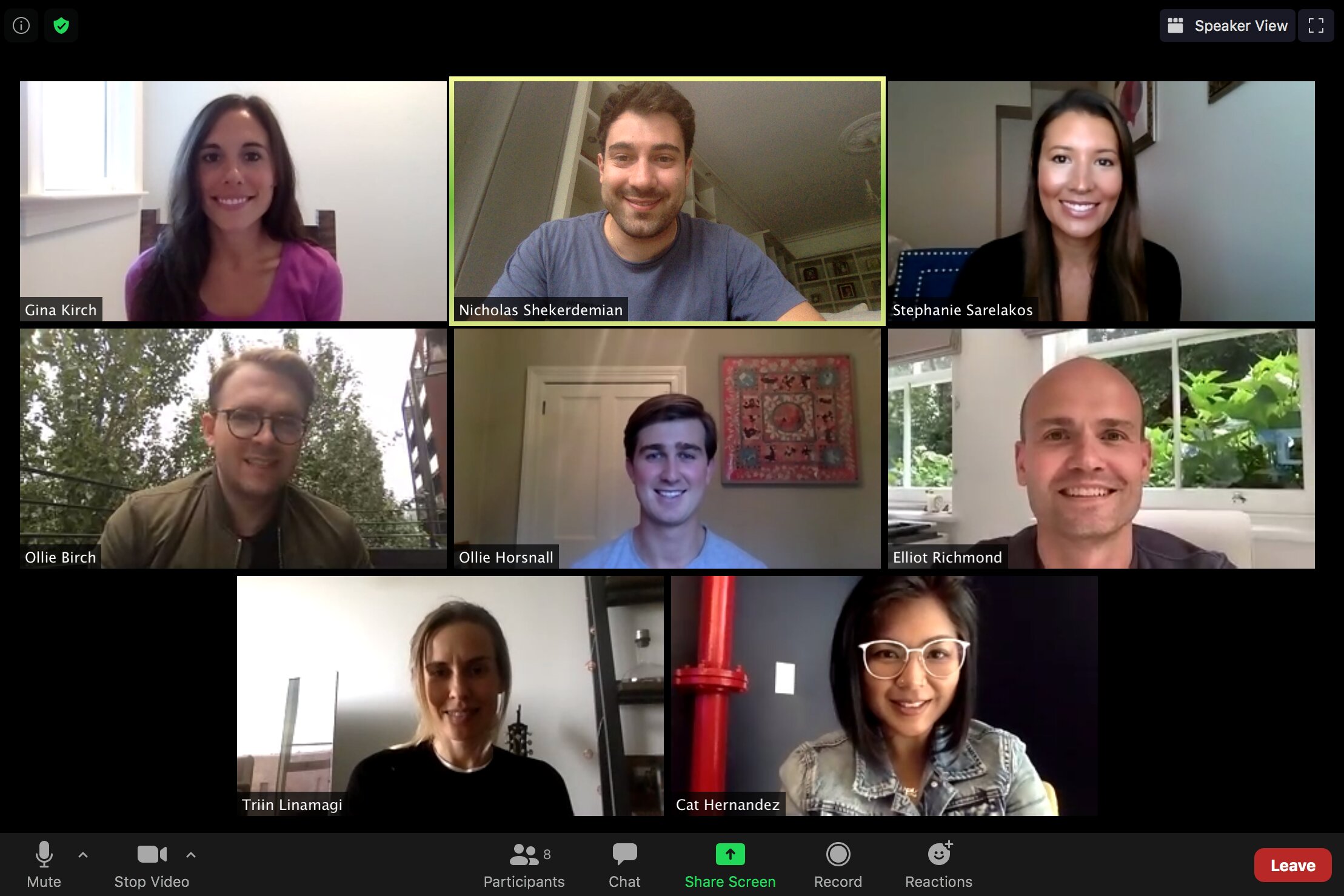
The team was finalized during COVID-19.

TVC’s funding model has two customer bases: startup founders and family offices.

For startups, the business will invest a $100,000 check into one company per month, with the flexibility to do more. TVC intends to reserve between $1 to $5 million for follow-on rounds.

For family offices, TVC charges an annual fee to serve as intel for what they think are lucrative pre-seed deals in the Valley. If a family office or someone within its network wants to invest, TVC will ultimately deploy an allocated amount of capital. It hopes that total capital commitments will increase over time. 

While TVC says the structure model is in stealth, it is reasonable to compare the structures of these family office investments to the structures of special purpose vehicles. SPVs are investment vehicles that exist outside a fund’s capital allotment and are more spur of the moment, versus traditionally syndicated.

The biggest difference is that SPV structure is centered around deals, but TVC’s structure is centered around a capital allotment, deployed into multiple deals. They essentially act as middlemen between promising startups and family offices.

It’s good news for family offices, as they often take the role of institutional investors, which are decade-long relationships. The problem with lengthy bets is that what was hot in 2010 might not be hot in 2020. TVC’s model lets LPs deploy capital in their interest areas on a year by year basis. So an LP who is newly bullish on remote work (for some wild reason) could get their hands in early deals instead of waiting for the AR/VR fund they invested in years ago to make that move.

Putting all these pieces together, TVC gets more funds by:

  • traditional equity raise
  • annual fee to provide information to its network
  • family office checks
  • portfolio exits

Because of all of these mechanisms, TVC’s total “fund size” will change depending on the week. It’s a unique example of how first-time fund managers are tackling investing in a volatile landscape.

Today TVC launches with an undisclosed amount of equity-based financing. The company declined to share total assets under management.

So a big factor in TVC’s success is if it can convince both founders and family offices that its perspective is worth the set up. TVC’s flexibility can be a blessing, but it also can be risky and unreliable in case family offices pull out. Or if there is an extended recession, for example.

As a sweetener, the company says that it will donate two-thirds of partner time to helping portfolio companies.

But how does this fit into diversity? It all goes back to TVC’s goal to make access to capital more equal.

According to the team, pre-seed to Series A is where most companies fail, but the very funds that back pre-seed are also the most strapped for resources (small fund sizes, fixed management fees). Thus, firms have to selectively pick the companies they think are outliers and spend time with those companies on a more regular basis. This disproportionately impacts underrepresented founders, who might have a slower start due to lack of access to resources.

TVC thinks its strategy will help grow the number of startups that are venture-backable by heavily supporting them through this time, without competing and driving up valuations for only a few outliers.

The company defined underrepresented founders through diversity, geography, age and social background. When asked if they will publicly disclose diversity metrics, TVC said “it wants to be thoughtful about how we hold our investments accountable in the long-term and we are balancing that with a desire to not be prescriptive.”

“We believe that part of our job as early investors is to ensure that this intent is top of mind as the business scales. That can come in many forms — tracking/reporting on diversity metrics being one of them. At its core, this isn’t about window dressing,” the firm told TechCrunch. Generally, TVC is focused on helping more people get funding, and pointed toward financial optionality as the “flywheel we’re playing for.”

In terms of sourcing, TVC is partnering with tech-focused groups in New York and London and will identify talent at the university and college level. It also said it will build relationships with underrepresented operators “at the most prominent tech companies” and co-invest with diversity-focused founders.

TVC also launched a group called “The Collective” that includes diverse founders, operators and investors, who will help as a deal flow channel.

Powered by WPeMatico

Fivetran snares $100M Series C on $1.2B valuation for data connectivity solution

A big problem for companies these days is finding ways to connect various data sources to their data repositories, and Fivetran is a startup with a solution to solve that very problem. No surprise then that even during a pandemic, the company announced today that it has raised a $100 million Series C on a $1.2 billion valuation.

The company didn’t mess around, with top flight firms Andreessen Horowitz and General Catalyst leading the investment, with participation from existing investors CEAS Investments and Matrix Partners. Today’s money brings the total raised so far to $163 million, according to the company.

Martin Casado from a16z described the company succinctly in a blog post he wrote after its $44 million Series B in September 2019, in which his firm also participated. “Fivetran is a SaaS service that connects to the critical data sources in an organization, pulls and processes all the data, and then dumps it into a warehouse (e.g., Snowflake, BigQuery or RedShift) for SQL access and further transformations, if needed. If data is the new oil, then Fivetran is the pipes that get it from the source to the refinery,” he wrote.

Writing in a blog post today announcing the new funding, CEO George Fraser added that in spite of current conditions, the company has continued to add customers. “Despite recent economic uncertainty, Fivetran has continued to grow rapidly as customers see the opportunity to reduce their total cost of ownership by adopting our product in place of highly customized, in-house ETL pipelines that require constant maintenance,” he wrote.

In fact, the company reports 75% customer growth over the prior 12 months. It now has more than 1,100 customers, which is a pretty good benchmark for a Series C company. Customers include Databricks, DocuSign, Forever 21, Square, Udacity and Urban Outfitters, crossing a variety of verticals.

Fivetran hopes to continue to build new data connectors as it expands the reach of its product and to push into new markets, even in the midst of today’s economic climate. With $100 million in the bank, it should have enough runway to ride this out, while expanding where it makes sense.

Powered by WPeMatico

OnePlus will return to its budget roots with the launch of Nord

Two factors defined OnePlus’s seemingly out-of-nowhere growth in the middle of the last decade: solid specs and a budget price tag. But markets change, and companies must adapt to survive. As someone who has followed the Chinese smartphone maker since close to the beginning, I can confidently say that it hasn’t wavered from that first part. The second bit, on the other hand, is a bit of a different story.

OnePlus has experienced a bit of a price creep as it has continued to add features to set itself apart from the competition. In the early days, the smartphone maker was content to wait a generation or two before embracing new tech, for the sake of keeping costs down. But increasingly, it has come to pride itself in being among the first to things like in-screen fingerprint readers and 5G.

Today, however, it’s announcing a bit of a return to its roots, with the Nord. The upcoming phone has been the subject of all manner of rumors under a variety of different names in recent months, but OnePlus just confirmed its name and arrival by way of an extended behind-the-scenes documentary on Instagram. Details are pretty slim at the moment, though the company confirmed that it will be priced at under $500.

Co-founder Carl Pei — who discussed the company’s place in the budget market at Disrupt last year — noted in the video, “There’s a huge change every two years. Anything can happen. Thousand-dollar phones are decreasing in sales.” It’s a pretty well-established phenomenon over the last few years that has led to, among other things, companies like Samsung, Apple and Google to embrace lower-cost devices amid stagnant sales figures.

OnePlus’s devices have still remained relatively affordable, compared to the competition, but the addition of the Nord will find it’s getting back to where it started with a line aimed at a wider range of consumers and different markets. More info soon, no doubt.

Powered by WPeMatico

Hunters raises $15M Series A for its threat-hunting platform

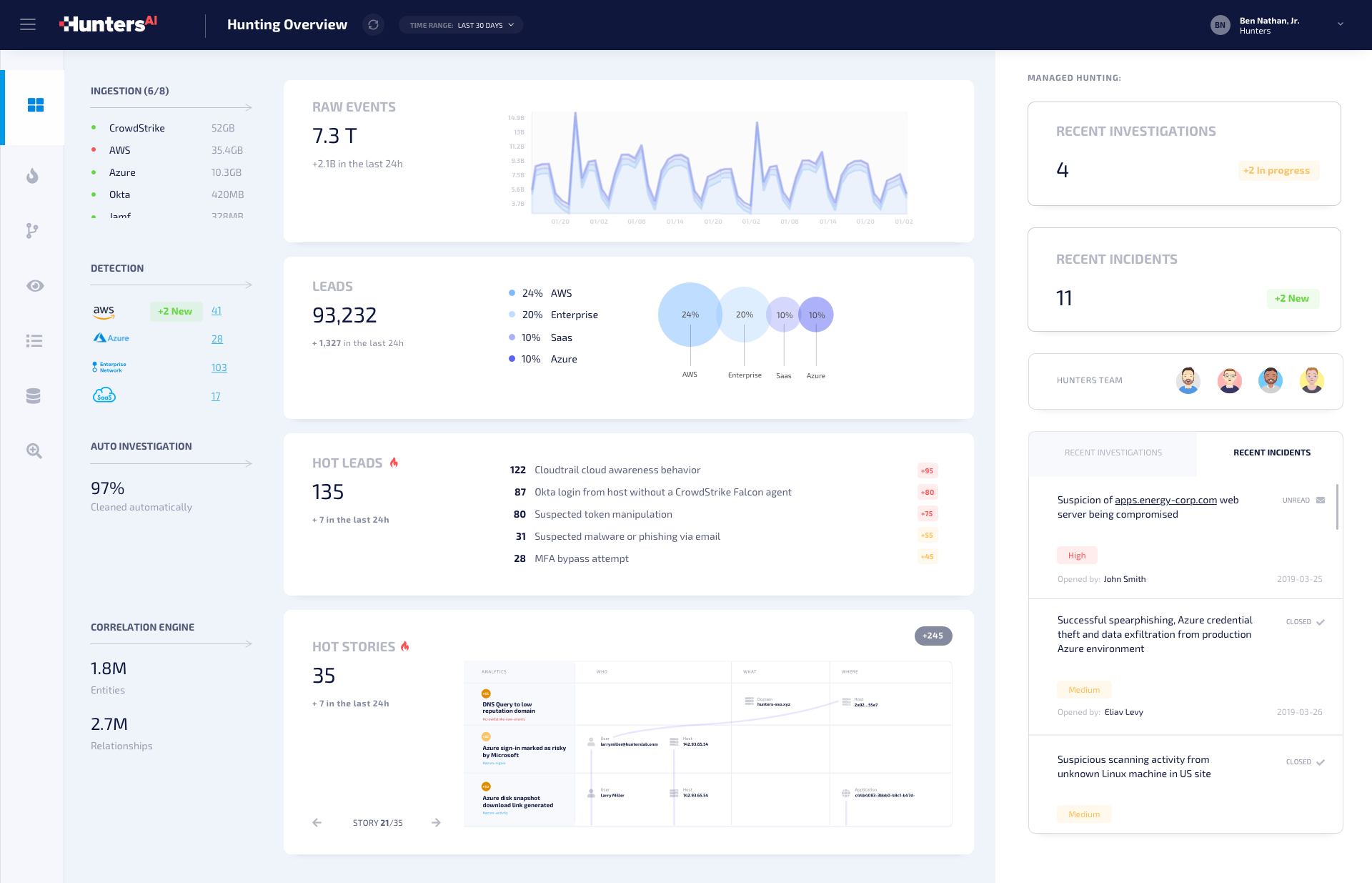
Hunters, a Tel Aviv-based cybersecurity startup that helps enterprises defend themselves from intruders and analyze attacks, today announced that it has raised a $15 million Series A funding round from Microsoft’s M12 and U.S. Venture Partners. Seed investors YL Ventures and Blumberg Captial also participated in this round, as well as new investor Okta Ventures, the venture arm of identity provider Okta. With this, Hunters has now raised a total of $20.4 million.

The company’s SaaS platform basically automates the threat-hunting processes, which has traditionally been a manual process. The general idea here is to take as much data from an enterprise’s various networking and security tools to detect stealth attacks.

“Hunters is basically this layer, a cognitive layer or connective tissue that you put on top of your telemetry stack,” Hunters co-founder and CEO Uri May told me. “So you have your [endpoint detection and response], your firewalls, cloud, production environment sensors — and all of those are shooting telemetry and detections all over the organization, generating huge amounts of data. And, basically, our place in the world depends on our ability to generate that delta. So without being able to find things that you can’t see with a single point solution or without really expediting response procedures and workflows by correlating things in a nontrivial way, we don’t have any excuse to exist. But we got pretty good at those — at showing that delta — and we onboarded customers — nice logos — and that was a very strong validation.”

Image Credits: Hunters

Hunters’ first customer was actually data management service Snowflake, which functioned as the company’s design partner. In addition to being a customer, Snowflake now also features Hunters in its partner marketplace, as does security service CrowdStrike. May also noted that Crowdstrike is a good example for the kind of customer Hunters is going after.

“Not necessarily Global 2000 or Fortune 500. It’s really high-end mid-market organizations, not necessarily tens of thousand employees, but billions of dollars in revenues, a lot of value at risk, born to the cloud, super mature tech stack, not necessarily a big security operation center, but definitely CISO and a team of security engineers and analysts, and they’re looking for the solution, that on-top solution that can make sense of a lot of the data and give them the confidence and also give them results in terms of cybersecurity, posture and their detection and response capabilities.”

Microsoft already has a large security development center in Israel and so it’s no surprise that Hunters appeared on the company’s radar. Hunters also spent some time proactively looking at the Microsoft ecosystem, May told me, but the company’s VCs also made some introductions. All of this culminated in a number of meetings at the Tel Aviv CyberTech conference in January and the RSA Conference in San Francisco in February, just before the coronavirus pandemic essentially shut down travel.

Hunters says it will use the new funding to build out its go-to-market capabilities in the U.S. and expand its R&D team in Israel. As for the product itself, the company will look to broaden its product integration and machine learning capabilities to help it generate better attack stories. May also noted that it plans to give its users capabilities to customize the system for their needs by allowing them to develop their own signals and detections to augment the company’s default tools. This, May argued, will allow the company to go after higher-end enterprise customers that already have threat-hunting teams but that are looking to automate more of the process. With that, it will also look to partner with other security firms to leverage its system to provide better services to their customers as well.

Powered by WPeMatico

Kong donates its Kuma control plane to the Cloud Native Computing Foundation

API management platform Kong today announced that it is donating its open-source Kuma control plane technology to the Cloud Native Computing Foundation (CNCF). Since Kong built Kuma on top of the Envoy service mesh — and Envoy is part of the CNCF’s stable of open-source projects — donating it to this specific foundation was likely an obvious move.

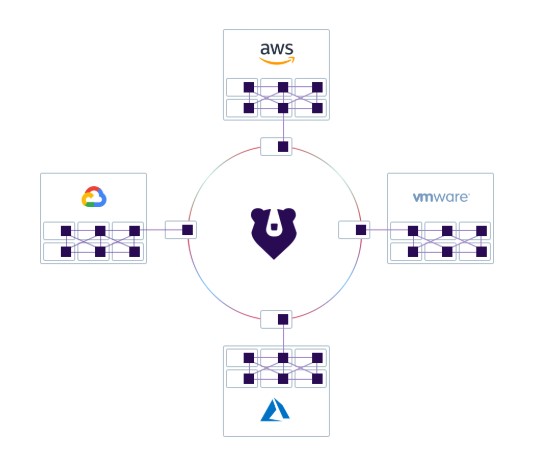
The company first open-sourced Kuma in September 2019. In addition to donating it to the CNCF, the company also today launched version 0.6 of the codebase, which introduces a new hybrid mode that enables Kuma-based service meshes to support applications that run on complex heterogeneous environments, including VMs, Kubernetes clusters and multiple data centers.

Image Credits: Kong

Kong co-founder and CTO Marco Palladino says that the goal was always to donate Kuma to the CNCF.

“The industry needs and deserves to have a cloud native, Envoy-based control plane that is open and not governed by a single commercial entity,” he writes in today’s announcement. “From a technology standpoint, it makes no sense for individual companies to create their own control plane but rather build their own unique applications on proven technologies like Envoy and Kuma. We welcome the broader community to join Kuma on Slack and on our bi-weekly community calls to contribute to the project and continue the incredible momentum we have achieved so far.”

Kuma will become a CNCF Sandbox project. The sandbox is the first stage that projects go through to become full graduated CNCF projects. Currently, the foundation is home to 31 sandbox projects, and Kong argues that Kuma is now production-ready and at the right stage where it can profit from the overall CNCF ecosystem.

“It’s truly remarkable to see the ecosystem around Envoy continue to develop, and as a vendor-neutral organization, CNCF is the ideal home for Kuma,” said Matt Klein, the creator of the Envoy proxy. “Now developers have access to the service mesh data plane they love with Envoy as well as a CNCF-hosted Envoy-based control plane with Kuma, offering a powerful combination to make it easier to create and manage cloud native applications.”

Powered by WPeMatico

Upsolver announces $13M Series A to ease management of cloud data lakes

There’s a lot of complexity around managing data lakes in the cloud that often requires expensive engineering expertise. Upsolver, an early-stage startup, wants to simplify all of that, so that a database administrator could handle it. Today the startup announced a $13 million Series A.

Vertex Ventures US was lead investor, with participation from Wing Venture Capital and Jerusalem Venture Partners. Today’s investment brings the total raised to $17 million, according to the company.

Co-founder and CEO Ori Rafael says that as companies move data to the cloud and store it in data lakes, it becomes increasingly difficult to manage. The goal of Upsolver is to abstract away a lot of those management tasks and allow users to query the data using SQL, making it a lot more accessible.

“The main criticism of data lakes over the years is they become data swamps. It’s very easy to store data there very cheaply, but making it [easy to query] and valuable is hard. For that you need a lot of engineering, which turns the lake into a swamp. So we take the data that you put into a lake and make it easier to query, and we take the biggest disadvantage of using a lake, which is the complexity of doing that process, and we make that process easy,” Rafael explained.

Investor In Sik Rhee, who is general partner and co-founder at Vertex Ventures US, sees a company that’s creating a cloud-native standard for data lake computing. “Upsolver succeeded in abstracting away the engineering complexity of data pipeline management so that enterprise customers can quickly solve their modern data challenges in real time and at any scale without having to build another silo of expertise within the organization,” he said in a statement.

The company currently has 22 employees spread out between San Francisco, New York and Israel. Rafael says they hope to expand to 50 employees by the end of next year, including adding new engineers for their R&D center in Israel and building sales and customer success teams in the U.S.

Rafael says he and his co-founder sat down early on and wrote down the company’s core values, and they see a responsibility of running a diverse company as part of that, as they search for these new hires. Certainly the pandemic has shown them that they can hire from anywhere and that can help contribute to a more diverse workforce as they grow.

He said running the company and raising money has been stressful during these times, but the company has continued to grow through all of this, adding new customers while staying relatively lean, and Rafael says that the investors certainly recognized that.

“We had high revenue compared to the low number of employees with [sales] acceleration during COVID — that was our big trio,” he said.

Powered by WPeMatico

CodeGuru, AWS’s AI code reviewer and performance profiler, is now generally available

AWS today announced that CodeGuru, a set of tools that use machine learning to automatically review code for bugs and suggest potential optimizations, is now generally available. The tool launched into preview at AWS re:Invent last December.

CodeGuru consists of two tools, Reviewer and Profiler, and those names pretty much describe exactly what they do. To build Reviewer, the AWS team actually trained its algorithm with the help of code from more than 10,000 open source projects on GitHub, as well as reviews from Amazon’s own internal codebase.

“Even for a large organization like Amazon, it’s challenging to have enough experienced developers with enough free time to do code reviews, given the amount of code that gets written every day,” the company notes in today’s announcement. “And even the most experienced reviewers miss problems before they impact customer-facing applications, resulting in bugs and performance issues.”

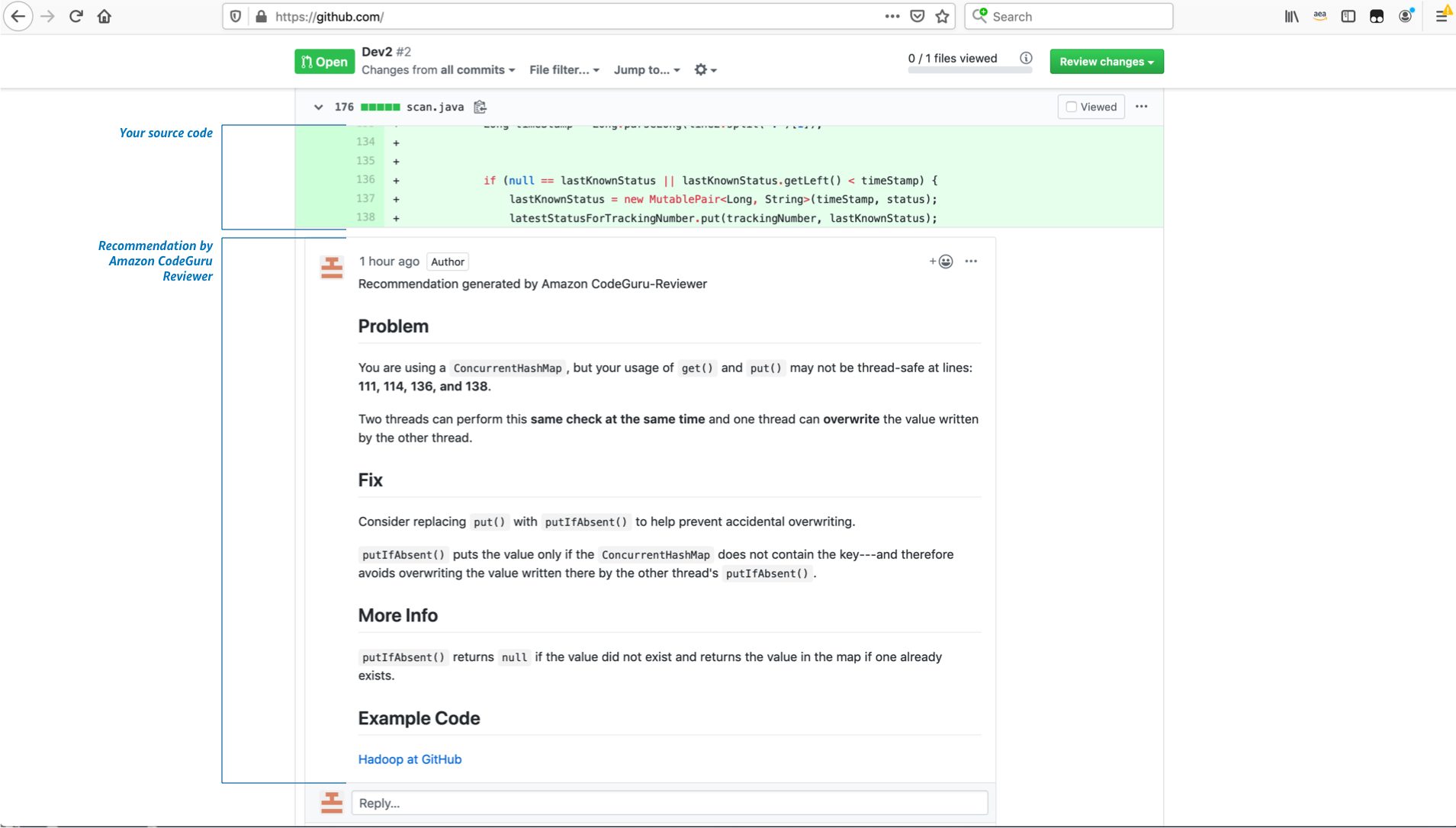
To use CodeGuru, developers continue to commit their code to their repository of choice, no matter whether that’s GitHub, Bitbucket Cloud, AWS’s own CodeCommit or another service. CodeGuru Reviewer then analyzes that code, tries to find bugs and, if it does, it will also offer potential fixes. All of this is done within the context of the code repository, so CodeGuru will create a GitHub pull request, for example, and add a comment to that pull request with some more info about the bug and potential fixes.

To train the machine learning model, users can also provide CodeGuru with some basic feedback, though we’re mostly talking “thumbs up” and “thumbs down” here.

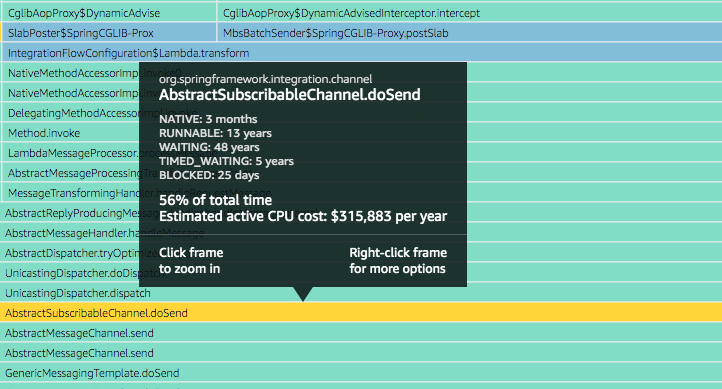
The CodeGuru Application Profiler has a somewhat different mission. It is meant to help developers figure out where there might be some inefficiencies in their code and identify the most expensive lines of code. This includes support for serverless platforms like AWS Lambda and Fargate.

One feature the team added since it first announced CodeGuru is that Profiler now attaches an estimated dollar amount to the lines of unoptimized code.

“Our customers develop and run a lot of applications that include millions and millions of lines of code. Ensuring the quality and efficiency of that code is incredibly important, as bugs and inefficiencies in even a few lines of code can be very costly. Today, the methods for identifying code quality issues are time-consuming, manual, and error-prone, especially at scale,” said Swami Sivasubramanian, vice president, Amazon Machine Learning, in today’s announcement. “CodeGuru combines Amazon’s decades of experience developing and deploying applications at scale with considerable machine learning expertise to give customers a service that improves software quality, delights their customers with better application performance, and eliminates their most expensive lines of code.”

AWS says a number of companies started using CodeGuru during the preview period. These include the likes of Atlassian, EagleDream and DevFactory.

“While code reviews from our development team do a great job of preventing bugs from reaching production, it’s not always possible to predict how systems will behave under stress or manage complex data shapes, especially as we have multiple deployments per day,” said Zak Islam, head of Engineering, Tech Teams, at Atlassian. “When we detect anomalies in production, we have been able to reduce the investigation time from days to hours and sometimes minutes thanks to Amazon CodeGuru’s continuous profiling feature. Our developers now focus more of their energy on delivering differentiated capabilities and less time investigating problems in our production environment.”

Image Credits: AWS

Powered by WPeMatico

The virtual state of corporate venture capital today

BIll Taranto
Contributor

GHI Fund President Bill Taranto has spent more than two decades in the healthcare industry and has 15 years of experience in healthcare investing. In addition to his venture investing knowledge, Bill has decades of management operations experience.
More posts by this contributor

When the going gets tough, it’s common for some corporate VCs to head for the hills.

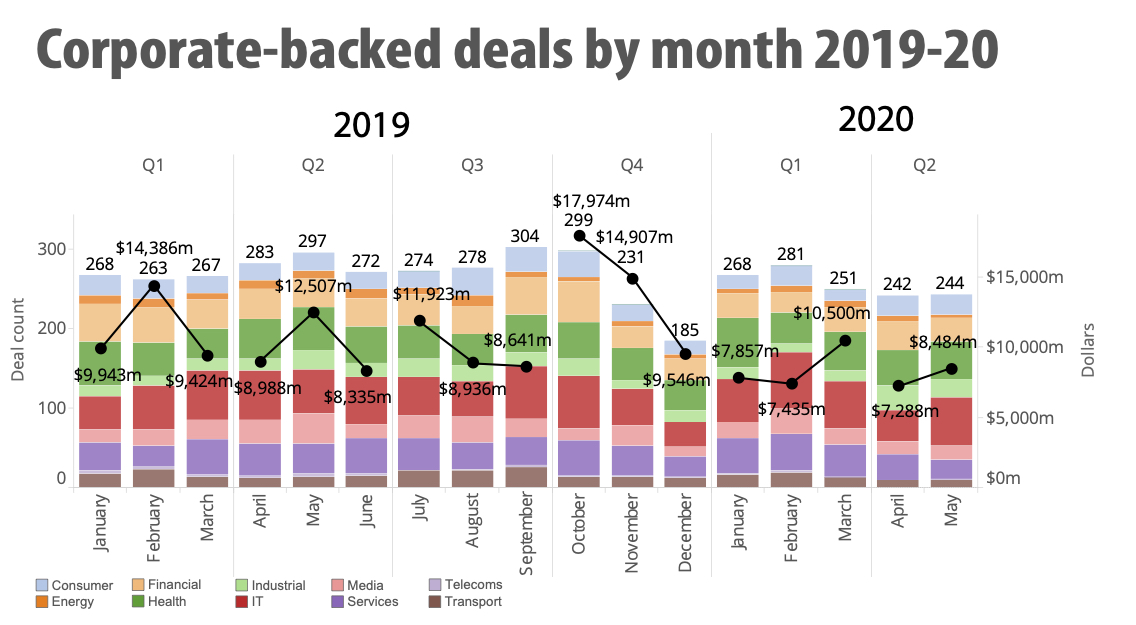
Today, it’s a narrative that’s emerging again amid the COVID-19 crisis. Global corporate venture deals fell from a total of 580 in April/May of 2019 to 486 in the same period this year, according to Global Corporate Venturing.

However, institutional VC deals are also headed for a decline, with PitchBook anticipating a drop in transaction volume over the next several quarters, as well as a downturn in valuations.

It remains to be seen how it will play out this time, but I believe corporate venture capital (CVC) will not only stick around, but also be a vital part of the innovation ecosystem going forward.

I know that Merck Global Health Innovation Fund (MGHIF) remains fully committed to “doing” venture. Now, more than ever, health innovation is vital. Second, we understand that many of today’s most successful companies were funded in times of uncertainty. In fact, to put our money where our mouth is, we’ve recently completed two spinouts, three follow-on investments, and two new deals in 2020 — all since COVID hit. We intend to increase that pace going forward in 2020 and beyond.

It hasn’t been easy. It’s hard to do venture when you can’t venture out into the world, meet founders and do diligence the way we did in the past. But it is possible, if you do some innovating of your own and set up a smoothly functioning system to do CVC virtually.

Here’s how we’ve done it.

Finding real benefits in virtual CVC

Powered by WPeMatico

Nacelle raises $4.8M for its headless e-commerce platform

As e-commerce companies aim to capitalize on the online spending boom connected to shelter-in-place and keep the party going as physical retailers open back up, more are turning their attention to how they can juice the functionality of their online storefronts and improve experiences for shoppers. Enter Nacelle, an LA-based startup in the burgeoning “headless” e-commerce space.

The startup bills itself as a JAMstack for e-commerce, offering a developer platform that delivers greater performance and scalability to online storefronts. Nacelle has raised about $4.8 million to date in fundings led by Index Ventures and Accomplice. Some of the company’s other angel investors include Shopify’s Jamie Sutton, Klaviyo CEO Andrew Bialecki and Attentive CEO Brian Long.

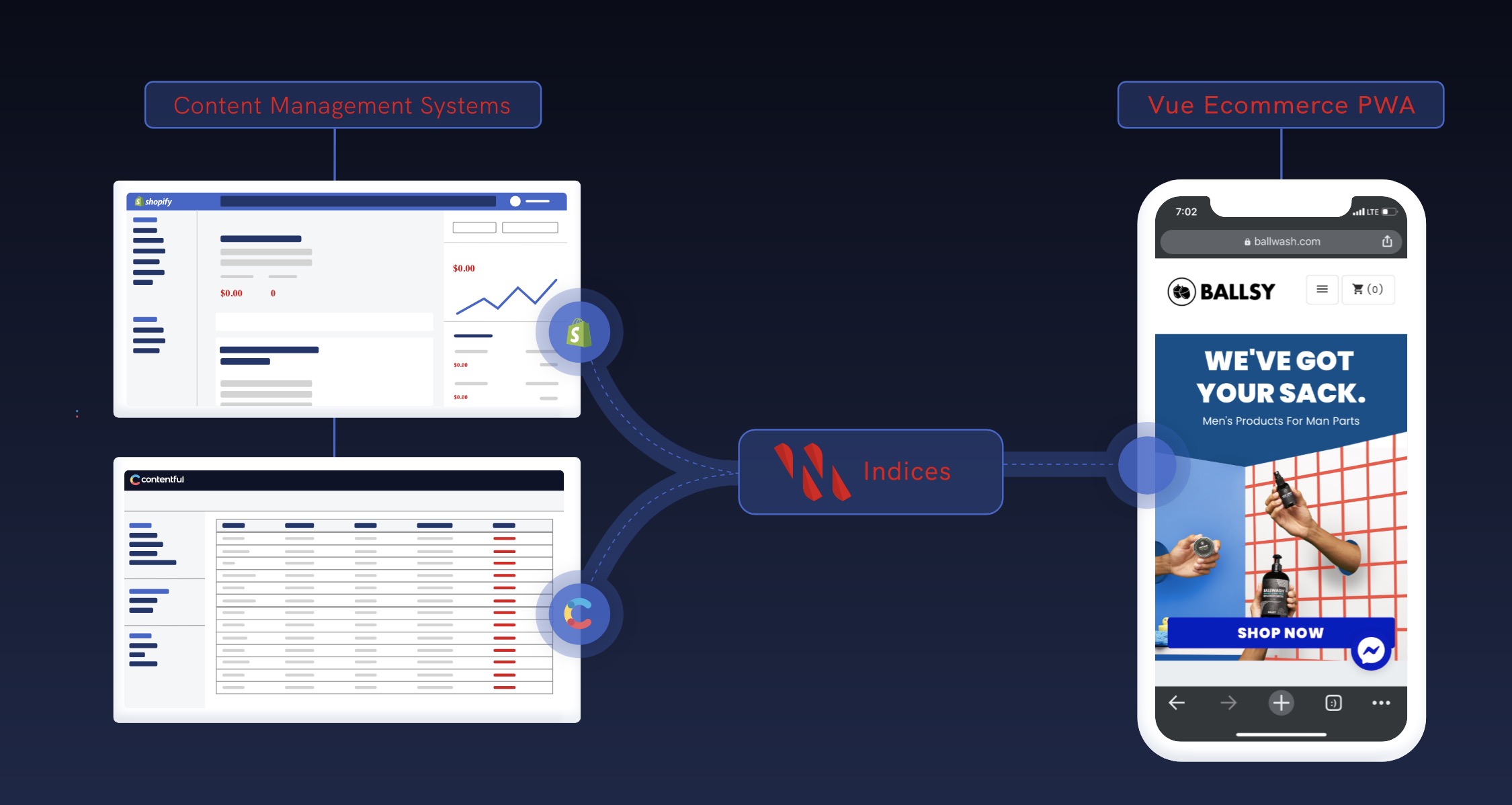
Nacelle builds an easier path for e-commerce brands to embrace a headless structure. Headless web apps essentially mean a site’s front end is decoupled from the backend infrastructure, so it’s leaning fully on dedicated frameworks for each to deliver content to users. There are some notable benefits for sites going headless, including greater performance, better scalability, fewer hosting costs and a more streamlined developer experience. For e-commerce sites, there are also some notable complexities due to how storefronts operate and how headless CMSs need to accommodate dynamic inventories and user shopping carts.

“We asked how do you pair a very dynamic requirement with the generally static system that JAMstack offers, and that’s where Nacelle comes in,” CEO Brian Anderson tells TechCrunch.

Anderson previously operated a technical agency for Shopify Plus customers building custom storefronts, a venture that has led to much of the company’s early customers. Nacelle also recently hired Kelsey Burnes as the startup’s first VP of marketing; she joins from e-commerce plug-in platform Nosto.

Though Anderson described a flurry of benefits regarding Nacelle’s platform, many are the result of reduced latency that he says converts more users and pushes them to spend more. The startup has a particular focus on mobile storefronts, with Anderson noting that most desktop storefronts dramatically outperform mobile counterparts and that the speedier load times Nacelle enables on mobile can do a lot to overcome this.

Image Credits: Nacelle

As more brands embrace headless structures, Nacelle is aiming to manage the experience. Nacelle is optimized for Shopify users to get up and running the most quickly. Users can also easily integrate the system with popular CMSs like Contentful and Sanity. All in all, Nacelle sports integrations for more than 30 services, including payments platforms, SMS marketing platforms, analytics platforms and more. The goal is to minimize the need for users to migrate data or learn new workflows.

The company is unsurprisingly going after direct-to-consumer brands pretty heavily. Some of Nacelle’s early customers include D2C bedding startup Boll & Branch, cozy things marketplace Barefoot Dreams and fashion brand Something Navy. Most of Nacelle’s rollouts launch later this summer. Last month, Nacelle went live with men’s toiletries startup Ballsy and says that the storefront has already seen conversions increase 28%.

Nacelle is far from the only young entrant in this space. Just last month, Commerce Layer announced that it had raised $6 million in funding from Benchmark.

Powered by WPeMatico