1010Computers | Computer Repair & IT Support

Tech shares set fresh records despite uncertain economy

Despite record-setting COVID-19 infections, American equities rose today. All major indices gained ground during regular trading, while tech stocks did even better.

The Nasdaq Composite set new 52-week and all-time highs, touching 10,462.0 points before closing at 10,433.65, up 2.21% on the day. Similarly, a basket of SaaS and cloud companies that has risen and fallen more sharply than even the tech-heavy Nasdaq closed this afternoon at 1,908.30 after touching 1,952.39 points. Both results were 52-week and all-time highs.

Such is the mood on Wall Street regarding the health of technology companies. It’s not hard to find bullish sentiment, jockeying to push tech shares higher. Some examples of today’s enthusiasm paint the picture:

  • The recent IPO for Lemonade is now worth $4.7 billion, according to Yahoo Finance. That price gives it a Q1-annualized revenue run rate multiple of around 45x. For a SaaS company, that would boggle the mind. As we’ve written, however, Lemonade has very un-SaaS-like gross margins, and has higher churn. The company’s stock rose around 17% today for no clear reason.
  • Tesla rose over 13% today to $1,371.58 per share, another huge day of gains for the company now worth in excess of $250 billion. Analysts expect the firm to report $4.83 billion in revenue in its most recent quarter, according to Yahoo Finance. That’s less than the company reported in its year-ago June quarter when it saw $6.35 billion in revenue. Since July 1, 2019, Tesla shares have appreciated in excess of 450%, despite the company prepping to report what the market anticipates will be revenue declines.
  • Amazon and Netflix also set new records today to toss a few more names into the mix.

You can’t swing your arms without running into a reason why it makes sense for SaaS stocks to be trading at record valuation multiples, or why one company or another is actually reasonably valued over a long-enough time horizon.

It’s worth noting that this putatively rational public investor thinking doesn’t fit at all with what the tech set used to pound into my head about the public markets, namely that they are infamously impatient and thus utter bilge for most long-term value creation. Going public was garbage, I was told; you have to report every three months and no one looks out a few years.

Now, I’m being told by roughly the same people that the market is doing the very thing that they said it didn’t do, namely price firms for future results instead of trailing outcomes. Fine by me either way, frankly, but I’d like to know which story is true.

Happily, we’re about to see if all this high-fiving and enthusiasm is real.

Earnings season beckons, and it should bring with it a dose or two of clarity. If the digital transformation has managed to accelerate sufficiently that most tech companies have managed to greatly boost their near-term value, hats off to the cohort and bully for the startups that must also be enjoying similar revenue upswells.

But that doesn’t have to happen. There are possible earnings result sets that can cause investors to dump tech shares, as Slack learned a month ago.

The background to all of this is that there are good reasons to have some doubts about the current health of the national economy. And, sure, most people are willing to allow that the stock market and the aggregate domestic economy are not perfectly linked — this is no less than partially true — but each day the stock market steps higher and COVID-19 surges again leading to re-closings around the nation makes you to wonder if this is all for real.

Earnings season is here soon. Let’s find out.

Powered by WPeMatico

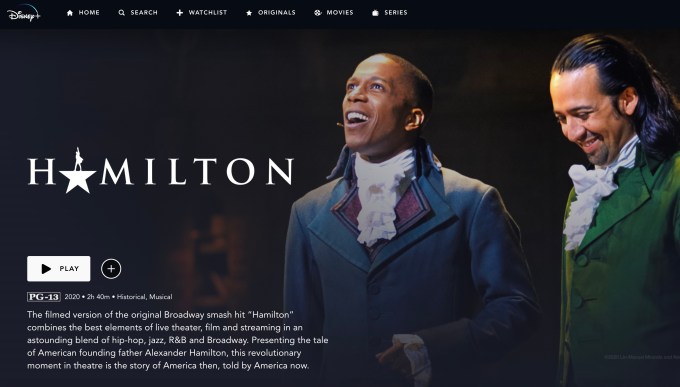
‘Hamilton’ gives Disney+ a holiday weekend bump in US, with app downloads up 74%

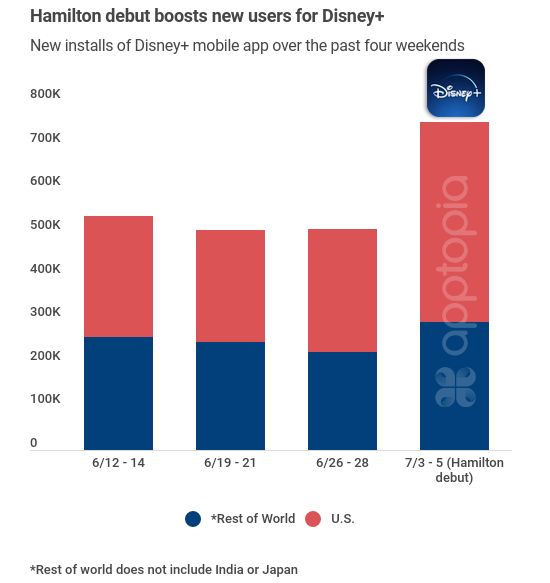
The much-anticipated addition of “Hamilton” seems to have paid off for Disney+. According to new data from app store analytics firm Apptopia, Disney’s streaming service saw a big jump in downloads over the July 4 holiday weekend in the U.S., following the worldwide debut of “Hamilton” on Friday, July 3rd. Between Friday and Sunday, that translated to over half a million new global downloads (752K+) for the Disney+ mobile app, excluding India and Japan. Some 458K+ of those downloads were in the U.S, the firm estimated.

These figures represent a 46.6% increase over the average seen during the previous four weekends in June (Friday through Sunday), Apptopia noted. But the numbers don’t include India or Japan as Disney+ is streamed via Hotstar in the former; and in the latter via a partnership with NTT Docomo through an existing service that later transitioned to Disney+.

Image Credits: Apptopia

The download figures also represented a 74% increase over the four prior weekends in June, in the U.S, indicating that a significant amount of interest in “Hamilton,” not surprisingly — given its “founding fathers” subject matter — comes from U.S. subscribers.

Notably, these downloads represent paid subscribers, not free trial users, as Disney+ ended its free week-long trial offering back in June. 

Rival firm Sensor Tower estimates a slightly different “Hamilton”-related bump for Disney+. During the week of June 29 to July 5, downloads spiked 64% over the week prior, Yahoo reported. Its preliminary estimates for July 3-5 put installs at 1 million across all available markets.

Image Credits: Apptopia

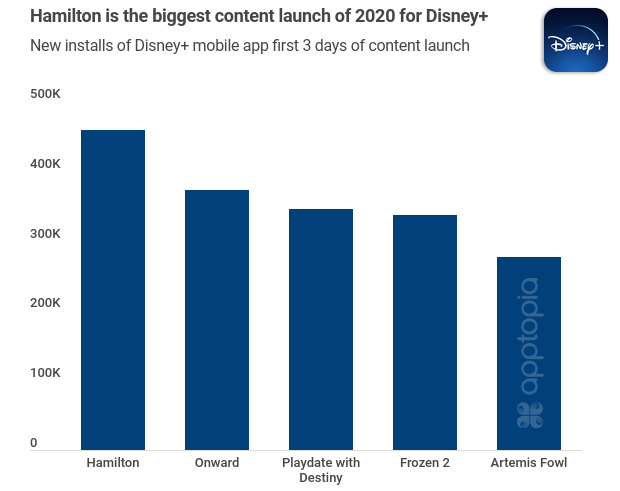
Apptopia also found that “Hamilton” represented the biggest content launch of all of 2020, so far, in terms of downloads. That means it also outpaced the streaming launch of “Frozen 2,” which arrived while consumers were under coronavirus lockdowns. It was also bigger than “Onward,” “Artemis Fowl,” and others, the firm found.

Image Credits: Disney

Of course, mobile download numbers don’t provide a full picture of how many signed up just for “Hamilton.” Many of the new Disney+ subscribers likely only signed up via a TV app and have yet to download the mobile companion.

If Roku’s online channel store offered a “top charts” section with rankings, we would have another window into Disney+ popularity given its status as a top streaming device and TV maker in the U.S. But it’s worth pointing out that Roku’s user base has given the Disney+ app a 4.3-star rating across 1,55,006 total reviews. For comparison, Netflix has 3,675,383 reviews — which shows how quickly the still relatively new service Disney+ is gaining on the market leader.

In May, Disney announced its streaming service had grown from 33.5 million subscribers as of March 28 to 54.4 million Disney+ subscribers as of May 4.

The service appeals to those who follow Disney’s top brands like Star Wars and Marvel, for example, but it’s also found a lot of growth among families who now more than ever need content to keep kids entertained amid the coronavirus outbreak, which has limited families’ usual activities and kept kids indoors.  At the $6.99 per month price point (or $69.99/yr), it’s one of the more affordable streaming services available.

Updated 7/6/20 3 PM ET: Apptopia revised its estimates this afternoon to indicate a larger increase of 74%, not 72.4% as the earlier headline stated. We’ve updated the article with its most recent data as well as the firm’s latest estimates on downloads. We’ll continue to update if newer numbers arrive. 

Powered by WPeMatico

Startups Weekly: Tech unicorns look to IPOs as Lemonade, Accolade boom

Hundreds of tech-oriented startups worth a billion or more dollars had envisioned successful public offerings before the pandemic hit. But new tech listings slowed to nearly nothing this spring as companies have tried to adjust to the profound changes sweeping the world.

Today, more and more companies are back to their previous plans, with Lemonade and Accolade finding an enthusiastic public this week, following Agora’s pop last Friday, as Alex Wilhelm has been covering.

The first big tech IPO this week was in online insurance, the second in health, and despite both being in promising markets, the valuations are quite a bit higher than their business realities to date. Here’s more, from his analysis on Extra Crunch:

Lemonade is being valued at more than 15x the value of its annualized Q1 revenue despite not sporting the gross margins you might expect investors to demand for it to merit that SaaS valuation. And Accolade only expects to grow by about 20% in Q2 2020 compared to its year-ago results while probably losing more money.

But who cares? The IPO market is standing there with open arms today (there’s always another IPO cliché lurking).

The read of this is impossibly simple: However open we thought that the IPO market was before, it is even more welcoming. For companies on the sidelines, like Palantir, Airbnb, DoorDash and Asana, you have to wonder what they are waiting for. Sure, you can raise more private capital like Palantir and DoorDash have, but so what; if you want to defend your valuation, isn’t this the market that was hoped for?

He also takes a look at a few more companies getting ready to file, including banking software company nCino and GoHealth, an insurance portal that was bought by a private equity firm last year, as well as gaming company DoubleDown Interactive. The general trend seems to be that initial stock pricing has stayed more conservative than how public markets are feeling.

Startup survey shows remote is new normal already

“Early-stage startups are confident of re-opening their offices in the wake of the COVID-19 within the next six months,” writes Mike Butcher for TechCrunch this week. “But there will be changes.” Here’s more from our UK-based editor-at-large:

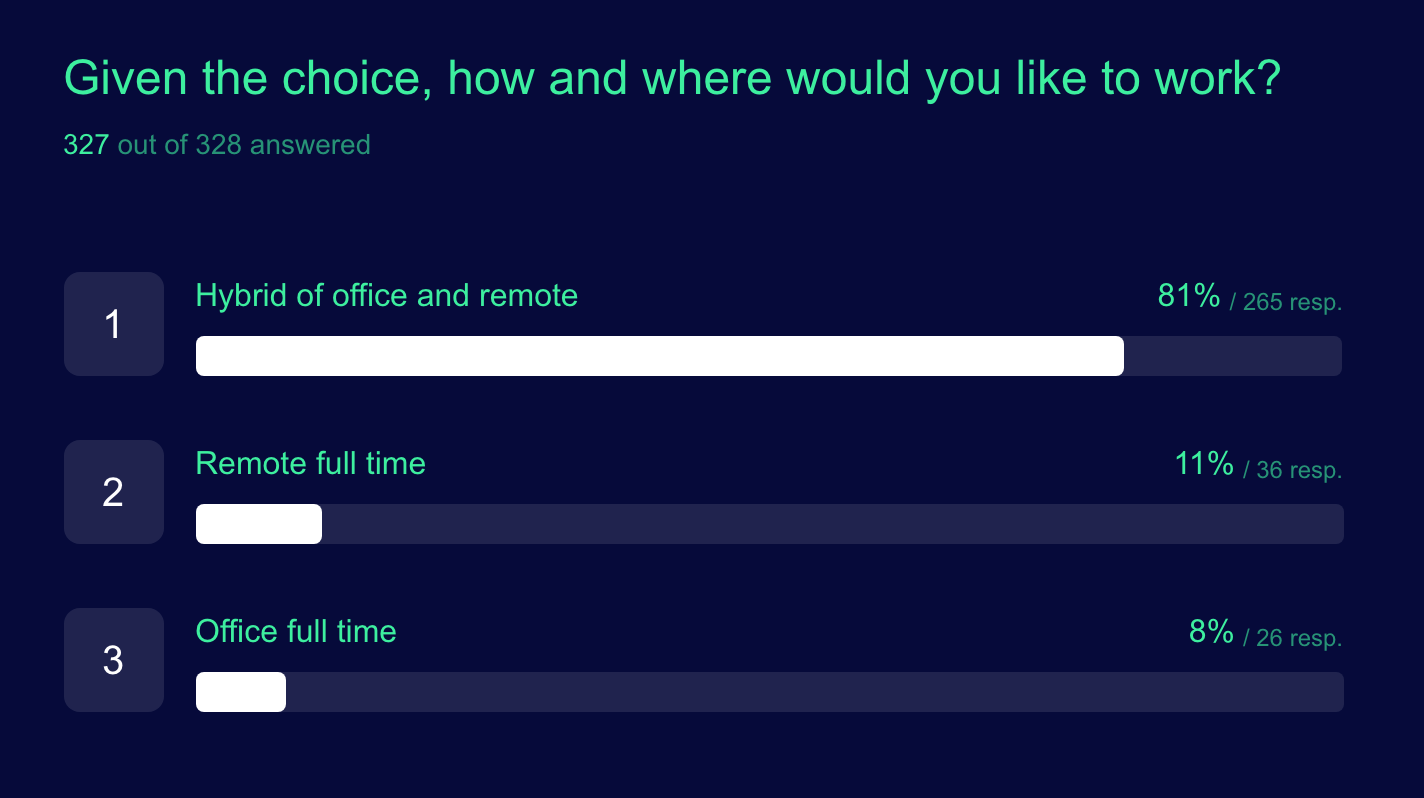
An exclusive survey compiled by Founders Forum, with TechCrunch, found 63% of those surveyed said they would only re-open in either 1-3 months or 3-6 months — even if the government advises [sic] that it is safe to do so before then. A minority have re-opened their offices, while 10% have closed their office permanently. The full survey results can be found here.

However, there will clearly be long-term impact on the model of office working, with a majority of those surveyed saying they would now move to either a flexible remote working model (some with permanent offices, some without), but only a small number plan a “normal” return to work. A very small number plan to go fully “remote.” Many cited the continuing benefits of face-to-face interaction when trying to build the team culture so crucial with early-stage companies.

Title insurance is getting the tech competition it deserves

A lot of people are thinking harder about homeownership as they wait out quarantines — but real estate is still an old-fashioned industry, layered with complexities and surprising costs that can keep a dream purchase out of reach. Title insurance is a great example. A one-time cost to protect buyers and sellers during the closing process, it can extend the purchase process by a month or two, in addition to potentially adding thousands of dollars in costs. But various new regulations and rulings have combined with the larger trends in SaaS to open up the market. Here’s more, in a detailed guest post for Extra Crunch from Ashley Paston of Bain Capital Ventures:

In a very short period of time, we’ve seen startups take advantage of this new, more competitive landscape by offering solutions to streamline the task of getting title insurance. Qualia, for example, offers an end-to-end platform that connects all parties involved in a real estate transaction, so title agents can manage and coordinate all aspects of the process in real time. San Francisco-based States Title, for example, uses a predictive underwriting engine that produces nearly instantaneous title assessment, dramatically reducing the cost and time required to issue a policy. Qualia and States Title are among several companies hoping to revolutionize title insurance and they reflect the two emerging meta-trends.

The first trend, enablement, consists of companies developing technology designed to integrate with incumbent real estate businesses… The second trend, disruption, consists of companies displacing incumbent real estate business altogether.

Image Credits: Black Innovation Alliance

Tech diversity stays in focus

The tech industry has talked about making its opportunities available to all for many years, and struggled to deliver. But more than a month after George Floyd was killed, this time is still feeling different. One example is 👁👄👁.fm, a viral sort of insidery prank from last weekend that a diverse small group of friends in tech created and turned into a successful grassroots fundraiser for racial justice organizations (it was not a VC fundraising stunt). “In one fell swoop,” veteran product leader Ravi Mehta wrote for TechCrunch, “the team chastised Silicon Valley’s use of exclusivity as a marketing tactic, trolled thirsty VCs for their desire to always be first on the next big thing, deftly leveraged the virality of Twitter to build awareness and channeled that awareness into dollars that will have a real impact on groups too often overlooked.”

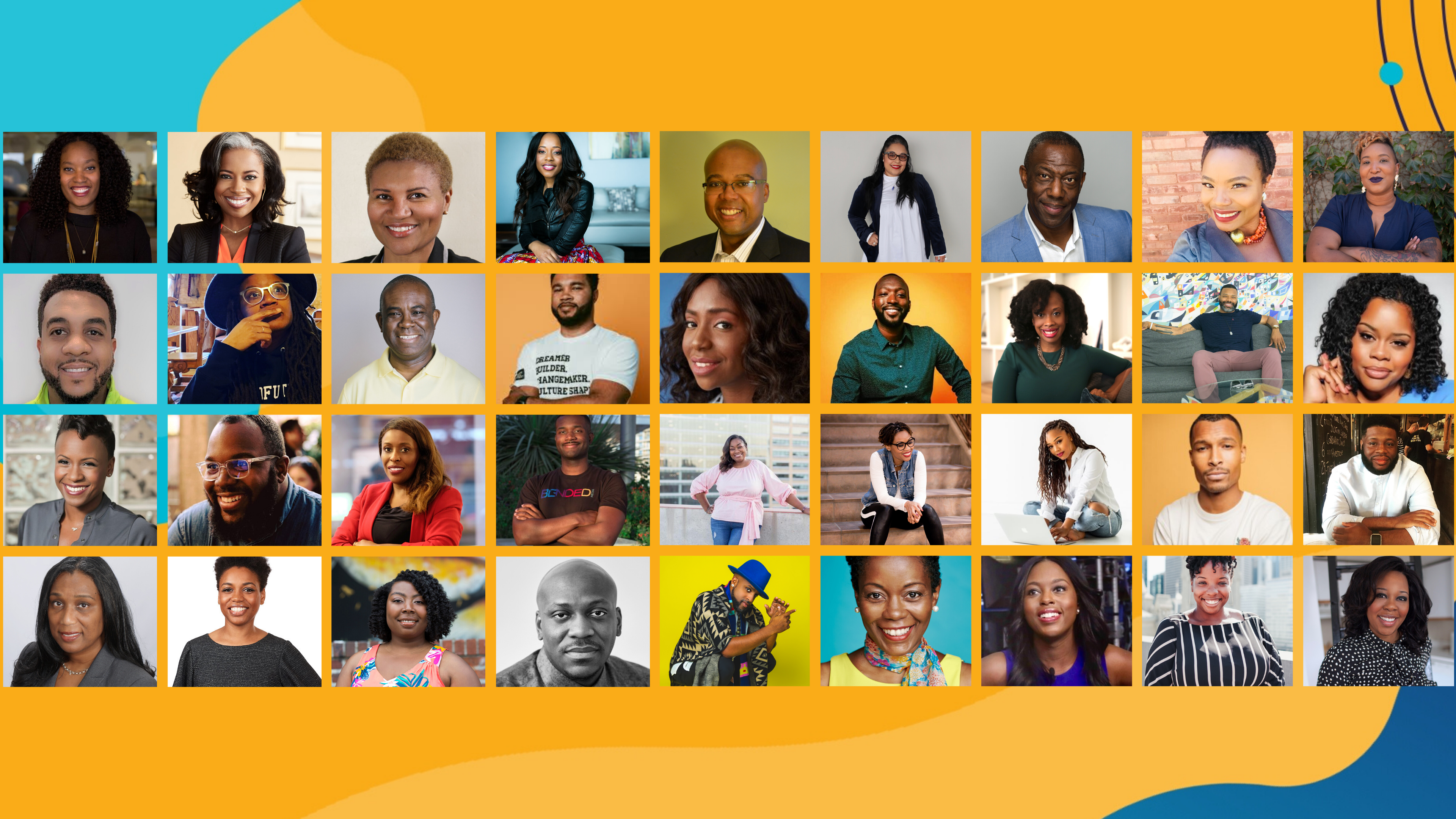
Meanwhile, a group of Black startup founders and the Transparent Collective created a public spreadsheet to provide a comprehensive list of every VC who has backed a Black founder in the US, and the umbrella Black Innovation Alliance launched to help hundreds of related Black-focused tech and entrepreneurship organizations connect and support each other. Efforts like these, combined with a real generational willingness to address the structural problems, are what can make the difference finally.

Why AR has mostly failed (so far)

Augmented reality concepts may become a core part of how people live in the future, but the first wave of companies in the space have not fared well. Here’s why, from Lucas Matney on Extra Crunch:

The technology was almost there in a lot of cases, but the real issue was that the stakes to beat the major players to market were so high that many entrants pushed out boring, general consumer products. In a race to be everything for everybody, the industry relied on nascent developer platforms to do the dirty work of building their early use cases, which contributed heavily to nonexistent user adoption.

Instead, he says success will come from nailing the use-cases first, and not messing around with complex developer platforms and expensive hardware.

Around TechCrunch

Hear Charles Hudson explain how to sell an idea (without a product) at Early Stage

Get your pitchdeck critiqued by Accel’s Amy Saper and Bessemer’s Talia Goldberg at Early Stage

Pioneering CRISPR researcher Jennifer Doudna is coming to Disrupt

One week only: Score 4th of July discounts on Disrupt 2020 passes

Sale: Save 25% on annual Extra Crunch membership

Extra Crunch is now available in Greece, Ireland and Portugal

Extra Crunch expands into Romania

Across the week

TechCrunch

Global app revenue jumps to $50B in the first half of 2020, in part due to COVID-19 impacts

Let’s stop COVID-19 from undoing diversity gains

Strap in — a virtual Tour de France is coming this weekend

US suspends export of sensitive tech to Hong Kong as China passes new national security law

India bans TikTok, dozens of other Chinese apps

Extra Crunch

Top LA investors discuss the city’s post-COVID-19 prospects

13 Boston-focused venture capitalists talk green shoots and startup recovery

How $20 billion health care behemoth Blue Shield of California sees startups

From napkin notes to term sheets: A chat with Inspired Capital’s Alexa von Tobel

Where to open a game studio

Are virtual concerts here to stay?

#EquityPod

From Alex:

Hello and welcome back to Equity, TechCrunch’s venture capital-focused podcast, where we unpack the numbers behind the headlines.

Before we dive in, don’t forget that the show is on Twitter now, so follow us there if you want to see discarded headline ideas, outtakes from the show that got cut, and more. It’s fun!

Back to task, listen, we’re tired too. But we didn’t let that stop us from packing this week’s Equity to the very gills with news and notes and jokes and fun. Hopefully you can chuckle along with myself and Natasha and Danny and Chris on the dials as we riffed through all of this:

Right, that’s our ep. Hugs from the team and have a lovely weekend. You are all tremendous and we appreciate you spending part of your day with the four of us.

Equity drops every Monday at 7:00 AM PT and Friday at 6:00 am PT, so subscribe to us on Apple PodcastsOvercastSpotify and all the casts.

Powered by WPeMatico

GGV’s Jeff Richards: ‘There is a level of resiliency in Silicon Valley that we did not have 10 years ago’

Earlier this week, GGV Capital’s Jeff Richards and Hans Tung joined TechCrunch for an Extra Crunch Live session. During our hour-long chat, we touched on startup profitability, the global venture capital scene, why GGV doesn’t have an office in Europe, how the venture industry is responding to its stark lack of diversity and other issues.

When it comes to useful bits of information, this was perhaps the most useful Extra Crunch Live discussion in which I’ve participated. One moment that stood out came early in the chat when we were talking about COVID-19-driven headwinds and tailwinds and how many startups might be in trouble. Richards said the following (emphasis via TechCrunch):

“You know, the one thing that’s been remarkable for me — I was in Silicon Valley as an entrepreneur in the ’99, 2000 dot-com bubble, and 9/11. I was here in ’08, ’09 — I think there is a level of resiliency in Silicon Valley that we did not have 10 years ago and 20 years ago. I don’t have data to point to that. But we have been saying now for a few months that we’ve been blown away at the level of maturity, calmness, perseverance [and] resiliency that our companies and the founders and management teams have. On an emotional level, it’s been very heartwarming, because you hope to back the kind of people that are building real companies that can withstand challenges.

I think the corollary to that is you’ve seen companies that raised a ton of money and were burning a ton of cash and weren’t building very good businesses, a lot of those frankly went under in Q1 or are going under now. They haven’t been able to raise more cash and they’re just kind of dead.”

Both Richards and Tung were positive about their own portfolio companies’ recent performance and financial health (cash position, really). But it appears that not only are their portfolios doing well, but other startups are a bit more solid than in previous downturns.

On the flip side, however, there is a separate cohort of startups that were running inefficiently before and are now perhaps unfundable. Reading both points in unison, it appears that the startup market is bifurcating between the companies that will come out of the COVID-19 era unwounded, and those that are suffering. And the companies that weren’t the most cash hungry probably have the highest chance of being in the first bucket.

There’s a lot more to get to. So hit the jump for the full video and audio, and a few more of the best bits from the transcript. (You can snag a cheap Extra Crunch trial here if you need one.)

Oh, and don’t forget to stay up to date on coming chats. There’s still a lot to do.

The full chat

Here’s the full video rewind. Our favorite bits of the transcript follow:

Powered by WPeMatico

As Q3 kicks off, four more companies join the $100M ARR club

Welcome back to our $100 million annual recurring revenue (ARR) series, in which we take irregular looks at companies that have reached material scale while still private. The goal of our project is simple: uncovering companies of real worth beyond how they are valued by private investors.


The Exchange is a daily look at startups and the private markets for Extra Crunch subscribers; use code EXCHANGE to get full access and take 25% off your subscription.


It’s all well and good to get a $1 billion valuation, call yourself a unicorn and march around like you invented the internet. But reaching material revenue scale means that, unlike some highly valued companies, you’re actually hard to kill. (And more valuable, and more likely to go public, we reckon.)

Before we dive into today’s new companies, keep in mind that we’ve expanded the type of company that can make it into the $100M ARR club to include companies that reach a $100 million annual run rate pace. Why? Because we don’t only want to collect SaaS companies, and if we could go back in time we’d probably draw a different box around the companies we are tracking.

$100M ARR or bust

If you need to catch up, you can find the two most recent entries in the series here and here. For everyone who’s current, today we are adding Snow Software, A Cloud Guru, Zeta Global and Upgrade to the club. Let’s go!

Snow Software

Just this week, Snow Software announced that it has crossed the $100 million ARR mark, according to a release shared with TechCrunch. The Swedish software asset management company has raised a few private rounds, including a $120 million private equity round in 2017. But, unlike many American companies that make this list, we don’t have a historical record of needing extensive private capital to scale.

Powered by WPeMatico

How Have I Been Pwned became the keeper of the internet’s biggest data breaches

When Troy Hunt launched Have I Been Pwned in late 2013, he wanted it to answer a simple question: Have you fallen victim to a data breach?

Seven years later, the data-breach notification service processes thousands of requests each day from users who check to see if their data was compromised — or pwned with a hard ‘p’ — by the hundreds of data breaches in its database, including some of the largest breaches in history. As it’s grown, now sitting just below the 10 billion breached-records mark, the answer to Hunt’s original question is more clear.

“Empirically, it’s very likely,” Hunt told me from his home on Australia’s Gold Coast. “For those of us that have been on the internet for a while it’s almost a certainty.”

What started out as Hunt’s pet project to learn the basics of Microsoft’s cloud, Have I Been Pwned quickly exploded in popularity, driven in part by its simplicity to use, but largely by individuals’ curiosity.

As the service grew, Have I Been Pwned took on a more proactive security role by allowing browsers and password managers to bake in a backchannel to Have I Been Pwned to warn against using previously breached passwords in its database. It was a move that also served as a critical revenue stream to keep down the site’s running costs.

But Have I Been Pwned’s success should be attributed almost entirely to Hunt, both as its founder and its only employee, a one-man band running an unconventional startup, which, despite its size and limited resources, turns a profit.

As the workload needed to support Have I Been Pwned ballooned, Hunt said the strain of running the service without outside help began to take its toll. There was an escape plan: Hunt put the site up for sale. But, after a tumultuous year, he is back where he started.

Ahead of its next big 10-billion milestone mark, Have I Been Pwned shows no signs of slowing down.

‘Mother of all breaches’

Even long before Have I Been Pwned, Hunt was no stranger to data breaches.

By 2011, he had cultivated a reputation for collecting and dissecting small — for the time — data breaches and blogging about his findings. His detailed and methodical analyses showed time and again that internet users were using the same passwords from one site to another. So when one site was breached, hackers already had the same password to a user’s other online accounts.

Then came the Adobe breach, the “mother of all breaches” as Hunt described it at the time: Over 150 million user accounts had been stolen and were floating around the web.

Hunt obtained a copy of the data and, with a handful of other breaches he had already collected, loaded them into a database searchable by a person’s email address, which Hunt saw as the most common denominator across all the sets of breached data.

And Have I Been Pwned was born.

It didn’t take long for its database to swell. Breached data from Sony, Snapchat and Yahoo soon followed, racking up millions more records in its database. Have I Been Pwned soon became the go-to site to check if you had been breached. Morning news shows would blast out its web address, resulting in a huge spike in users — enough at times to briefly knock the site offline. Hunt has since added some of the biggest breaches in the internet’s history: MySpace, Zynga, Adult Friend Finder, and several huge spam lists.

As Have I Been Pwned grew in size and recognition, Hunt remained its sole proprietor, responsible for everything from organizing and loading the data into the database to deciding how the site should operate, including its ethics.

Hunt takes a “what do I think makes sense” approach to handling other people’s breached personal data. With nothing to compare Have I Been Pwned to, Hunt had to write the rules for how he handles and processes so much breach data, much of it highly sensitive. He does not claim to have all of the answers, but relies on transparency to explain his rationale, detailing his decisions in lengthy blog posts.

His decision to only let users search for their email address makes logical sense, driven by the site’s only mission, at the time, to tell a user if they had been breached. But it was also a decision centered around user privacy that helped to future-proof the service against some of the most sensitive and damaging data he would go on to receive.

In 2015, Hunt obtained the Ashley Madison breach. Millions of people had accounts on the site, which encourages users to have an affair. The breach made headlines, first for the breach, and again when several users died by suicide in its wake.
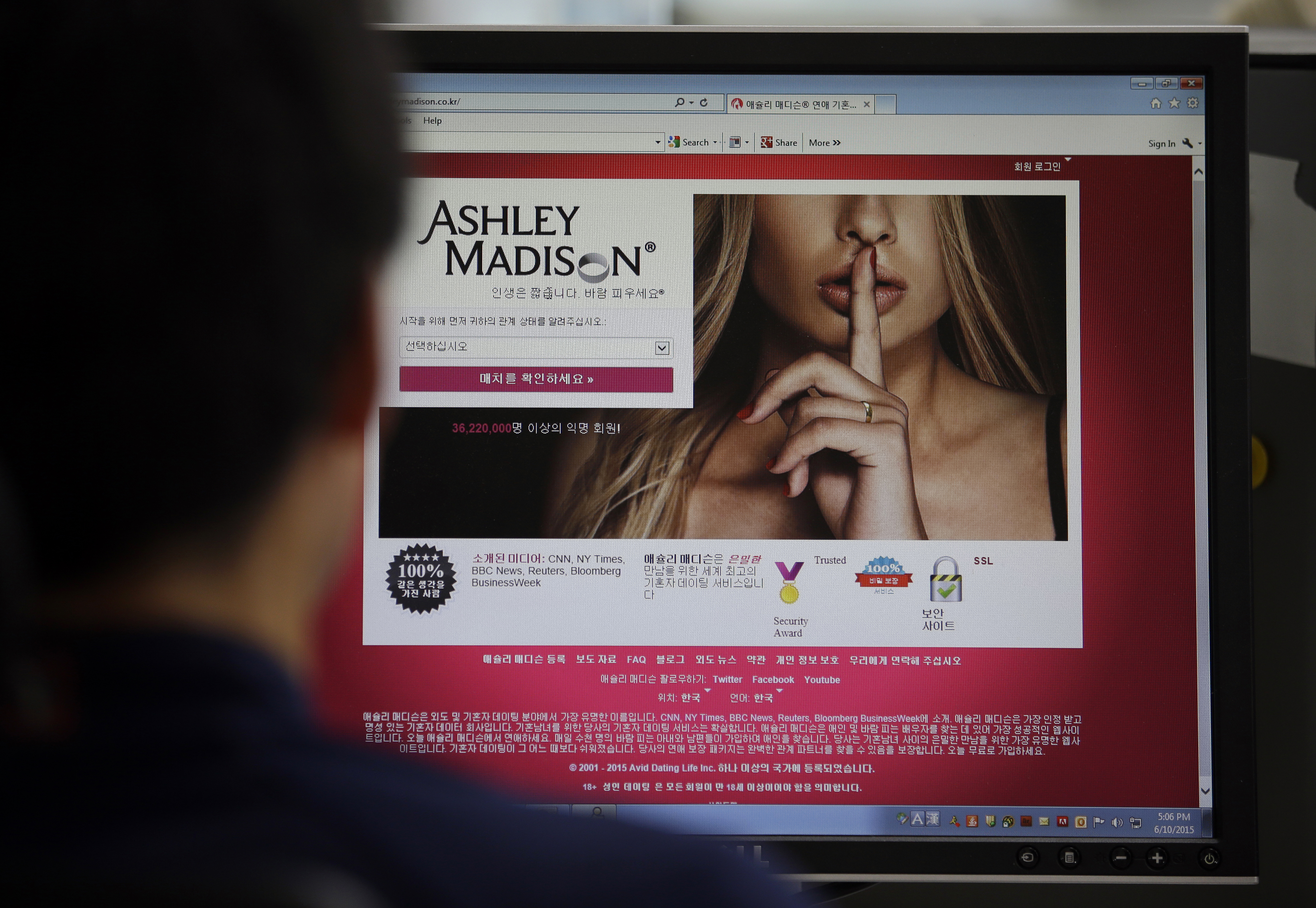
The hack of Ashley Madison was one of the most sensitive entered into Have I Been Pwned, and ultimately changed how Hunt approached data breaches that involved people’s sexual preferences and other personal data. (AP Photo/Lee Jin-man, File)

Hunt diverged from his usual approach, acutely aware of its sensitivities. The breach was undeniably different. He recounted a story of one person who told him how their local church posted a list of the names of everyone in the town who was in the data breach.

“It’s clearly casting a moral judgment,” he said, referring to the breach. “I don’t want Have I Been Pwned to enable that.”

Unlike earlier, less sensitive breaches, Hunt decided that he would not allow anyone to search for the data. Instead, he purpose-built a new feature allowing users who had verified their email addresses to see if they were in more sensitive breaches.

“The purposes for people being in that data breach were so much more nuanced than what anyone ever thought,” Hunt said. One user told him he was in there after a painful break-up and had since remarried but was labeled later as an adulterer. Another said she created an account to catch her husband, suspected of cheating, in the act.

“There is a point at which being publicly searchable poses an unreasonable risk to people, and I make a judgment call on that,” he explained.

The Ashely Madison breach reinforced his view on keeping as little data as possible. Hunt frequently fields emails from data breach victims asking for their data, but he declines every time.

“It really would not have served my purpose to load all of the personal data into Have I Been Pwned and let people look up their phone numbers, their sexualities, or whatever was exposed in various data breaches,” said Hunt.

“If Have I Been Pwned gets pwned, it’s just email addresses,” he said. “I don’t want that to happen, but it’s a very different situation if, say, there were passwords.”

But those remaining passwords haven’t gone to waste. Hunt also lets users search more than half a billion standalone passwords, allowing users to search to see if any of their passwords have also landed in Have I Been Pwned.

Anyone — even tech companies — can access that trove of Pwned Passwords, he calls it. Browser makers and password managers, like Mozilla and 1Password, have baked-in access to Pwned Passwords to help prevent users from using a previously breached and vulnerable password. Western governments, including the U.K. and Australia, also rely on Have I Been Pwned to monitor for breached government credentials, which Hunt also offers for free.

“It’s enormously validating,” he said. “Governments, for the most part, are trying to do things to keep countries and individuals safe — working under extreme duress and they don’t get paid much,” he said.

“There have been similar services that have popped up. They’ve been for-profit — and they’ve been indicted.”
Troy Hunt

Hunt recognizes that Have I Been Pwned, as much as openness and transparency is core to its operation, lives in an online purgatory under which any other circumstances — especially in a commercial enterprise — he would be drowning in regulatory hurdles and red tape. And while the companies whose data Hunt loads into his database would probably prefer otherwise, Hunt told me he has never received a legal threat for running the service.

“I’d like to think that Have I Been Pwned is at the far-legitimate side of things,” he said.

Others who have tried to replicate the success of Have I Been Pwned haven’t been as lucky.

“There have been similar services that have popped up,” said Hunt. “They’ve been for-profit — and they’ve been indicted,” he said.

LeakedSource was, for a time, one of the largest sellers of breach data on the web. I know, because my reporting broke some of their biggest gets: music streaming service Last.fm, adult dating site AdultFriendFinder, and Russian internet giant Rambler.ru to name a few. But what caught the attention of federal authorities was that LeakedSource, whose operator later pleaded guilty to charges related to trafficking identity theft information, indiscriminately sold access to anyone else’s breach data.

“There is a very legitimate case to be made for a service to give people access to their data at a price.”

Hunt said he would “sleep perfectly fine” charging users a fee to access their data. “I just wouldn’t want to be accountable for it if it goes wrong,” he said.

Project Svalbard

Five years into Have I Been Pwned, Hunt could feel the burnout coming.

“I could see a point where I would be if I didn’t change something,” he told me. “It really felt like for the sustainability of the project, something had to change.”

He said he went from spending a fraction of his time on the project to well over half. Aside from juggling the day-to-day — collecting, organizing, deduplicating and uploading vast troves of breached data — Hunt was responsible for the entirety of the site’s back office upkeep — its billing and taxes — on top of his own.

The plan to sell Have I Been Pwned was codenamed Project Svalbard, named after the Norweigian seed vault that Hunt likened Have I Been Pwned to, a massive stockpile of “something valuable for the betterment of humanity,” he wrote announcing the sale in June 2019. It would be no easy task.

Hunt said the sale was to secure the future of the service. It was also a decision that would have to secure his own. “They’re not buying Have I Been Pwned, they’re buying me,” said Hunt. “Without me, there’s just no deal.” In his blog post, Hunt spoke of his wish to build out the service and reach a larger audience. But, he told me, it was not about the money

As its sole custodian, Hunt said that as long as someone kept paying the bills, Have I Been Pwned would live on. “But there was no survivorship model to it,” he admitted. “I’m just one person doing this.”

By selling Have I Been Pwned, the goal was a more sustainable model that took the pressure off him, and, he joked, the site wouldn’t collapse if he got eaten by a shark, an occupational hazard for living in Australia.

But chief above all, the buyer had to be the perfect fit.

Hunt met with dozens of potential buyers, and many in Silicon Valley. He knew what the buyer would look like, but he didn’t yet have a name. Hunt wanted to ensure that whomever bought Have I Been Pwned upheld its reputation.

“Imagine a company that had no respect for personal data and was just going to abuse the crap out of it,” he said. “What does that do for me?” Some potential buyers were driven by profits. Hunt said any profits were “ancillary.” Buyers were only interested in a deal that would tie Hunt to their brand for years, buying the exclusivity to his own recognition and future work — that’s where the value in Have I Been Pwned is.

Hunt was looking for a buyer with whom he knew Have I Been Pwned would be safe if he were no longer involved. “It was always about a multiyear plan to try and transfer the confidence and trust people have in me to some other organizations,” he said.
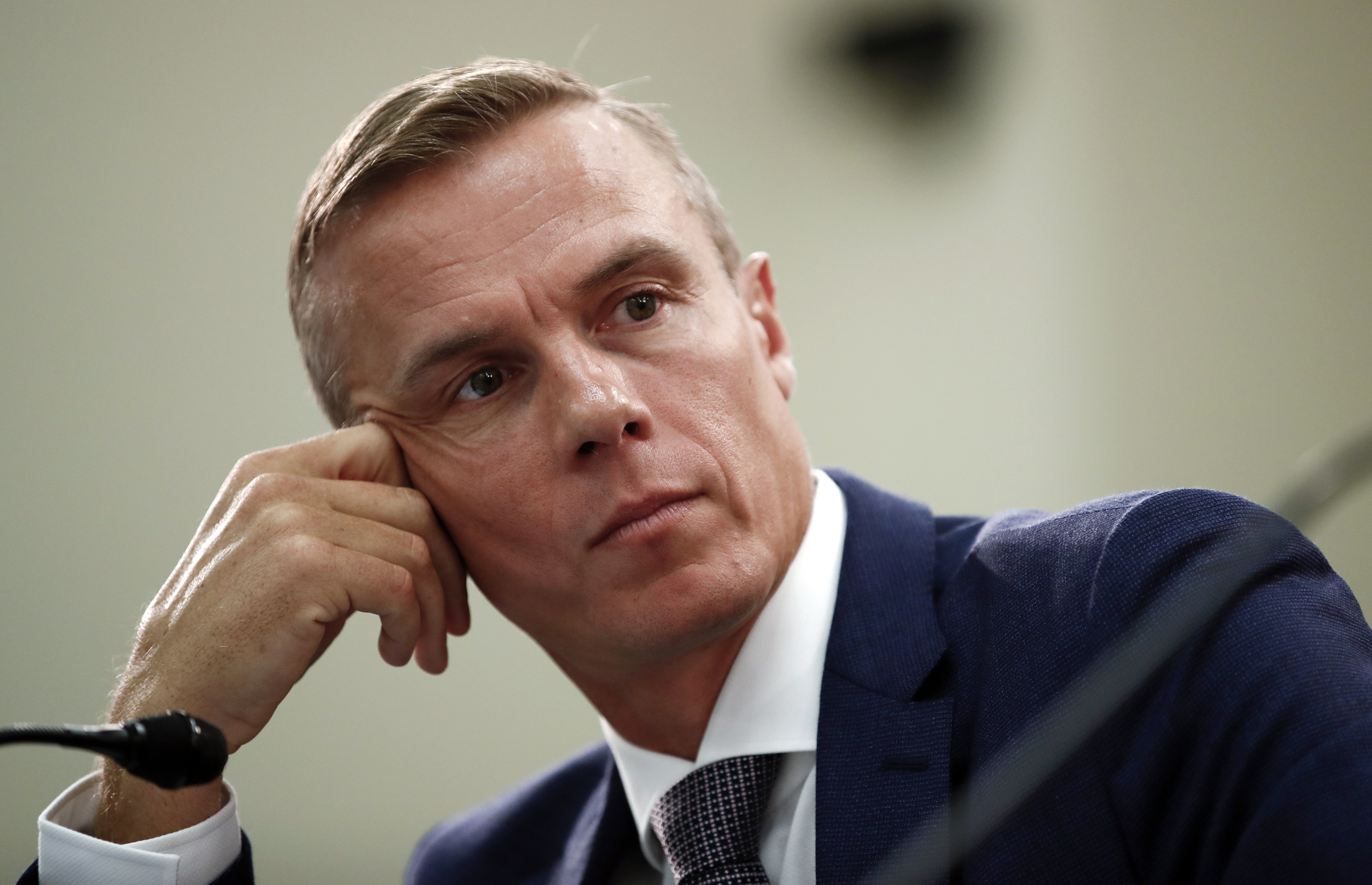
Hunt testifies to the House Energy Subcommittee on Capitol Hill in Washington, Thursday, Nov. 30, 2017. (AP Photo/Carolyn Kaster)

The vetting process and due diligence was “insane,” said Hunt. “Things just drew out and drew out,” he said. The process went on for months. Hunt spoke candidly about the stress of the year. “I separated from my wife early last year around about the same time as the [sale process],” he said. They later divorced. “You can imagine going through this at the same time as the separation,” he said. “It was enormously stressful.”

Then, almost a year later, Hunt announced the sale was off. Barred from discussing specifics thanks to non-disclosure agreements, Hunt wrote in a blog post that the buyer, whom he was set on signing with, made an unexpected change to their business model that “made the deal infeasible.”

“It came as a surprise to everyone when it didn’t go through,” he told me. It was the end of the road.

Looking back, Hunt maintains it was “the right thing” to walk away. But the process left him back at square one without a buyer and personally down hundreds of thousands in legal fees.

After a bruising year for his future and his personal life, Hunt took time to recoup, clambering for a normal schedule after an exhausting year. Then the coronavirus hit. Australia fared lightly in the pandemic by international standards, lifting its lockdown after a brief quarantine.

Hunt said he will keep running Have I Been Pwned. It wasn’t the outcome he wanted or expected, but Hunt said he has no immediate plans for another sale. For now it’s “business as usual,” he said.

In June alone, Hunt loaded over 102 million records into Have I Been Pwned’s database. Relatively speaking, it was a quiet month.

“We’ve lost control of our data as individuals,” he said. But not even Hunt is immune. At close to 10 billion records, Hunt has been ‘pwned’ more than 20 times, he said.

Earlier this year Hunt loaded a massive trove of email addresses from a marketing database — dubbed ‘Lead Hunter’ — some 68 million records fed into Have I Been Pwned. Hunt said someone had scraped a ton of publicly available web domain record data and repurposed it as a massive spam database. But someone left that spam database on a public server, without a password, for anyone to find. Someone did, and passed the data to Hunt. Like any other breach, he took the data, loaded it in Have I Been Pwned, and sent out email notifications to the millions who have subscribed.

“Job done,” he said. “And then I got an email from Have I Been Pwned saying I’d been pwned.”

He laughed. “It still surprises me the places that I turn up.”

Related stories:

Powered by WPeMatico
Dating app S’More adds blurred video calling and launches in LA

The pandemic hasn’t slowed down dating app S’More — at least according to CEO Adam Cohen-Aslatei, who said that the app’s daily active user count doubled in March and hasn’t gone down since.

“When people are working form home, they have much more time to dedicate to their relationships,” Cohen-Aslatei told me.

The app (whose name is short for “something more”) launched last fall and has supposedly attracted nearly 50,000 users. The goal is to move beyond the superficiality of most dating apps, where you first learn about another user and then unlock visual elements (like a profile photo) as you interact.

Cohen-Aslatei said the team has also spent more on marketing to attract a diverse audience, both in terms of racial diversity (something S’more reinforces by not allowing users to filter by race) and sexual orientation, with 15% of users identifying as LGBTQ.

Of course, dating someone new can be challenging when meeting up in-person poses real health risks, but Cohen-Aslatei said S’More users have gotten creative, like remote dinners where they order each other takeout from their favorite restaurants. And now that things are reopening (though some of those reopenings are getting pulled back), users are asking, “How do we transition these virtual relationships into IRL?”

S'More video calling

Image Credits: S’More

To give users more ways to interact, the S’More team recently launched a video calling feature. But Cohen-Aslatei noted, “We had to to create it in a way that was really fitting for our app … Women actually don’t want to see a guy right away, when you don’t know if they’re a creep.”

So in S’more’s video calling, the video is blurred for the first two minutes, which means you’ve got to actually start an interesting conversation before you can see who you’re talking to, and before they see you (a concept that may be familiar to viewers of Netflix’s dating show “Love is Blind”).

S’More has also expanded geographically, launching last week in Los Angeles (it was already available in Boston, Washington, D.C., New York and Chicago). And it recently started its a video series of its own on Instagram’s IGTV — the S’More Live Happy Hour, where celebrities offer dating advice.

“There’s this negative history of dating apps perpetuating negative online behaviors, fake images, catfishers,” Cohen-Aslatei said. “But now we’re going into a new era of authenticity, where we’re going from super vain to super authentic. S’more is one of those apps that’s going to lead you in that direction.”

Powered by WPeMatico

Sprint 5G is no more, as T-Mobile focuses on its own network

A day after formally completing the sale of Boost, Virgin and other Sprint prepaid networks to Dish, T-Mobile is pulling the plug on Sprint 5G. The move is one in a long list of issues that need sorting out in the wake of April’s $26.5 billion merger. And like a number of other moves, it’s set to leave some customers in the lurch.

The end of Sprint’s 2.5 GHz 5G comes as T-Mobile opts to focus on its own network. T-Mobile already started the process in New York City, a few weeks after the merger and has since completed it in a handful of other cities, including Atlanta, Chicago, Dallas-Fort Worth, Houston, Kansas City, Los Angeles, Phoenix and Washington, D.C.

As CNET notes, while most of the Sprint 5G handsets won’t be able to make the transition, Samsung Galaxy S20 5G users are in the clear here. For everyone else, T-Mobile is offering up credits on leases for new 5G handsets.

T-Mobile told TechCrunch in a statement, “We are working to quickly re-deploy, optimize and test the 2.5GHz spectrum before lighting it up on the T-Mobile network.”

Along with the sale of Boost, 5G was a big selling point for T-Mobile’s Sprint acquisition. The carriers argued that the deal was necessary to keep them competitive with first and second place carriers AT&T and Verizon when it came to the next-generation wireless technology.

At the time FCC chairman Ajit Pai agreed stating, “This transaction will provide New T-Mobile with the scale and spectrum resources necessary to deploy a robust 5G network across the United States.”

Earlier this week, OpenSignal awarded T-Mobile the top spot in availability, noting, “In the U.S., T-Mobile won the 5G Availability award by a large margin with Sprint and AT&T trailing with scores of 14.1% and 10.3%, respectively.”

Update: The language of the post has been updated to reflect the impact on specific unsupported devices, rather than user base figures.

Powered by WPeMatico

‘Westworld’ creators are developing a ‘Fallout’ TV series for Amazon

“Fallout,” the post-apocalyptic video game franchise published by Bethesda Softworks, is being turned into a TV series by Kilter Films, the production company of Jonathan Nolan and Lisa Joy.

The series, which began in 1997, takes place in an alternate future with a retro tone, after a nuclear war has turned most of the world into a wasteland. The games have continued in the two decades since, most recently with the release of “Fallout 76.”

The show — currently in development, with a series commitment from Amazon Studios — is part of Nolan and Joy’s overall deal with streaming service, which they signed last year for a reported $150 million.

The husband-and-wife team is best known for creating HBO’s new version of “Westworld” (based on a Michael Crichton film from the 1970s). They’re also working on an adaptation of William Gibson’s novel “The Peripheral.”

“Fallout is one of the greatest game series of all time,” Nolan and Joy said in a statement. “Each chapter of this insanely imaginative story has cost us countless hours we could have spent with family and friends. So we’re incredibly excited to partner with Todd Howard and the rest of the brilliant lunatics at Bethesda to bring this massive, subversive, and darkly funny universe to life with Amazon Studios.”


Powered by WPeMatico

Police roll up crime networks in Europe after infiltrating popular encrypted chat app

Hundreds of alleged drug dealers and other criminals are in custody today after police in Europe infiltrated an encrypted chat system reportedly used by thousands to discuss illegal operations. The total failure of this ostensibly secure method of communication will likely have a chilling effect on the shadowy industry of crime-focused tech.

“Operation Venetic” was reported by various police agencies, major local news outlets, and by Motherboard in especially vibrant form, quoting extensively people apparently from within the groups affected.

The operation involved hundreds of officers working across numerous agencies in France, the Netherlands, the U.K., and other countries. It began in 2017, and culminated two months ago when a service called EncroChat was hacked and the messages of tens of thousands of users exposed to police scrutiny.

EncroChat is a step up in some ways from encrypted chat apps like Signal and WhatsApp. Rather like Blackberry once did, EncroChat provided customized hardware, a dedicated OS, and its own servers to users, providing an expensive service costing thousands per year rather than a one-time purchase or download.

Messages on the service were supposedly very secure and had deniability built in by letting conversations be edited later — so theoretically a user could claim after the fact they never said something. Motherboard’s Joseph Cox has been following the company for some time and has far more details on its claims and operations.

Image Credits: EncroChat /

Needless to say those claims were not entirely true, as at some point in early 2020 police managed to introduce malware into the EncroChat system that completely exposed the conversations and images of its users. Because of the trusted nature of the app, people would openly discuss drug deals, murders, and other crimes, making them sitting ducks for law enforcement.

Throughout the spring criminal operations were being cracked open with alarming (to them) regularity, but it wasn’t until May that users and EncroChat managed to put the pieces together. The company attempted to warn its users and issue an update, but the cat was out of the bag. Seeing that its operation was now exposed, the Operation Venetic teams struck.

Arrests across the several countries involved (there were numerous sub-operations but France and the Netherlands were the primary investigators) total near a thousand, but exact numbers are not clear. Dozens of guns, tons (metric, naturally) of drugs and the equivalent of tens of millions of dollars in cash were seized. More importantly, the chat logs seem to have provided access to people higher up the food chain than ordinary busts would have.

That the reportedly most popular of encrypted chat companies focused on illegal activities could be so completely subverted by international authorities will likely put a damper on its competition. But like other, more domestic challenges to encryption, such as the perennial complaints by the FBI, this event is more likely to strengthen the tools in the long run.

Powered by WPeMatico