1010Computers | Computer Repair & IT Support

PQShield raises $7M for quantum-ready cryptographic security solutions

A deep tech startup building cryptographic solutions to secure hardware, software, and communications systems for a future when quantum computers may render many current cybersecurity approaches useless is today emerging out of stealth mode with $7 million in funding and a mission to make cryptographic security something that cannot be hackable, even with the most sophisticated systems, by building systems today that will continue to be usable in a post-quantum future.

PQShield (PQ being short for “post-quantum”), a spin out from Oxford University, is being backed in a seed round led by Kindred Capital, with participation also Crane Venture Partners, Oxford Sciences Innovation and various angel investors, including Andre Crawford-Brunt, Deutsche Bank’s former global head of equities.

PQShield was founded in 2018, and its time in stealth has not been in vain.

The startup claims to have the UK’s highest concentration of cryptography PhDs outside academia and classified agencies, and it is one of the biggest contributors to the NIST cybersecurity framework (alongside academic institutions and huge tech companies), which is working on creating new cryptographic standards, which take into account the fact that quantum computing will likely make quick work of breaking down the standards that are currently in place.

“The scale is massive,” Dr Ali El Kaafarani, a research fellow at Oxford’s Mathematical Institute and former engineer at Hewlett-Packard Labs, who is the founder and CEO of PQShield said of that project. “For the first time we are changing the whole of public key infrastructure.”

And according to El Kaafarani, the startup has customers — companies that build hardware and software services, or run communications systems that deal with sensitive information and run the biggest risks from being hacked.

They include entities in the financial and government sectors that it’s not naming, as well as its first OEM customer, Bosch. El Kaafarani said in an interview that it is also in talks with at least one major communications and messaging provider exploring more security for end-to-end encryption on messaging networks. Other target applications could include keyless cars, connected IoT devices, and cloud services.

The gap in the market the PQShield is aiming to address is the fact that while there are already a number of companies exploring the cutting edge of cryptographic security in the market — they include large tech companies like Amazon and MicrosoftHub Security, Duality, another startup out of the UK focused on post-quantum cryptography called Post Quantum and a number of others — the concern is that quantum computing will be utilised to crack even the most sophisticated cryptography such as the RSA and Elliptic Curve cryptographic standards.

This has not been much of a threat so far since quantum computers are still not widely available and used, but there have been a number of signs of a breakthrough on the horizon.

El Kaafarani says that PQShield is the first startup to approach that predicament with a multi-pronged solution aimed at a variety of use cases, including solutions that encompass current cryptographic standards and provide a migration path the next generation of how they will look — meaning, they can be commercially deployed today, even without quantum computers being a commercial reality, but in preparation for that.

“Whatever we encrypt now can be harvested, and once we have a fully functioning quantum computer people can use that to get back to the data and the sensitive information,” he said.

For hardware applications, it’s designed a System on Chip (SoC) solution that will be licensed to hardware manufacturers (Bosch being the first OEM). For software applications, there is an SDK that secures messaging and is protected by “post-quantum algorithms” based on a secure, Signal-derived protocol.

Thinking about and building for the full spectrum of applications is central to PQShield’s approach, he added. “In security it’s important to understand the whole ecosystem since everything is about connected components.”

Some sectors in the tech world have been especially negatively impacted by the coronavirus and its consequences, a predicament that has been exacerbated by uncertainties over the future of the global economy.

I asked El Kaafarani if that translated to a particularly tricky time to raise money as a deep tech startup, given that deep tech companies so often work on long-term problems that may not have immediate commercial outcomes.

Interestingly, he said that wasn’t the case.

“We talked to VCs that were interested in deep tech to begin with, which made the discussion a lot easier,” he said. “And the fact is that we’re a security company, and that is one of the areas that is doing well. Everything has become digitised, and we have all become more heavily reliant on our digital connections. We ultimately help make the digital world more secure. There are people who understand that, and so it wasn’t too difficult to talk to them and understand the importance of this company.”

Indeed, Chrysanthos Chrysanthou, partner at Kindred Capital, echoed that sentiment:

“With some of the brightest minds in cryptography, mathematics and engineering, and boasting world-class software and hardware solutions, PQShield is uniquely positioned to lead the charge in protecting businesses from one of the most profound threats to their future,” he said. “We couldn’t be happier to support the team as it works to set a new standard for information security and defuse risks resulting from the rise of quantum.”

Powered by WPeMatico
Slack snags corporate directory startup Rimeto to up its people search game

For the second time in less than 24 hours, an enterprise company bought an early-stage startup. Yesterday afternoon DocuSign acquired Liveoak, and this morning Slack announced it was buying corporate directory startup Rimeto, which should help employees find people inside the organization who match a specific set of criteria from inside Slack.

The companies did not share the purchase price.

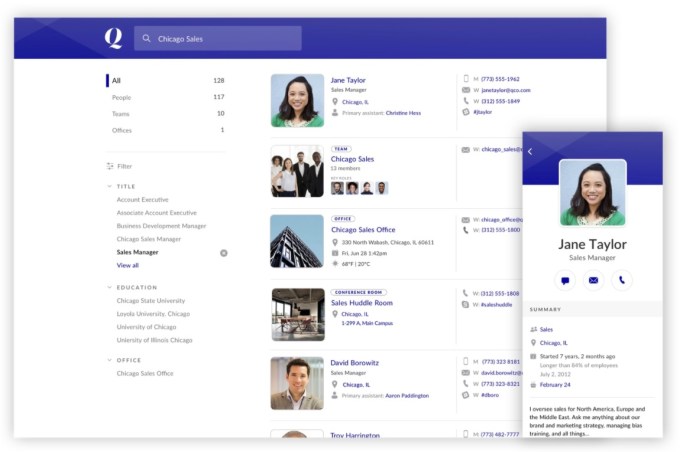
Rimeto helps companies build directories to find employees beyond using tools like Microsoft Active Directory, homegrown tools or your corporate email program. When we covered the company’s $10 million Series A last year, we described what it brings to directories this way:

Rimeto has developed a richer directory by sitting between various corporate systems like HR, CRM and other tools that contain additional details about the employee. It of course includes a name, title, email and phone like the basic corporate system, but it goes beyond that to find areas of expertise, projects the person is working on and other details that can help you find the right person when you’re searching the directory.

In the build versus buy equation that companies balance all the time, it looks like Slack weighed the pros and cons and decided to buy. You could see how a tool like this would be useful to Slack as people try to build teams of employees, especially in a world where so many are working from home.

While the current Slack people search tool lets you search by name, role or team, Rimeto should give users a much more robust way of searching for employees across the company. You can search for the right person to help you with a particular problem and get much more granular with your search requirements than the current tool allows.

Image Credit: Rimeto

At the time of its funding announcement, the company, which was founded in 2016 by three former Facebook employees, told TechCrunch it had bootstrapped for the first three years before taking the $10 million investment last year. It also reported it was cash-flow positive at the time, which is pretty unusual for an early-stage enterprise SaaS company.

In a company blog post announcing the deal, as is typical in these deals, the founders saw being part of a larger organization as a way to grow more quickly than they could have alone. “Joining Slack is a special opportunity to accelerate Rimeto’s mission and impact with greater reach, expanded resources, and the support of Slack’s impressive global team,” the founders wrote in the post.

The acquisition is part of a continuing trend around enterprise companies buying early-stage startups to fill in holes in their product road maps.

Powered by WPeMatico

Google launches the Open Usage Commons, a new organization for managing open-source trademarks

Google, in collaboration with a number of academic leaders and its consulting partner SADA Systems, today announced the launch of the Open Usage Commons, a new organization that aims to help open-source projects manage their trademarks.

To be fair, at first glance, open-source trademarks may not sound like it would be a major problem (or even a really interesting topic), but there’s more here than meets the eye. As Google’s director of open source Chris DiBona told me, trademarks have increasingly become an issue for open-source projects, not necessarily because there have been legal issues around them, but because commercial entities that want to use the logo or name of an open-source project on their websites, for example, don’t have the reassurance that they are free to use those trademarks.

“One of the things that’s been rearing its ugly head over the last couple years has been trademarks,” he told me. “There’s not a lot of trademarks in open-source software in general, but particularly at Google, and frankly the higher tier, the more popular open-source projects, you see them more and more over the last five years. If you look at open-source licensing, they don’t treat trademarks at all the way they do copyright and patents, even Apache, which is my favorite license, they basically say, nope, not touching it, not our problem, you go talk.”

Traditionally, open-source licenses didn’t cover trademarks because there simply weren’t a lot of trademarks in the ecosystem to worry about. One of the exceptions here was Linux, a trademark that is now managed by the Linux Mark Institute on behalf of Linus Torvalds.

With that, commercial companies aren’t sure how to handle this situation and developers also don’t know how to respond to these companies when they ask them questions about their trademarks.

“What we wanted to do is give guidance around how you can share trademarks in the same way that you would share patents and copyright in an open-source license […],” DiBona explained. “And the idea is to basically provide that guidance, you know, provide that trademarks file, if you will, that you include in your source code.”

Google itself is putting three of its own open-source trademarks into this new organization: the Angular web application framework for mobile, the Gerrit code review tool and the Istio service mesh. “All three of them are kind of perfect for this sort of experiment because they’re under active development at Google, they have a trademark associated with them, they have logos and, in some cases, a mascot.”

One of those mascots is Diffi, the Kung Fu Code Review Cuckoo, because, as DiBona noted, “we were trying to come up with literally the worst mascot we could possibly come up with.” It’s now up to the Open Usage Commons to manage that trademark.

DiBona also noted that all three projects have third parties shipping products based on these projects (think Gerrit as a service).

Another thing DiBona stressed is that this is an independent organization. Besides himself, Jen Phillips, a senior engineering manager for open source at Google is also on the board. But the team also brought in SADA’s CTO Miles Ward (who was previously at Google); Allison Randal, the architect of the Parrot virtual machine and member of the board of directors of the Perl Foundation and OpenStack Foundation, among others; Charles Lee Isbell Jr., the dean of the Georgia Institute of Technology College of Computing, and Cliff Lampe, a professor at the School of Information at the University of Michigan and a “rising star,” as DiBona pointed out.

“These are people who really have the best interests of computer science at heart, which is why we’re doing this,” DiBona noted. “Because the thing about open source — people talk about it all the time in the context of business and all the rest. The reason I got into it is because through open source we could work with other people in this sort of fertile middle space and sort of know what the deal was.”

Update: even though Google argues that the Open Usage Commons are complementary to other open source organizations, the Cloud Native Computing Foundation (CNCF) released the following statement by Chris Aniszczyk, the CNCF’s CTO: “Our community members are perplexed that Google has chosen to not contribute the Istio project to the Cloud Native Computing Foundation (CNCF), but we are happy to help guide them to resubmit their old project proposal from 2017 at any time. In the end, our community remains focused on building and supporting our service mesh projects like Envoy, linkerd and interoperability efforts like the Service Mesh Interface (SMI). The CNCF will continue to be the center of gravity of cloud native and service mesh collaboration and innovation.”


Powered by WPeMatico

Tinder now testing video chat in select markets, including US

Tinder announced this morning it will begin to test video chat in its mobile dating app with some members in select worldwide markets, including in the U.S. The feature, which allows Tinder matches to go on “virtual” dates when both opt in, will first be available to users in Virginia, Illinois, Georgia and Colorado in the U.S., as well as in Brazil, Australia, Spain, Italy, France, Vietnam, Indonesia, Korea, Taiwan, Thailand, Peru and Chile, also with some members.

Parent company Match had first promised it would introduce video chat in Tinder as part of its Q1 2020 earnings report and touted the feature as a way Tinder was evolving its business in the face of the coronavirus pandemic. The company had also then detailed the pandemic’s impact on its app, which had slowed Tinder user growth in the quarter as social distancing requirements and government lockdowns went into effect.

Tinder ended Q1 with 6 million subscribers, up from 5.9 million in December 2019 — meaning it only added 100,000 paid subscribers during the quarter. For comparison, in the year-ago quarter it added 384,000 paid users. Tinder’s average revenue per user (ARPU) also grew just 2%, mainly due to purchases of à la carte features, not subscriptions.

Tinder parent Match says it had tested video at various times before the COVID-19 outbreak, but said it never saw significant adoption. The pandemic has changed things, however. Today, Tinder allows users to search for matches worldwide through its Passport feature, making its dating app more of a social network. Meanwhile, Tinder users who do want to date now feel almost forced to use video for their early interactions instead of going on briefer “getting to know you” coffee or drink dates, as before.

Without a video option in the app, these users often turned to third-party apps like Snapchat or other video chat apps for these early connections. Meanwhile, daters who prioritized a video option may have even made the switch to rival Bumble, which has offered video for a year. Facebook also recently said it would add video for its Facebook Dating users, as a result of the coronavirus pandemic, forcing Tinder’s hand.

Image Credits: Tinder

The new feature itself is simple to use. Once two people have matched and are chatting in the app, they can indicate they’re ready to move to a video session by tapping the new video icon. The clever part is that the feature itself isn’t enabled until both matches opt in. The company notes that Tinder users won’t be informed if a match toggles on the video chat feature. The idea is to wait until the discussion comes up naturally, as it often does in a text-based chat.

When both users have toggled on video chat, they have to agree to ground rules before the chat begins. Tinder says calls should remain “PG,” with no nudity or sexual content. The chats are also supposed to stay “clean,” meaning no harassment, hate speech, violence or other illegal activities. Users also agree calls will need to be age-appropriate, meaning without minors involved.

The feature, which Tinder calls “Face to Face,” is enabled on a match-by-match basis, not universally for all matches.

How exactly Tinder plans to properly moderate what appears to be a fantastic new solicitation platform remains less clear. In addition, Tinder’s move to embrace video means it could be putting sex offenders in front of the camera. As an investigative report last year from ProPublica found, most of the Match-owned dating apps, including Tinder, were not screening for sexual predators.

For now, Tinder says users are asked to review the call when it wraps.

In a pop-up, users who finish a video call will be asked whether they would go Face to Face again. Here, they’ll also have the option to report the user, if needed. These sorts of retroactive rating systems don’t do much for anyone who feels unsafe in the moment, of course, and it’s not clear to what extent Tinder will step in to police calls in progress.

Asked for specifics, Tinder declined to share. (In an earlier report, Tinder CEO Elie Seidman suggested Tinder would use machine learning models to monitor chats.)

Also unclear is to what extent Tinder would step into to stop what may otherwise be consensual sexual activity, including of the paid variety.

Tinder doesn’t seem worried about these off-brand use cases for video chat, however. It says it recently surveyed around 5,000 members in the U.S. and around half of them have already had video dates with a match off its platform over the past month, indicating a willingness to try video for online dating. In addition, 40% of Gen Z members said they wanted to keep using video as an initial step before agreeing to meet in real life, even when places like restaurants and bars were re-opened.

“Connecting face-to-face is more important than ever, and our video chat feature represents a new way for people to get to know one another in-app no matter their physical distance,” said Rory Kozoll, head of Trust and Safety Products at Tinder, in a statement about the launch. “Face to Face prioritizes control to help our members feel more comfortable taking this next step in chats if and when it feels right for them. We’ve built a solid foundation, and look forward to learning from this test over the coming weeks,” Kozoll added.

The feature is launching in testing only starting today, in select markets.

Powered by WPeMatico

Suse acquires Kubernetes management platform Rancher Labs

Suse, which describes itself as “the world’s largest independent open source company,” today announced that it has acquired Rancher Labs, a company that has long focused on making it easier for enterprises to make their container clusters.

The two companies did not disclose the price of the acquisition, but Rancher was well funded, with a total of $95 million in investments. It’s also worth mentioning that it has only been a few months since the company announced its $40 million Series D round led by Telstra Ventures. Other investors include the likes of Mayfield and Nexus Venture Partners, GRC SinoGreen and F&G Ventures.

Like similar companies, Rancher’s original focus was first on Docker infrastructure before it pivoted to putting its emphasis on Kubernetes, once that became the de facto standard for container orchestration. Unsurprisingly, this is also why Suse is now acquiring this company. After a number of ups and downs — and various ownership changes — Suse has now found its footing again and today’s acquisition shows that its aiming to capitalize on its current strengths.

Just last month, the company reported the annual contract value of its booking increased by 30% year over year and that it saw a 63% increase in customer deals worth more than $1 million in the last quarter, with its cloud revenue growing 70%. While it is still in the Linux distribution business that the company was founded on, today’s Suse is a very different company, offering various enterprise platforms (including its Cloud Foundry-based Cloud Application Platform), solutions and services. And while it already offered a Kubernetes-based container platform, Rancher’s expertise will only help it to build out this business.

“This is an incredible moment for our industry, as two open source leaders are joining forces. The merger of a leader in Enterprise Linux, Edge Computing and AI with a leader in Enterprise Kubernetes Management will disrupt the market to help customers accelerate their digital transformation journeys,” said Suse CEO Melissa Di Donato in today’s announcement. “Only the combination of SUSE and Rancher will have the depth of a globally supported and 100% true open source portfolio, including cloud native technologies, to help our customers seamlessly innovate across their business from the edge to the core to the cloud.”

The company describes today’s acquisition as the first step in its “inorganic growth strategy” and Di Donato notes that this acquisition will allow the company to “play an even more strategic role with cloud service providers, independent hardware vendors, systems integrators and value-added resellers who are eager to provide greater customer experiences.”

Powered by WPeMatico

SetSail raises raises $7M to change how sales teams are compensated

Most sales teams earn a commission after a sale closes, but nothing prior to that. Yet there are a variety of signals along the way that indicate the sales process is progressing, and SetSail, a startup from some former Google engineers, is using machine learning to figure out what those signals are, and how to compensate salespeople as they move along the path to a sale, not just after they close the deal.

Today, the startup announced a $7 million investment led by Wing Venture Capital with help from Operator Collective and Team8. Under the terms of the deal, Leyla Seka from Operator will be joining the board. Today’s investment brings the total raised to $11 million, according to the company.

CEO and co-founder Haggai Levi says his company is based on the idea that commission alone is not a good way to measure sales success, and that it is in fact a lagging indicator. “We came up with a different approach. We use machine learning to create progress-based incentives,” Levi explained.

To do that they rely on machine learning to discover the signals that are coming from the customer that indicate that the deal is moving forward, and using a points system, companies can begin compensating reps on hitting these milestones, even before the sale closes.

The seeds for the idea behind SetSail were planted years ago when the three founders were working at Google tinkering with ways to motivate sales reps beyond pure commission. From a behavioral perspective, Levi and his co-founders found that reps were taking fewer risks with a pure commission approach and they wanted to find a way to change that. The incremental compensation system achieves that.

“If I’m closing the deal, I’m getting my commission. If I’m not closing the deal, I’m getting nothing. That means from a behavioral point of view, I would take the shortest path to win a deal, and I would take the minimum risk possible. So if there’s a competitive situation I will try to avoid that,” he said.

They look at things like appointments, emails and call transcripts. The signals will vary by customer. One may find an appointment with CIO is a good signal a deal is on the right trajectory, but to avoid having reps gaming the system by filling the CRM with the kinds of positive signals the company is looking for, they only rely on objective data, rather than any kind of self-reporting information from reps themselves.

The team eventually built a system like this inside Google, and in 2018, left to build a solution for the rest of the world that does something similar.

As the company grows, Levi says he is building a diverse team, not only because it’s the right thing to do, but because it simply makes good business sense. “The reality is that we’re building a product for a diverse audience, and if we don’t have a diverse team we would never be able to build the right product,” he explained.

The company’s unique approach to sales compensation is resonating with customers like Dropbox, Lyft and Pendo, who are looking for new ways to motivate sales teams, especially during a pandemic when there may be a longer sales cycle. This kind of system provides a way to compensate sales teams more incrementally and reward positive approaches that have proven to result in sales.

Powered by WPeMatico

Karma Automotive raises $100 million as it looks to resell it EV platform to other automakers

Karma Automotive has raised a $100 million lifeline from outside investors, as reported by Bloomberg, with the struggling electric vehicle maker’s fortunes likely buoyed by the current market optimism on other EV companies, including Tesla. Karma is the reincarnated version of Fisker Automotive, which previously faced bankruptcy before being acquired by Wanxiang Group in 2014.

Karma Automotive has made more progress than Fisker ever did, including actually delivering around 500 of its inaugural Revero electric sport sedan in 2019. The company will be continuing to sell the Revero, which retails starting at around $140,000, and will also be looking to add a high-horsepower GTE version, as well as a supercar for an even higher-tier customer.

The automaker also says that it’s in discussions with a partner for a commercial delivery truck, which it intends to develop in prototype form by year’s end. There are a number of different companies pursuing delivery vans for use by courier companies, including UPS and FedEx, and the increase in e-commerce spending presents an opportunity for multiple players to succeed in this category, even as there is a rush on in terms of entrants.

Karma will also seek to leverage and extend the benefits of its fresh investment by shopping around its EV platform to other automakers and OEMs, the company says, and also will eventually expand beyond pure EVs to hybrid fuel vehicles. In short, it sounds like Karma is willing to try just about everything and anything to chart a path toward profitability, but time will tell if that’s intelligent opportunism, or scattershot desperation.

Powered by WPeMatico

Samsung will reveal the next Galaxy Note on August 5

Samsung’s next big Unpacked event is scheduled for August 5. As is the trend these days, the unveiling will be online-only, following in the footsteps of big virtual events from the likes of Microsoft and Apple. It’s Samsung’s first crack at the format. The company just made it under the pre-COVID-19 shutdown wire back in February for the Galaxy S20 launch.

Image Credits: Samsung

The headliner of next month’s event will no doubt be the next version of Samsung’s popular phablet line. The Galaxy Note S20 has leaked online a fair bit already, because Samsung. The most notable occasion was the beginning of the month, when the company’s Russia site briefly posted a copper colored version of the Note 20 Ultra. Fittingly, the invite for the event features a copper S-Pen dripping into a big similarly-colored puddle. 

The premium version of the handset sports a folded zoom lens, much like the Galaxy S20 Ultra. Additional leaks appear to confirm some minor changes to the handset’s design, including the swapping of some buttons and moving the S-Pen slot to the left of the charging port. Other details will almost certainly leak out between now and August 5, because that’s just how these things go. There will likely be a slew of other devices on the docket for the event, as well. Samsung likes to pack a lot into Unpacked, after all. Accessories, audio products and wearables are all candidates. 

Notably, Samsung also announced that it will be holding its own virtual event in the early September time frame. The company had initially planned to attend IFA, but ultimately — and understandably — thought better of it. The August 5 event, meanwhile, kicks off at 10 a.m. ET/7 a.m. PT. It will be available via Samsung.com

Powered by WPeMatico

Samsung will reveal the next Galaxy Note on August 5

Samsung’s next big Unpacked event is scheduled for August 5. As is the trend these days, the unveiling will be online-only, following in the footsteps of big virtual events from the likes of Microsoft and Apple. It’s Samsung’s first crack at the format. The company just made it under the pre-COVID-19 shutdown wire back in February for the Galaxy S20 launch.

Image Credits: Samsung

The headliner of next month’s event will no doubt be the next version of Samsung’s popular phablet line. The Galaxy Note S20 has leaked online a fair bit already, because Samsung. The most notable occasion was the beginning of the month, when the company’s Russia site briefly posted a copper colored version of the Note 20 Ultra. Fittingly, the invite for the event features a copper S-Pen dripping into a big similarly-colored puddle. 

The premium version of the handset sports a folded zoom lens, much like the Galaxy S20 Ultra. Additional leaks appear to confirm some minor changes to the handset’s design, including the swapping of some buttons and moving the S-Pen slot to the left of the charging port. Other details will almost certainly leak out between now and August 5, because that’s just how these things go. There will likely be a slew of other devices on the docket for the event, as well. Samsung likes to pack a lot into Unpacked, after all. Accessories, audio products and wearables are all candidates. 

Notably, Samsung also announced that it will be holding its own virtual event in the early September time frame. The company had initially planned to attend IFA, but ultimately — and understandably — thought better of it. The August 5 event, meanwhile, kicks off at 10 a.m. ET/7 a.m. PT. It will be available via Samsung.com

Powered by WPeMatico

Extra Crunch support expands into Argentina, Brazil and Mexico

We’re excited to announce that Extra Crunch is now available to readers in Argentina, Brazil and Mexico. That adds to our existing support in the U.S., Canada, the U.K., and select European countries.

You can sign for Extra Crunch here.

Latin America has always caught the eye of big tech. For companies like Facebook, Amazon and Uber, Latin America has represented a massive growth opportunity. But it’s not just big tech that’s investing in Latin America. The startup scene is booming. According to Crunchbase, VCs invested billions into Latin America in 2018 and 2019.

In 2018, the TechCrunch team took a trip to São Paulo, Brazil to host Startup Battlefield Latin America. We knew about the hot startup scene and massive investments, and wanted to meet the founders fueling the fire in person.

The excitement, wit, creativity and energy of the entrepreneurs in Latin America was impressive. We were dazzled by the pitches from budding startup teams, and we were enlightened by the investors sharing their wealth of knowledge about the ecosystem. What we saw in person helped us tie the funding to the faces of the teams building the future. The entrepreneurial mentality of Silicon Valley doesn’t have borders; it’s alive and well across Latin America.

We wanted to bring Extra Crunch to Latin America to help support the startups and investors in this market because community has always been our top priority. We hope that Extra Crunch’s deep analysis and company-building resources will help the Latin America tech community grow even stronger than it is today.

We’ve been polling our audience about expanded country support for over a year now, and Argentina, Brazil and Mexico have always been near the top of the list. Now, we’re delivering on the promise to bring Extra Crunch to everyone who asked for it.

We’re optimistic that Extra Crunch will be a big hit in Latin America, and we hope entrepreneurs and investors in the region who have not yet heard of TechCrunch will give it a try.

You can sign for Extra Crunch here.

What is Extra Crunch?

Extra Crunch is a membership program from TechCrunch that features research and reporting, reader utilities and savings on software services and events. We deliver more than 100 exclusive articles per month, with a focus on startup teams and investors.

Our weekly Extra Crunch investor surveys will help members find out where startup investors plan to write their next checks. Extra Crunch subscribers will be able to build a company better with how-tos and interviews from experts on fundraising, growth, monetization and other key work topics. Readers can also learn about the best startups through our IPO analysis, late-stage deep dives and other exclusive reporting delivered daily.

Here’s a taste of the articles you can expect to see in Extra Crunch:

Beyond articles, Extra Crunch also features a series of reader utilities and discounts to help save time and money. This includes an exclusive newsletter, no banner ads on TechCrunch.com, Rapid Read mode, List Builder tool and more. Committing to an annual or two-year Extra Crunch membership will unlock discounts on TechCrunch events and access to Partner Perks. Our Partner Perks can help you save on services like AWS, Brex, Canva, DocSend, Zendesk and more.

Thanks to all of our readers who voted on where to expand support for Extra Crunch, and thanks to all who participated in the Extra Crunch beta in Latin America. If you haven’t voted and you want to see Extra Crunch in your local country, let us know here. We’re actively working on expanding support to more countries, and input from readers is greatly appreciated.

You can sign up or learn more about Extra Crunch here.

Powered by WPeMatico