1010Computers | Computer Repair & IT Support

Spotify debuts new podcast top charts across 26 markets

Spotify is today introducing a new feature aimed at helping people discover interesting and popular podcasts. The company this morning announced the launch of two brand-new podcast charts, Top Podcasts and Trending Podcasts, which will showcase both the overall most-listened to and the biggest movers, respectively. The new feature will arrive in the Spotify mobile app across 26 markets. In addition, category-level charts will be available in 7 of the 26, including the U.S., U.K., Mexico, Brazil, Sweden, Germany and Australia.

The new charts will replace the existing “Top Shows” chart to offer a better discovery experience that separates popular from trending and offers, in some cases, category-level detail.

Music services have long since used top charts to help users find new music and discover artists, and Spotify hopes the same will be true for podcasts. Like its music charts, Spotify’s podcast charts will also be updated regularly to help users keep up with which podcasts are seeing the most engagement and growth.

Image Credits: Spotify

The Top Podcasts charts will include the overall most popular audio programs, geared for stability and integrity, as determined by recent listener numbers, Spotify explains. This chart will be updated on a daily basis, giving users a look at which shows have longer-lasting influence. Users will also be able to view the top podcasts for any market where they’re available, not just their own.

Meanwhile, the Trending Podcasts charts use an algorithm that will blend for discovery of newly-launched shows along with the fastest-climbing shows. This will be focused more on helping creators secure a place on the charts to help reach a new audience.

In the seven markets where category-level data is available, Spotify will also separate out the Top and Trending Podcasts by genre — like True Crime, Comedy, News, Lifestyle & Health, TV, Educational, Business & Technology, Celebrities, Sports & Recreation, and others. At the category level, the Top Podcasts charts will list the top 200 overall shows in the selected region and the Trending chart will show the top 50 rapidly rising shows.

Image Credits: Spotify

Related to this, podcasters will also see an updated experience in Spotify’s online dashboard, Spotify for Podcasters, which will now alert them when their podcast is charting. They can then turn this notification into a visual card to share across social media to help further market their podcast.

Podcasts have been of significant interest to all streaming services, and particularly Spotify, in recent years. The company has acquired podcasting software and studios, made deals to secure exclusive and original content (including Joe Rogan) and it has invested in software features like podcast playlists and algorithmic recommendations to introduce podcasts to Spotify’s millions of users.

Today, the service offers over 1 million podcasts, up from the 700,000-plus it was reporting in March. And despite the coronavirus impact on where users listen to podcasts, Spotify said podcast consumption was up by “triple digits” in the first quarter of the year, compared with Q1 2019.

Updated 7/14/20, 11:20 AM ET: Spotify PR originally told us the Top Podcasts chart was “updated monthly.” They corrected this later to say daily. We’ve also updated the article to reflect this change. 

Powered by WPeMatico
New Acquia platform looks to bring together developers, marketers and data

Acquia, the commercial company built on top of the open source Drupal content management system has pushed to be more than a publishing platform in recent years, using several strategic acquisitions to move into managing customer experience, and today the company announced a new approach to developing and marketing on the Drupal Cloud.

This involves bringing together developers and marketers under the umbrella of the new Acquia Open DXP platform. This approach has two main components: “What we’ve been working on is deep integration across our suite and pulling together our new foundational Drupal Cloud offering, and our new foundational Marketing Cloud offering,” Kevin Cochrane, senior vice president of product marketing at Acquia said.

The offerings bring together a set of acquisitions the company made over the last year including Mautic for marketing automation in May 2019, Cohesion for low-code developing in September and AgileOne in December for a customer data platform (CDP).

Cochrane says that the company is leveraging these acquisitions along with tools they developed internally and the upcoming release of Drupal 9 to offer a platform approach for customers where they can build content on the Drupal Cloud side and leverage customer data on the Marketing Cloud side.

On the Drupal Cloud, the company is offering a set of tools that includes an integrated development environment (IDE) where developers can build services, while marketers get a low code offering, where they can drag and drop content and design components from a library of offerings that could come from internal sources or the open source community. It also includes other components like security and content management.

The Marketing Cloud is the data layer where companies collect and manage data about customers with the goal of offering a more personalized and meaningful experience in a digital context.

Marketing automation tooling has shifted in recent years with the goal of providing customers with a unique and meaningful experience using the vast amount of data available to build a more complete picture of the customer and give them what they need, when they need it in a digital context. This has involved building a digital experience platform (DXP) and a customer data platform (CDP).

By pulling together these different elements, Acquia is attempting to put itself in a position to compete directly with big players in this space like Adobe and Salesforce offering a similar unified approach.

Vista Equity Partners bought Acquia last September for $1 billion. At the time, company founder Dries Buytaert said one of the advantages of being part of Vista was to get the resources to compete with larger companies in this space, and today’s announcement could be seen in that light.

Powered by WPeMatico

Google Cloud launches Confidential VMs

At its virtual Cloud Next ’20 event, Google Cloud today announced Confidential VMs, a new type of virtual machine that makes use of the company’s work around confidential computing to ensure that data isn’t just encrypted at rest but also while it is in memory.

We already employ a variety of isolation and sandboxing techniques as part of our cloud infrastructure to help make our multi-tenant architecture secure,” the company notes in today’s announcement. “Confidential VMs take this to the next level by offering memory encryption so that you can further isolate your workloads in the cloud. Confidential VMs can help all our customers protect sensitive data, but we think it will be especially interesting to those in regulated industries.”

In the backend, Confidential VMs make use of AMD’s Secure Encrypted Virtualization feature, available in its second-generation EPYC CPUs. With that, the data will stay encrypted when used and the encryption keys to make this happen are automatically generated in hardware and can’t be exported — and with that, even Google doesn’t have access to the keys either.

Image Credits: Google

Developers who want to shift their existing VMs to a Confidential VM can do so with just a few clicks. Google notes that it built Confidential VMs on top of its Shielded VMs, which already provide protection against rootkits and other exploits.

“With built-in secure encrypted virtualization, 2nd Gen AMD EPYC processors provide an innovative hardware-based security feature that helps secure data in a virtualized environment,” said Raghu Nambiar, corporate vice president, Data Center Ecosystem, AMD. “For the new Google Compute Engine Confidential VMs in the N2D series, we worked with Google to help customers both secure their data and achieve performance of their workloads.”

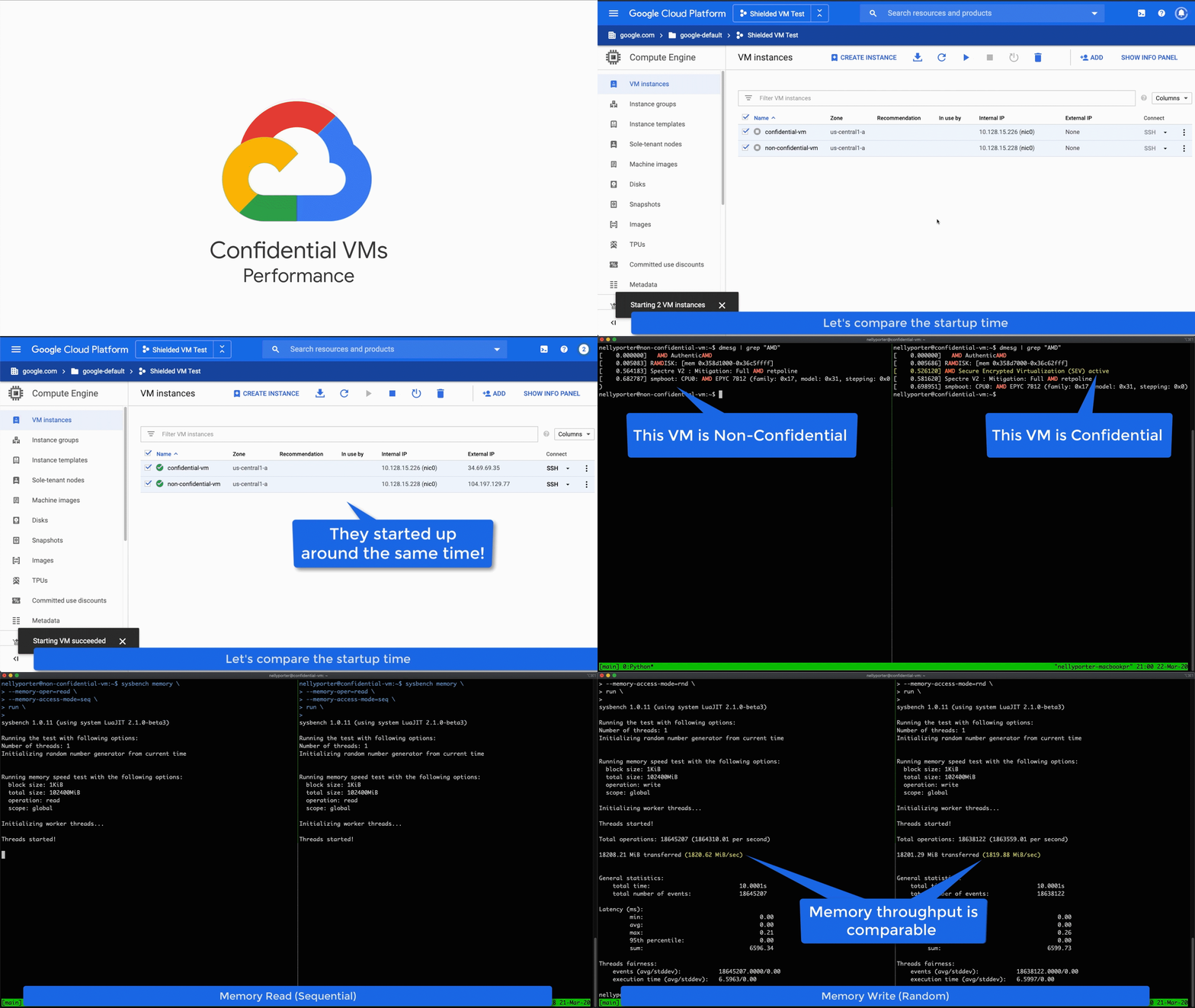
That last part is obviously important, given that the extra encryption and decryption steps do incur at least a minor performance penalty. Google says it worked with AMD and developed new open-source drivers to ensure that “the performance metrics of Confidential VMs are close to those of non-confidential VMs.” At least according to the benchmarks Google itself has disclosed so far, both startup times and memory read and throughput performance are virtually the same for regular VMs and Confidential VMs.

Powered by WPeMatico

NS1 nets $40M ‘true coronavirus fundraise’ amidst surging customer demand

Apparently, the internet is still popular.

With the novel coronavirus marooning people at home for work and play, those “tubes” carrying our data back and forth have become ever more important to our livelihoods. Yet while we often as consumers think of the internet as what we buy from a service provider like Spectrum or TechCrunch’s parent company Verizon, the reality is that businesses need key network services like DNS and IP Address Management in order to optimize their performance and costs.

That’s where New York City-based NS1 has done particularly well. My colleague Ron Miller first covered the company and its founding story for us two years ago, as part of our in-depth look at the New York City enterprise software ecosystem. Fast forward two years, and NS1 couldn’t be doing better: in just the first quarter of this year, new customer bookings were up 159% year over year according to the company, and it currently serves 600 customers.

That traction in a critical infrastructure segment of the market attracted the attention of even more growth capital. Today, the company announced that Energy Impact Partners, which has traditionally invested in sustainable energy startups but has recently expanded into software and internet services, is leading a $40 million Series D round into the startup, bringing its total fundraising to date to $125 million. The round was led by Shawn Cherian, a partner at EIP who just joined the firm at the beginning of June (nothing like getting a deal done your first day on the job).

Kris Beevers, cofounder and CEO of NS1, said that COVID-19 has had a huge impact on the startup’s growth the past few months. “For example, [a] large software customer of ours [said] that our number two KPI for our coronavirus task force is network performance and saturation as managed by NS1.” Customers have made network management significantly higher priority since degradations in latency and reliability can dramatically limit a service’s viability for stay-at-home workers and consumers.

NS1’s Founding Team

“The quip that I have used a few times recently is digital transformation initiatives have compressed from five or ten years down to months or a year at this point. Everybody’s just having to accelerate all of these things,” Beevers said.

The company has doubled down on its key tools like DNS and IP management, but it has also launched new features using feedback from customers. “For example, we launched a VPN steering capability to help our customers optimize their VPN footprints because obviously those suddenly are more important than they’ve ever been,” he said. Virtual Private Networks (VPNs) allow employees to login to their company’s network as if they were physically present in the office.

While NS1 had money in the bank and increasing appetite from customers, the company was also starting a fundraise in the middle of a global pandemic. Beevers said that it was hard at first to get momentum. “April was a dead zone,” he said. “All the VCs were sort of turtle up.”

The tide began to turn by early May as VCs got a handle on their portfolios and started to survey where the opportunities were in the market given the lessons of the early days of COVID-19. “We actually started to get a huge amount of inbound interest in early May timeframe,” he said.

“Call it like a true coronavirus fundraise,” Beevers explained. It was “end to end like less than a month getting to know [Cherian] to term sheet, and all virtual. Partner meeting was all virtual, diligence all virtual. Not a single in-person interaction in the whole fundraising process, and that was the case with everybody else who was involved in the round too, so all the folks that didn’t in the end write the winning term sheet.”

What made Cherian stand out was Energy Impact Partners’ portfolio, which touches on energy, industry and IoT — sectors that are increasingly being digitized and need the kind of internet infrastructure services that NS1 provides. Also, Cherian led a round into Packet, which is a fellow NYC enterprise company that sold to Equinox for more than $300 million. Packet’s founder Zac Smith and Beevers worked together at Voxel and are part of the so-called “Voxel mafia” of infrastructure engineers in Manhattan.

With the new funding, NS1 intends to continue to expand its traction in the network layer while also doubling down on new markets like IoT.

Powered by WPeMatico

Google Cloud’s new BigQuery Omni will let developers query data in GCP, AWS and Azure

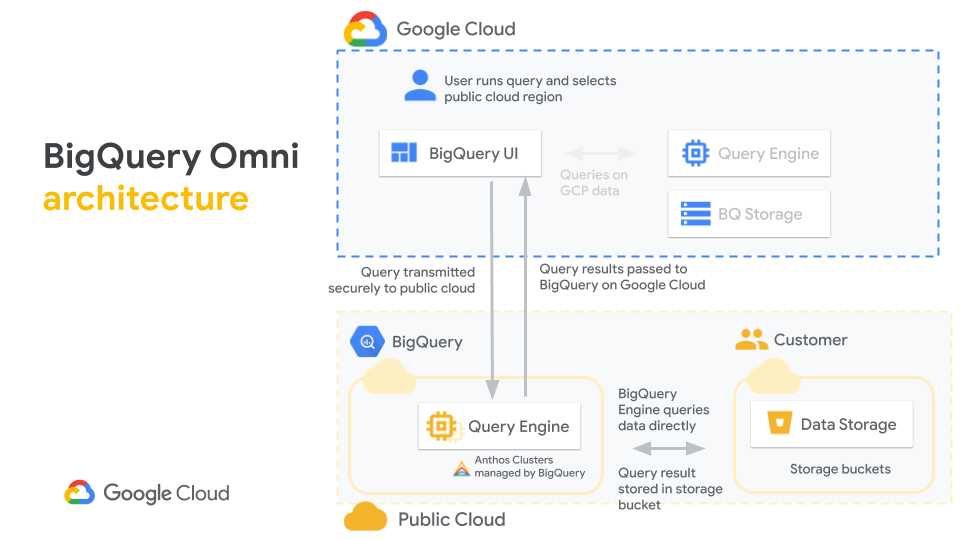
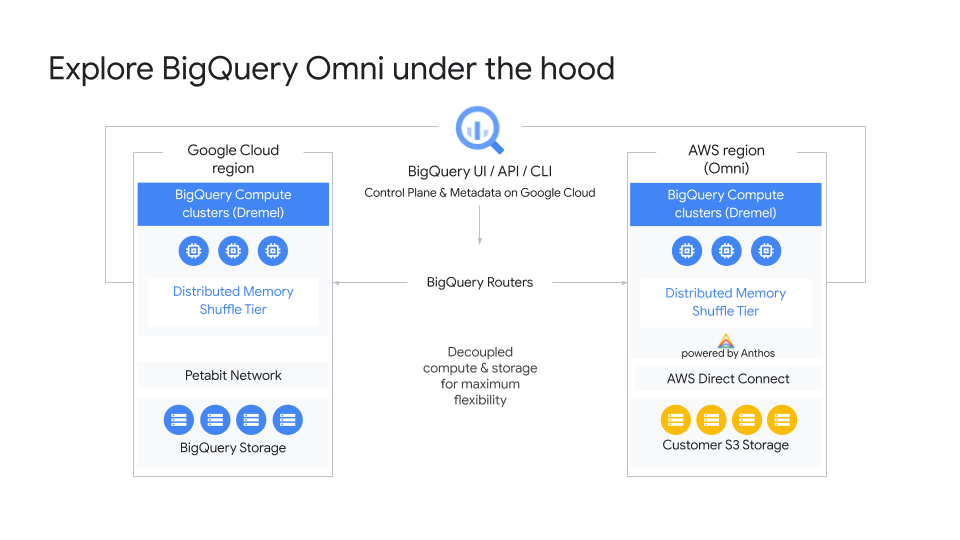
At its virtual Cloud Next ’20 event, Google today announced a number of updates to its cloud portfolio, but the private alpha launch of BigQuery Omni is probably the highlight of this year’s event. Powered by Google Cloud’s Anthos hybrid-cloud platform, BigQuery Omni allows developers to use the BigQuery engine to analyze data that sits in multiple clouds, including those of Google Cloud competitors like AWS and Microsoft Azure — though for now, the service only supports AWS, with Azure support coming later.

Using a unified interface, developers can analyze this data locally without having to move data sets between platforms.

“Our customers store petabytes of information in BigQuery, with the knowledge that it is safe and that it’s protected,” said Debanjan Saha, the GM and VP of Engineering for Data Analytics at Google Cloud, in a press conference ahead of today’s announcement. “A lot of our customers do many different types of analytics in BigQuery. For example, they use the built-in machine learning capabilities to run real-time analytics and predictive analytics. […] A lot of our customers who are very excited about using BigQuery in GCP are also asking, ‘how can they extend the use of BigQuery to other clouds?’ ”

Image Credits: Google

Google has long said that it believes that multi-cloud is the future — something that most of its competitors would probably agree with, though they all would obviously like you to use their tools, even if the data sits in other clouds or is generated off-platform. It’s the tools and services that help businesses to make use of all of this data, after all, where the different vendors can differentiate themselves from each other. Maybe it’s no surprise then, given Google Cloud’s expertise in data analytics, that BigQuery is now joining the multi-cloud fray.

“With BigQuery Omni customers get what they wanted,” Saha said. “They wanted to analyze their data no matter where the data sits and they get it today with BigQuery Omni.”

Image Credits: Google

He noted that Google Cloud believes that this will help enterprises break down their data silos and gain new insights into their data, all while allowing developers and analysts to use a standard SQL interface.

Today’s announcement is also a good example of how Google’s bet on Anthos is paying off by making it easier for the company to not just allow its customers to manage their multi-cloud deployments but also to extend the reach of its own products across clouds. This also explains why BigQuery Omni isn’t available for Azure yet, given that Anthos for Azure is still in preview, while AWS support became generally available in April.

Powered by WPeMatico

Hand-crank a level of Super Mario Bros. on Lego’s new 2,646-piece NES kit

Feel that? That’s the unmistakable and overwhelming sensation of nostalgia for your misspent youth coursing through your blood, as the 35th anniversary of the Nintendo Entertainment System is sneaking up on you. The original NES turns 35 years old tomorrow, and to celebrate another shocking reminder of our own mortality, Lego just announced another fantastic-looking set scheduled to arrive later this summer.

Image Credits: Lego/Nintendo

After a brief tease, the NES Building Kit is now officially official, featuring a buildable console, cartridge and controller (even the RCA ports are present on the system’s side). The game can be loaded into the system and locked in place, and the controller has its own cable that plugs directly into the front. The pièce de résistance, however, is that period-appropriate television set. There’s a buildable 2D Mario that runs and jumps along a level that unfolds and scrolls as you spin a hand crank.

Image Credits: Lego/Nintendo

Honestly, the execution is great. Just really, really clever. It plays on the boxy eight-bit graphics of the classic console, while offering an adorable counterpart to the already announced Mario set. The power of synergy is strong here. The Mario from the other set actually plugs into the top of the TV set once you remove a piece, with its speaker playing out the soundtrack and effects as his 2D counterpart makes his way through the level.

Image Credits: Lego/Nintendo

No word on pricing, but I’m willing to bet that the final price is no object for many fans. Also, knowing what we know about Lego, it seems safe to guess it’s not going to be cheap. There are 2,646 pieces in the set. It’s one of the most technically impressive Lego sets I’ve seen, starting with the detailed accuracy of the console and really taking it up a notch with the crank system that advances the background, as Mario, attached to a stick, bounds up and down. The Mario from the other set, meanwhile, appears to scan for the colors on the series of blocks at the top, outputting the corresponding sounds. 

Honestly, this thing effectively triggers all of the human nostalgia centers simultaneously, and you’re powerless to deny it, so you might as well earmark some cash and set aside some shelf space. If I had to guess, I would put it somewhere in the ballpark of $300. Consider the Mario set the playable one for the kids and this one a complimentary conversation piece for their parents who grew up playing the original system. It’s available through the Lego site (and those brick and mortar stores that happen to be open) starting August , along with the Super Mario set). It will be available at additional retailers at some point next year. 

Powered by WPeMatico

Verizon partners with Airtel to launch BlueJeans in India

Bharti Airtel announced on Tuesday it has partnered with Verizon* to launch BlueJeans video-conferencing service in India to serve business customers in the world’s second largest internet market.

The video conferencing service, branded as Airtel BlueJeans in India, offers “enterprise-grade security” (which includes encrypted calls, ability to lock and password protect a meeting and generate randomized meeting IDs), a cloud point presence in India to enable low latency, HD video and Dolby Voice, and can accommodate up to 50,000 participants on a call.

Gopal Vittal, chief executive of Airtel, said in a call with reporters Tuesday that the Indian telecom operator is exploring ways to bring Airtel BlueJeans to home customers as well, though he cautioned that any such offering would take at least a few weeks to hammer out.

Airtel BlueJeans is being offered to businesses at no charge for the first three months, after which the video conferencing service will be offered at a “very competitive” price, said Vittal. Airtel will offer customized pricing plans for large businesses and small businesses, he added.

Airtel, the third largest telecom operator in India with 300 million subscribers, already maintains a partnership with G Suite and Cisco Webex, and Zoom. However, Vittal said that its collaboration with Verizon was “special” and enabled it to host data in India itself.

Verizon acquired BlueJeans in April this year. At the time, BlueJeans had over 15,000 business customers. Hans Vestberg, chief executive of Verizon, said on Tuesday that the American telecom giant was hopeful that Airtel BlueJeans would make major inroads in the Indian market, though he declined to share any figures.

Vestberg said Verizon is open to extending this partnership with Airtel to serve the Indian telecom operator’s business in African market, though both are currently focused on serving clients in India.

Tuesday’s announcement comes as video conferencing services have gained impressive momentum in India in recent months. Zoom app, which is also available to consumers, has already amassed over 35 million monthly active users in the country, according to mobile insights firm App Annie — data of which an industry executive shared with TechCrunch.

Reliance Jio Platforms, the top telecom operator in India with nearly 400 million subscribers, launched its video conferencing service JioMeet earlier this month. JioMeet is currently available to both consumers and business customers at no charge and a session on the service can last for up to 24 hours.

“We know we are not the first to launch a video conferencing in India, but we are confident that our differentiated offerings and brand value would stand out,” said Vittal.

Airtel BlueJeans, which includes BlueJeans’ Meetings, Events, Rooms, and Gateway for Microsoft Teams functionalities, will go live in India Tuesday evening.

*Verizon is TechCrunch’s parent company.

Powered by WPeMatico

Writing app Ulysses gets new document dashboard and advanced grammar and style check

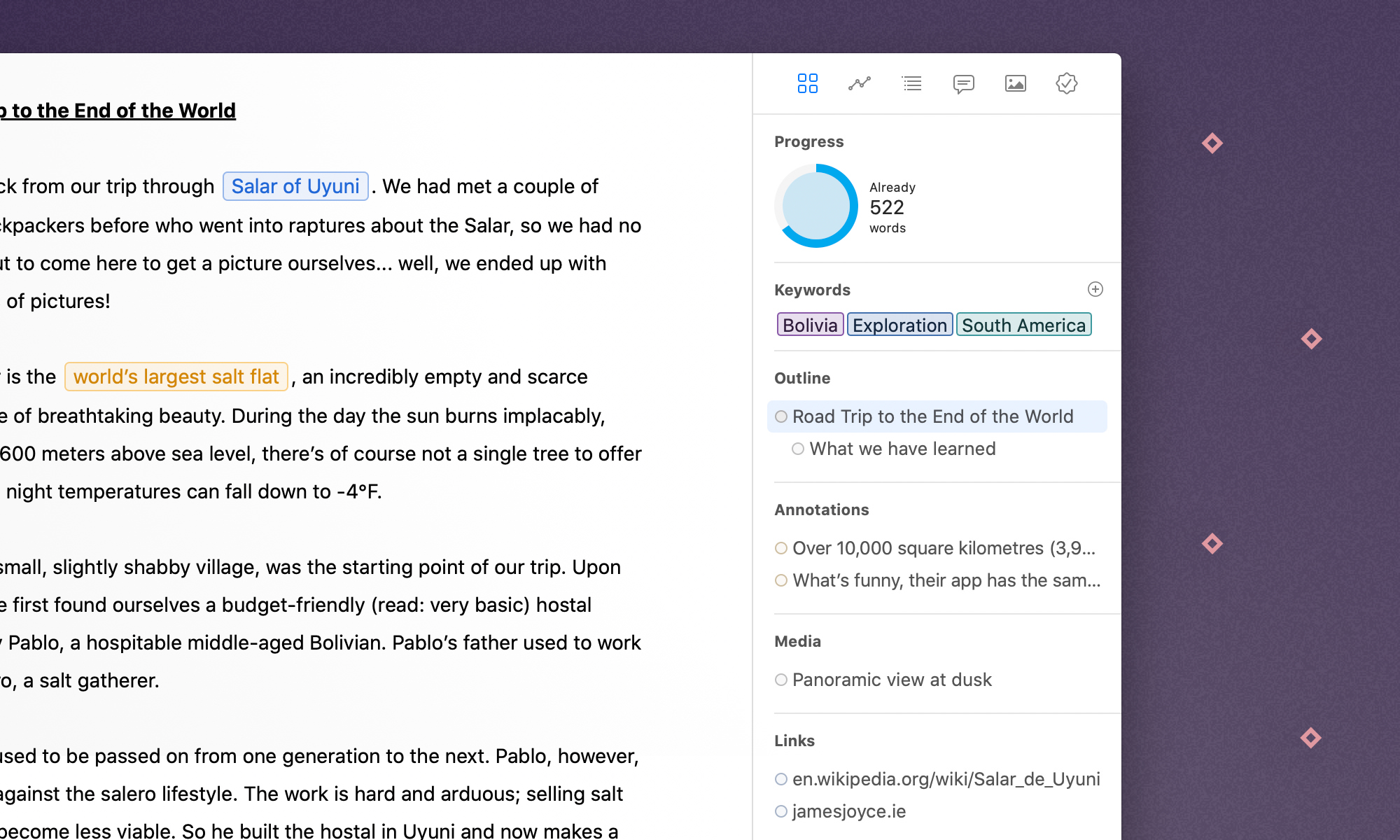
Ulysses, a popular writing app for the Mac, iPhone and iPad, is receiving an update with some new features. The user interface has been slightly redesigned with a new right-hand column that acts as a dashboard. There’s also a new grammar and style check feature that goes beyond what’s provided on Apple’s platform by default.

Let’s start with the dashboard. The new column is all about consolidating existing elements in a more cohesive interface. Previously, you could click on a button to see document statistics, click on another button to see the outline of your document and click on a clip-shaped button to access attachments, notes, tags but also your writing goal.

It was a bit confusing as you couldn’t see your statistics next to your goal. Or you couldn’t keep your outline next to your document unless you knew that you can drag the popover menu so that it doesn’t automatically closes.

Now, everything is consolidated under three buttons — a share menu, a formatting menu and the dashboard. There are multiple tabs within the dashboard and you can customize the widgets that you want to view in most tabs.

For instance, it’s much more comfortable to keep your outline in the right column next to your document. You can click on headlines and sub-headlines to jump to the right part of your work. You can also view a list of all your footnotes, images and links in that view. The new dashboard is also available on the iPad and iPhone.

Image Credits: Ulysses

When it comes to spell checking, Ulysses has always taken advantage of the native features on Apple’s platforms — your words are underlined in red when there’s a typo.

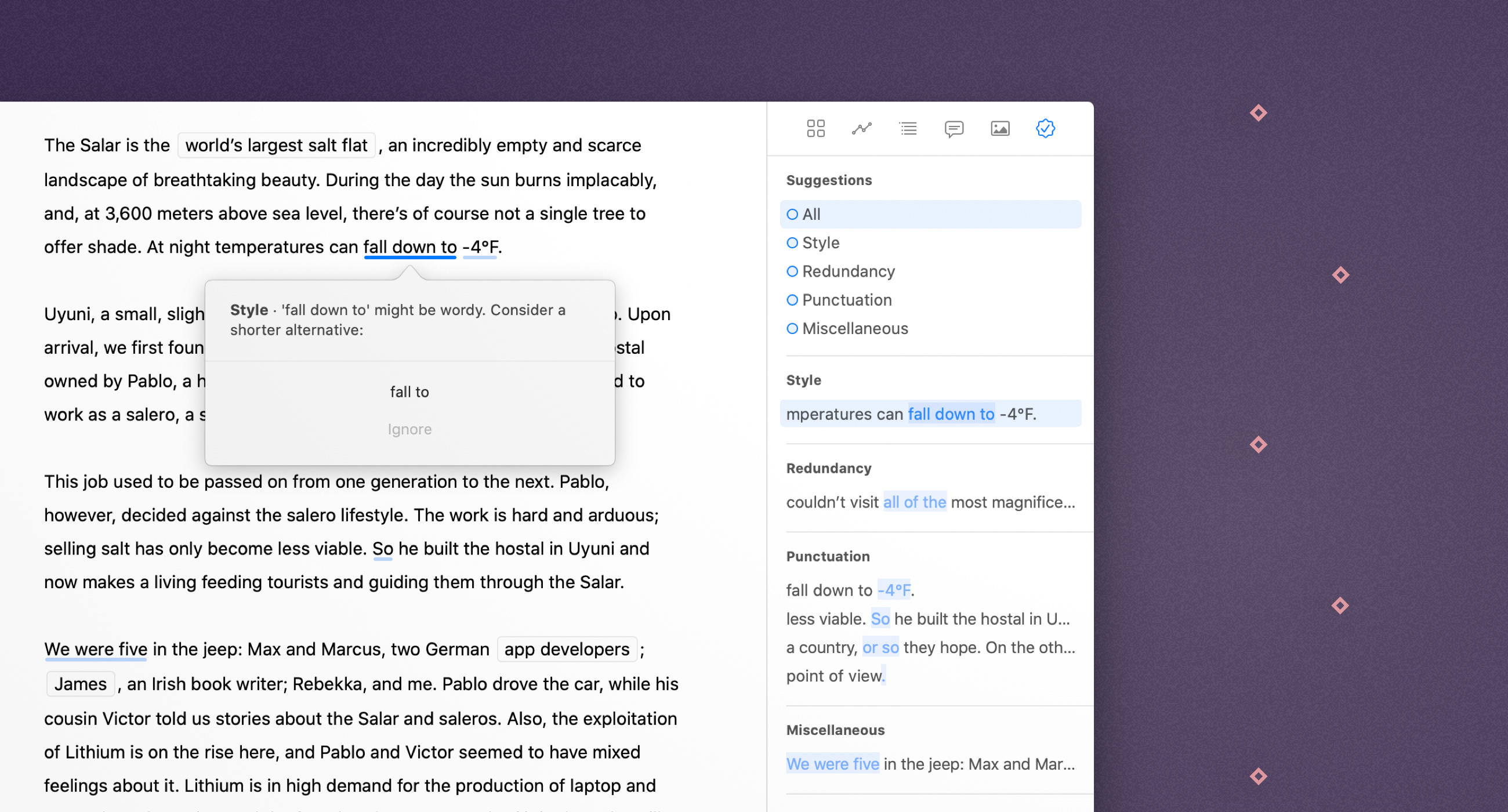
But the new version of Ulysses goes one step further by integrating with LanguageTool Plus, a proofreading service that works in your browser and provides an API to third-party developers. The result is a new feature that lets you review your text before exporting it from Ulysses.

LanguageTool Plus is a freemium product with a paid subscription beyond 2,500 characters. You hit that limit pretty quickly as the article you’re reading is longer than 2,500 characters for instance. If you’re a Ulysses user, the grammar and style suggestions are included in your subscription.

It analyzes your text for typos, but also punctuation errors, redundancy, typography, style, etc. Compared to Grammarly, LanguageTool Plus supports more than 20 languages. You can approve or reject suggestions one by one or browse them by category in the dashboard.

Grammar and style suggestions are only available on the Mac version of Ulysses for now and will come to the iPhone and iPad later this year.

Image Credits: Ulysses

Powered by WPeMatico

App Annie launches ad analytics product Ascend

App Annie is building on last year’s acquisition of analytics company Libring with the launch of a new version of Libring, rebranded as App Annie Ascend.

CEO Ted Krantz told me that while Ascend will be sold to existing App Annie customers, the real hope is to reach “a dramatically different market” as App Annie moves beyond just providing app market data by offering advertising analytics as well — particularly for game publishers and other companies on the supply side of the ad industry.

Krantz argued that with mobile platforms and browsers adding more limitations to user tracking (most recently with Apple’s announcement that it will give users the ability to decline app ad tracking), “the room is going to get pretty dark” for advertisers — creating an opportunity for App Annie’s approach of combining broader market data with a publisher’s own first party data.

To achieve this, Ascend offers what Krantz said are “hundreds of connectors” to pull data from the different platforms like AdColony, Unity and Chartboost, allowing customers to see these data sets “side by side.” Krantz emphasized that this data is very much for the customer’s own use and will be “quarantined” from App Annie’s larger market data, at least initially.

“Over time, we have the ability to open that up [for] benchmarking data,” he said, adding that this approach is part of what makes Ascend unique: “You’ve got to have that benchmarking data from your peer group. Without the market data, you can’t be certain you’re making the right calls.”

Companies already using Ascend include Reddit and Jam City.

”Ascend takes away the burden of integrating, maintaining and constantly updating dozens of APIs, allowing us to focus on what matters: achieving our KPIs and improving our campaigns,” said Reddit’s director of marketing Spiros Christakopoulos in a statement. “
Thanks to the critical insights Ascend provides, via its well designed reporting tools, it has become an essential part of our marketing analytics infrastructure.”

Powered by WPeMatico

BigCommerce files to go public

As expected, BigCommerce has filed to go public. The Austin, Texas, based e-commerce company raised over $200 million while private. The company’s IPO filing lists a $100 million placeholder figure for its IPO raise, giving us directional indication that this IPO will be in the lower, and not upper, nine-figure range.

BigCommerce, similar to public market darling Shopify, provides e-commerce services to merchants. Given how enamored public investors are with its Canadian rival, the timing of BigCommerce’s debut is utterly unsurprising and is prima facie intelligent.

Of course, we’ll know more when it prices. Today, however, the timing appears fortuitous.

The numbers

BigCommerce is a SaaS business, meaning that it sells a digital service for a recurring payment. For more on how it derives revenue from customers, head here. For our purposes what matters is that public investors will classify it along with a very popular — today’s trading notwithstanding — market segment.

Starting with broad strokes, here’s how the company performed in 2019 compared to 2018, and Q1 2020 in contrast to Q1 2019:

  • In 2019, BigCommerce’s revenue grew to $112.1 million, a gain of around 22% from its 2018 result of $91.9 million.
  • In Q1 2020, BigCommerce’s revenue grew to $33.2 million, up around 30% from its Q1 2019 result of $25.6 million.

BigCommerce didn’t grow too quickly in 2019, but its Q1 2020 expansion pace is much better. BigCommerce will file an S-1/A with more information in Q2 2020, we expect; it can’t go public without sharing more about its recent financial performance.

If the company’s revenue growth acceleration continues in the most recent period — bearing in mind that e-commerce as a segment has proven attractive to many businesses during the COVID-19 pandemic — BigCommerce’s IPO timing would appear even more intelligent than it did at first blush. Investors love growth acceleration.

Moving from revenue growth to revenue quality, BigCommerce’s Q1 2020 gross margins came in at 77.5%, a solid SaaS result. In Q1 2019 its gross margin was 76.8%, a slightly worse figure. Still, improving gross margins are popular as they indicate that future cash flows will grow at a faster clip than revenues, all else held equal.

In 2018 BigCommerce lost $38.9 million on a GAAP basis. Its net loss expanded modestly to $42.6 million in 2020, a larger dollar figure in gross terms, but a slimmer percent of its yearly top line. You can read those results however you’d like. In Q1 2020, however, things got better, as the company’s GAAP net loss fell to $4 million from its year-ago Q1 result of $10.5 million.

The BigCommerce big commerce business is growing more slowly than I had anticipated, but its overall operational health is better than I expected.

A few other notes, before we tear deeper into its S-1 filing tomorrow morning. BigCommerce’s adjusted EBITDA, a metric that gives a distorted, partial view of a company’s profitability, improved along similar lines to its net income, falling from -$9.2 million in Q1 2019 to -$5.7 million in Q1 2020.

The company’s cash flow is, akin to its adjusted EBITDA, worse than its net loss figures would have you guess. BigCommerce’s operating activities consumed $10 million in Q1 2020, an improvement from its Q1 2019 operating cash burn of $11.1 million.

The company is further in debt than many SaaS companies, but not so far as to be a problem. BigCommerce’s long-term debt, net of its current portion, was just over $69 million at the end of Q1 2020. It’s not a nice figure, per se, but it is one small enough that a good IPO haul could sharply reduce while still providing good amounts of working capital for the business.

Investors listed in its IPO document include Revolution, General Catalyst, GGV Capital, and SoftBank.

Powered by WPeMatico