1010Computers | Computer Repair & IT Support

Plum raises $10M for its ‘smart’ money management app

Plum, the London and Athens-based fintech that offers a “smart” money management app to help you improve your “financial resilience,” has raised a further $10 million in funding as it gears up for European expansion.

The new round is led by Japan’s Global Brain and the European Bank for Reconstruction and Development, which has participated in previous Plum funding rounds.

In addition, the company has received further funding from early backer VentureFriends, matched by the U.K. taxpayer via the U.K. government’s Future Fund scheme. Plum has raised $19.3 million in total since being founded by Victor Trokoudes (an early TransferWise employee) and Alex Michael in 2016.

Launched in the U.K. the following year, Plum is one of a number of fintech startups that is vying to become a user’s financial hub or control centre, in a way that goes far beyond the first generation of personal finance manager apps and bank account aggregators.

You link the app to your bank account and gain access to a range of functionality, including savings, investments and analysis of your utility bills to help you make better purchasing decisions. Like similar apps, Plum’s “artificial intelligence” also deems what you can afford to save by analysing your bank transactions. It then puts money away each month in the form of round-ups and/or regular savings.

You can open an ISA investment account and invest based on themes, such as only in “ethical companies” or technology. Another related feature is “Splitter,” which, as the name suggests, lets you split your automatic savings between Plum savings pots and investments, selecting the percentage amounts to go into each pot, from 0-100%.

In a call with Trokoudes, he talked me through a few recent Plum updates that he says bring it much closer to fulfilling its financial control centre mission and being a candidate to replace your individual banking apps.

Crucially, you can now link all of your accounts to Plum, whereas previously Plum only let you access a single linked bank account. This gives you “full visibility” of your saving, spending and investments all in a single app.

On the roadmap is also the ability to make payments via Open Banking — and Trokoudes doesn’t rule out a Plum card in the future as a complementary feature with additional benefits, not a core offering, unlike numerous competitors.

More immediately, Plum is launching interest for savers who use Plum to set money aside but don’t want to invest any or all of it. Paid users are being offered an interest rate of 0.6% for instant access savings and 0.75% for 95 days’ notice. Plum users on its free tier can earn 0.35% interest.

Trokoudes explained that there’s also the option to split a percentage of the money put aside automatically, allocating deposits between the new interest-bearing account and Plum-powered investments.

Meanwhile, armed with fresh capital, Plum plans to launch in Spain and France by the end of 2020. The company claims 1 million registered users in the U.K., and now employs more than 60 people split across London, U.K. and Athens, Greece. Trokoudes tells me it will scale up further to 80 employees by the end of 2020 and is aiming for 5 million users across Europe by the end of 2021.

Adds Naoki Kamimaeda, partner and Europe office representative at Global Brain Corporation: “More users have started using fintech apps and personal financial management apps across the globe, to be more efficient and be better off. Among these fintech apps, Plum has a very unique position and very bold ambition to be a partner of individuals to save more money and manage their financial life in an easier and more effective manner.”

Powered by WPeMatico

Gett raises $100M more to double down on its B2B on-demand ride business

A number of on-demand ride hailing companies are feeling the strain from reduced business, with many consumers still reluctant to travel, and especially to travel in surroundings that might increase the risk of spreading or catching the novel coronavirus. But today, one of the startups in the space is announcing a significant round of funding to continue growing in its target sector of corporate travel, underscoring where there may still be some existing and growing opportunities.

Gett, the London and Israel-based company that competes with the likes of Uber and many others to provide private car rides on-demand, has raised $100 million. Gett’s CEO and founder Dave Waiser told TechCrunch that the funding is all primary equity capital, and the company says it plans to use it to continue investing in its B2B business, which has been growing — not shrinking or staying flat — in the midst of the global health pandemic.

“The way people move around in cities is changing dramatically as a result of COVID-19 and businesses are seeking to optimise costs and to put in place efficient and safe ground travel solutions for their employees,” said Waiser, in a statement. “Our mobility software is helping businesses thrive by empowering people to be their best on the go. Being fully funded and reaching a key milestone in our profitability journey is an important step for the company. The proceeds will help us grow our unique corporate SaaS platform internationally, while we consider an IPO in the future, to further accelerate our expansion.”

The company turned operationally profitable in December 2019 and had said it planned to go public in 2020, but it sounds like that timeline, if it happens, has now been pushed back to 2021. Gett says it has met its “original financial targets that were set pre-COVID-19.” It also reached profitability in each of its core markets in June, and is on target now to be cash flow positive in 2021, ahead of a “potential” IPO.

“It’s a luxury, enabling flexibility for the company to go public when it’s best, rather than from the cash needs reasoning as many (money-losing) companies have to do nowadays,” Waiser said in an interview.

Gett is not disclosing the names of any of its investors in this round except to note that it’s a mix of new and existing backers, nor is it disclosing its valuation.

Waiser said the reason for that is that the round is still being expanded after getting oversubscribed, so it plans to announce a list of investors (and valuation?) after the expansion closes.

For some context, though, Gett has now raised $750 million, with investors including VW, Access and its founder Len Blavatnik, Kreos, MCI and more, and its last valuation was $1.5 billion, pegged to a $200 million fundraise in May 2019.

Gett started operations years ago serving both consumers and corporate users going head-to-head with the Ubers of the world for app-based, on-demand rides, but it had always differentiated its positioning by working with (in London) the “black cabs” and in NYC “yellow cabs” — that is, the established infrastructure of ride-hailing.

In recent years, it has honed its focus specifically on business accounts. No surprise, when you think about it, considering the capital intensiveness, competitiveness and subsequent poor unit economics of scaling a consumer-focused ridesharing business (a confluence of factors we’ve seen played out at Uber, Lyft, Grab and many others).

Gett’s turn to B2B has seen it pick up some 15,000 corporate customers, including one-third of the Fortune 500.

What has been interesting too is the approach Gett has taken to scale: Today, it provides rides in some 1,500 cities, but a large part of that footprint is served not directly by Gett. One of its key partners is Lyft — the result of a deal Gett inked with the company in November 2019 after Gett shut down its Juno operations in New York City. And it’s been expanding that list to include other third-party partnerships in the mix.

Partnerships may not yield margins as strong as those Gett has with direct operations. Gett still is the direct link between drivers and riders in its key markets, which include cities like London and Moscow. (It’s not disclosing what percentage of its business today is direct versus via third-party businesses.)

But on the other hand, Gett has been building its business by providing a plethora of analytics and invoicing services around the actual ride, and what it makes by securing corporate accounts on the back of that software becomes a revenue stream to offset the decline in margins from partnerships. Gett claims that its services ultimately undercut by about 25% other ground transportation options for corporates.

While a lot of consumers may have curtailed their Uber rides in recent months, the business market has seen a turn to ensuring that the travel that its users are taking is well-controlled when it has to be done, specifically to meet specific safety standards. That has been the sweet spot for Gett, with its very specific B2B approach.

“The completion of the fundraising during the pandemic is a clear expression of confidence by our shareholders and new investors in Gett’s vision to focus on the corporate market and its plan to expand globally, as well as in the Company’s strong operational and financial performance,” said Amos Genish, Gett chairman, in a statement.

Powered by WPeMatico

Higher Steaks brings home the bacon, revealing lab-grown pork belly and bacon strips

In what could be a starting gun for the commercialization of the cell-based meat business, upstart cultivated meat company Higher Steaks said it has managed to produce samples of its first products — bacon strips and pork belly made in a lab from cellular material.

With the revelation, Higher Steaks, a bootstrapped Cambridge, U.K.-based company, leapfrogs into a competitive position with a number of far larger companies that have raised far more capital.

“There’s still a lot of work until it’s commercial,” said Higher Steaks chief executive Benjamina Bollag, “but the revelation of a pork belly product that’s made from 50% cultivated cells and a bacon product which contains 70% meat grown from a cell material in a laboratory is something of a milestone for the industry.”  

The remaining ingredients in Higher Steaks bacon and pork belly are a mixture of plant base, proteins, fats and starches to bind the cellular material together. To achieve this first step on its road to commercialization, Higher Steaks tapped the expertise of an undisclosed chef to formulate the meat into an approximation of the pork belly and bacon.

Higher Steaks head of research and development, Ruth Helen Faram (left) and chief executive Benjamina Bollag (right) Image Credits: Higher Steaks (opens in a new window)

At this stage, the pilot was more to show what Higher Steaks can do rather than what the company will do, said Bollag.

“In the future it will be scaffolding,” said Bollag. “It’s more showing what our meat can do and what we’re working on. In the future it will be with scaffolding.”

A number of companies, including Tantti Laboratories, Matrix Meats and Prellis Biologics, make the kind of biomaterial nano-scale scaffolding that could be used as a frame on which to grow structures equivalent to the fibrous textures of muscle.

The commercial viability of products from companies like Higher Steaks, Memphis Meats, Aleph Farms, Meatable, Integriculture, Mosa Meat and Supermeat depends on more than just companies like Tantti and Matrix, but also on the ability of Thermo Fisher, Future Fields and Merck to bring down the cost of the cell cultures that are required to grow the animal cells.

In all, some 30 cell-based meat startups have launched globally since 2014, and they’re all looking for a slice of the $1.4 trillion meat market.

Meanwhile, demand for pork continues to rise even as supplies have been decimated by an outbreak of African Swine Fever that could have killed as much as 40% of China’s population of pigs in 2019.

“Our mission is to provide meat that is healthy and sustainable without the consumer making any sacrifices on taste,” said Bollag in a statement. “The production of the first ever cultivated bacon and pork belly is proof that new techniques can help meet overwhelming demand for pork products globally.”

Given the highly capitalized competitors that Higher Steaks faces off against, the company is looking for industry partners to help commercialize its technology.

To improve its competitive position, Higher Steaks recently hired Dr. James Clark, the former chief technology officer of PredictImmune.

“I was always quite intrigued by cultured meat production, a mix of both science and food production. In 2013 I watched the first cultured meat burger from Mark Post costing £250,000, cooked on the BBC,” said Clark. “I was approached about joining Higher Steaks earlier this year and was attracted to joining primarily by the science along with the ambition and energy of the Higher Steaks founder Benjamina Bollag . I believe Higher Steaks is a company with a technology to be disruptive in the cultured meat area and at my career stage I was looking for a challenge.”

Brought in to scale the cultivated meat process at Higher Steaks, Clark has led the development of biotech and pharma products at early-stage and publicly traded companies.

“The addition of Dr. James Clark to the team gives Higher Steaks a significant advantage,” said Dr. Ruth Helen Faram, head of R&D. “Cultivated pork belly and bacon have never been demonstrated before and Higher Steaks is the first to develop a prototype containing over 70% cultivated pork muscle, without the use of bovine serum.”

Consumers shouldn’t expect to see Higher Steaks’ pork belly on store shelves or in restaurants anytime soon, Bollag cautioned. “We’re still in the thousands of pounds per kilogram.”

The company does expect to have a larger tasting event later this year.

Powered by WPeMatico

Former SoundCloud founders launch e-bike subscription service, backed by BlueYard

You’ve heard of e-bike and e-scooter rental startups spreading across cities. But today three veterans of the startup world will launch what appears to be a brand new take on the “e-revolution” sweeping cities in the wake of the global pandemic: subscription e-bikes, or, if you will, “EaaS” or “E-bikes-as-a-Service.” The previous founders of SoundCloud and Jimdo will today launch Dance, a new subscription e-bike service, backed by a stellar lineup of European investors.

The invite-only program kicks-off first in Berlin, with an all-inclusive service package of a €59-a-month “introductory price” and its own design of e-bike. The founders’ goal is to emphasize the community aspects of the rental service, just as they did with SoundCloud.

Dance is co-founded by SoundCloud founders Eric Quidenus-Wahlforss and Alexander Ljung, together with the co-founder of Jimdo, Christian Springub. While Quidenus-Wahlforss and Ljung are best known for co-founding SoundCloud more than 10 years ago as CTO and CEO, respectively, Quidenus-Wahlforss is taking the CEO role this time, while Ljung will be chairman. Ljung remains chairman of SoundCloud in the meantime.

The main institutional backer is Berlin-based VC BlueYard Capital, together with entrepreneurs and investors such as Ilkka Paananen (founder & CEO Supercell), Jeannette zu Fürstenberg (La Famiglia), Kevin P. Ryan (founder & CEO, AlleyCorp), Neil Parikh (founder & CSO Casper), Bjarke Ingels (founder & CEO BIG Architects) and several others.

Here’s how it will work: Users will download an app and register for the service. A fully assembled e-bike is delivered to a subscriber within 24 hours. If the bike needs maintenance or gets stolen, the user alerts Dance via the app and the bike is replaced “immediately.” That’s more or less it. Here’s the current design of the bike:

Image Credits: Dance

However, a specially designed Dance e-bike will look closer to this rendering at launch:

Image Credits: Dance

Quidenus-Wahlforss, co-founder and CEO of Dance said: “Dance means having a state-of-the-art e-bike always and only available to you, but without the hassle of buying and owning it… Dance is the perfect solution for those who are looking for a healthy, environmentally friendly, time-saving and joyful form of mobility.”

“We are convinced that Dance provides the missing piece of the puzzle at the right time to accelerate a broad and lasting movement from individual car ownership to daily use of e-bikes,” he added.

The startup notes that 45% of Germans are interested in owning an e-bike, while the European market is projected to double by 2025, according to some estimates.

This could be a disruptive moment in the e-bike space. E-bikes are generally considered the fastest and most efficient means of individual urban transport on routes up to 10 kilometres, but the pandemic has put new emphasis on their utility.

But with an average purchasing price of €2,300, e-bikes can be expensive and have a higher probability of being stolen, leaving many consumers out of the market.

At the same time, more than 930 kilometres of new cycling infrastructure have been implemented in Europe since March due to the COVID-19 pandemic, which has shifted populations away from “risky” public transport.

Ljung commented: “You save time and you save the environment. You exercise, but you don’t sweat. And besides that, riding an e-bike is simply joyful. Music was one of the first industries to experience the shift from ownership to subscription. At SoundCloud we helped usher in this transformation… Now we want to transfer this experience to the mobility space and start a movement that will ultimately make our cities more livable.”

Springub added: “We have carefully analyzed the mobility market in the past years and we are deeply concerned that despite the new options out there and the clear necessities set by climate protection, car ownership continues to be high, along with all its negative implications such as congestion and pollution.”

Powered by WPeMatico

After numerous rejections, Struck’s dating app for the Co-Star crowd hits the App Store

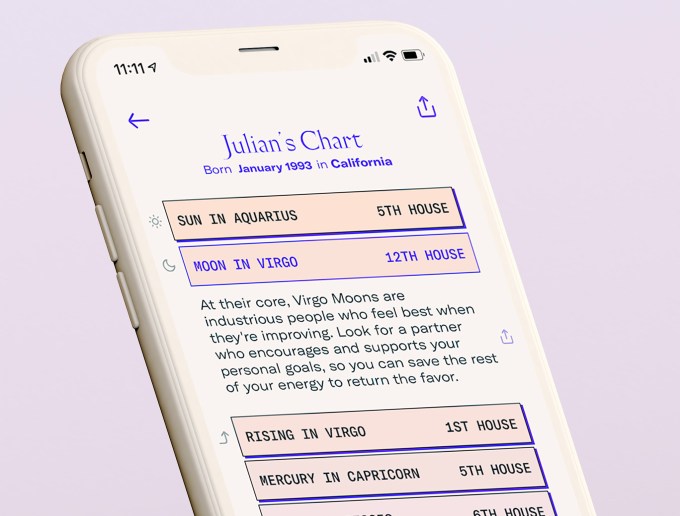
Founded by former Apple engineers, a new app called Struck wants to be the Tinder for the Co-Star crowd. In other words, it’s an astrology-based matchmaker. But it took close to 10 attempts over several months for the startup to get its app approved by Apple for inclusion in the App Store. In nearly every rejection, app reviewers flagged the app as “spam” either due to its use of astrology or, once, simply because it was designed for online dating.

Apple continually cited section 4.3 of its App Store Review Guidelines in the majority of Struck’s rejections, with the exception of two that were unrelated to the app’s purpose. (Once, it was rejected for use of a broken API. Another rejection was over text that needed correction. It had still called itself a “beta.”)

The 4.3 guideline is something Apple wields to keep the App Store free from what it considers to be clutter and spam. In spirit, the guideline makes sense, as it gives Apple permission to make more subjective calls over low-quality apps.

Today, the guideline states that developers should “avoid piling on to a category that is already saturated,” and reminds developers that the App Store has “enough fart, burp, flashlight, fortune telling, dating, and Kama Sutra apps, etc. already.”

In the document, Apple promises to reject anything that “doesn’t offer a high-quality experience.”

Image Credits: Struck

This guideline was also updated in March to further raise the bar on dating apps and create stricter rules around “fortune-telling” apps, among other things.

Struck, unfortunately, found itself in the crosshairs of this new enforcement. But while its app may use astrology in a matchmaking process, its overall design and business model is nowhere close to resembling that of a shady “fortune-telling” app.

In fact, Struck hasn’t even implemented its monetization model, which may involve subscriptions and à la carte features at a later date.

Rather, Struck has been carefully and thoughtfully designed to provide an alternative to market leaders like Tinder. Built by a team of mostly women, including two people of color and one LGBTQ+ team member, the app is everything mainstream dating apps are not.

Image Credits: Struck

Struck doesn’t, for example, turn online dating into a Hot-or-Not style game. It works by first recommending matches by way of its understanding of users’ detailed birth charts and aspects. But you don’t have to be a true believer in astrology to enjoy the experience. You can use the app just for fun if you’re open-minded, the company website says. “Skeptics welcome,” it advertises.

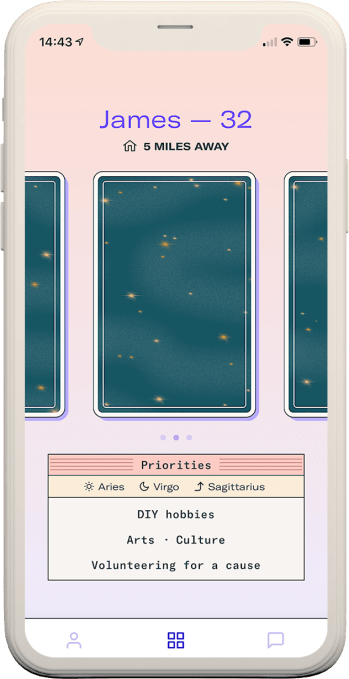
And while Tinder and others tend to leverage psychological tricks to make their apps more addictive, Struck aims to slow things down in order to allow users to once again focus on romance and conversations. There are no endless catalogs of head shots to swipe upon in Struck. Instead, it sends you no more than four matches per day and you can message only one of the four.

Image Credits: Struck

The app’s overall goal is to give users time to analyze their matches’ priorities and values, not just how they appear in photos.

If anything, this is precisely the kind of unique, thoughtfully crafted app the App Store should cater to, not the kind it should ban.

“We come from an Apple background. We come from a tech background. We were very insistent on having a good, quality user interface and user experience,” explains Struck co-founder and CEO Rachel Lo. “That was a big focus for us in our beta testing. We honestly didn’t expect any pushback when we submitted to the App Store,” she says.

Image Credits: Struck

But Apple did push back. After first submitting the app in May, Struck went through around nine rounds of rejections where reviewers continued to claim it was spam simply for being an astrology-based dating application. The team would then pull out astrology features hoping to get the app approved… with no luck. Finally, one reviewer told them Struck was being rejected for being a dating app.

“I remember thinking, we’re going to have to shut down this project. There’s not really a way through,” recounts Lo. The Struck team, in a last resort, posted to their Instagram page about their struggles and how they felt Apple’s rejections were unfair given the app’s quality. Plus, as Lo points out, the rejection had a tinge of sexism associated with it.

“Obviously, astrology is a heavily female-dominated category,” she says. “I took issue with the guideline that says ‘burps, farts and fortune-telling apps.’ I made a fuss about that verbiage and how offensive it is for people in most of the world who actually observe astrology.”

Image Credits: Struck

Despite the founders’ connections within the technology industry, thanks to their ex-Apple status and relationships with journalists who would go on to plead their case, Struck was not getting approved.

Finally, after several supporters left comments on Apple VP Lisa Jackson’s Instagram where she had posted about WWDC, the app was — for unknown reasons — suddenly given the green light. It’s unclear if the Instagram posts made a difference. Even the app reviewer couldn’t explain why the app was now approved, when asked.

The whole debacle has soured the founders on the way Apple today runs its App Store, and sees them supportive of the government’s antitrust investigations into Apple’s business, which could result in new regulations.

“We had no course of action. And it felt really, really wrong for this giant company to basically be squashing small developers, says Lo. “I don’t know what’s going to become of our app — we hope it’s successful and we hope we can build a good, diverse business from it,” she continues. “But the point was that we weren’t even being given the opportunity to distribute our app that we had spent nine months building.”

Image Credits: Struck

Though Apple is turning its nose up at astrology apps, apparently, you don’t have to take astrology to heart to have fun with apps like Struck or those that inspired it, such as Co-Star. These newer Zodiac apps aren’t as obsessed with predicting your future as they are with offering a framework to examine your emotions, your place in the world and your interpersonal relationships. That led Co-Star to snag a $5 million seed round in 2019, one of many astrology apps investors were chasing last year as consumer spend among the top 10 in this space jumped 65% over 2018.

Struck, ultimately, wants to give the market something different from Tinder, and that has value.

“We want to challenge straight men since it is — quote unquote — a traditionally feminine-looking app,” says Lo. “For us, it’s 2020. It’s shocking to us that every dating app looks like a slot machine. We want to make something that has a voice and makes women feel comfortable. And I think our usership split between the genders kind of proved that.”

Struck is live today on the App Store — well, for who knows how long.

It initially caters to users in the Bay Area and LA and will arrive in New York on Friday. Based on user feedback, it will slowly roll out to more markets where it sees demand.

Powered by WPeMatico

Jamf ups its IPO range, now targets a valuation of up to $2.7B

Today Jamf, a software company that helps other firms manage their Apple devices, raised its IPO price range.

The company had previously targeted a $17 to $19 per-share range. A new SEC filing from the firm today details a far higher $21 to $23 per-share IPO price interval.

Jamf still intends to sell up to 18.4 million shares in its debut, including 13.5 million in primary stock, 2.5 million shares from existing shareholders and an underwriter option worth 2.4 million shares. The whole whack at $21 to $23 per share would tally between $386.4 million and $423.2 million, though not all those funds would flow to the company.

At the low and high-end of its new IPO range, Jamf is worth between $2.44 billion and $2.68 billion, steep upgrades from its prior valuation range of $1.98 billion to $2.21 billion.

Jamf follows in the footsteps of recent IPOs like nCino, Vroom and others in seeing demand for its public offering allow its pricing to track higher the closer it gets to its public offering. Such demand from public-market investors indicates there is ample demand for debut shares in mid-2020, a fact that could spur other companies to the exit market.

Coinbase, Airbnb and DoorDash are three such companies that are expected to debut in the next year’s time, give or take a quarter or two.

Results, multiples

In anticipation of the Jamf debut that should come this week, let’s chat about the company’s recent performance.

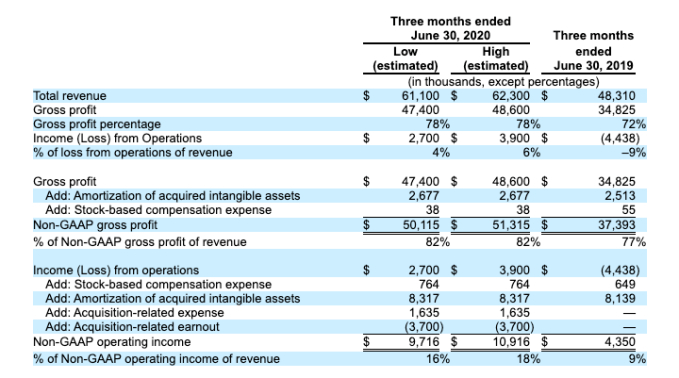
Observe the following table from the most-recent Jamf S-1/A:

From even a quick glance we can learn much from this data. We can see that Jamf is growing, has improving gross margins and has managed to swing from an operating loss to operating profit in Q2 2020, compared to Q2 2019. And, for you fans out there of adjusted metrics, that Jamf managed to generate more non-GAAP operating income in its most recent period than the year-ago quarter.

In more precise terms:

  • Jamf grew from 26.5% to 29.0% on a year-over-year basis in Q2 2020
  • Its gross margin grew by 6% in gross terms, and 8.3% in relative terms
  • Its non-GAAP operating income grew 123.4%, to 150.9% in Q2 2020 compared to the year-ago quarter

Profits! Growth! Software! Improving margins! It’s not a huge surprise that Jamf managed to bolster its IPO price range.

Finally, for the SaaS-heads out there, the following:

This data lets us have a little fun. Recall that we have seen possible valuations for Jamf at IPO that started at $1.98 billion to $2.21 billion, and now include $2.44 billion and $2.68 billion? With our two ARR ranges for the end of Q2, we can now come up with eight ARR multiples for Jamf, from the low-end of its initial IPO price estimate, to the top-end of its new range.

Here they are:

  • Multiple at $1.98 billion valuation and $238 million ARR: 8.3x
  • Multiple at $1.98 billion valuation and $241 million ARR: 8.2x
  • Multiple at $2.21 billion valuation and $238 million ARR: 9.3x
  • Multiple at $2.21 billion valuation and $241 million ARR: 9.2x
  • Multiple at $2.44 billion valuation and $238 million ARR: 10.3x
  • Multiple at $2.44 billion valuation and $241 million ARR: 10.1x
  • Multiple at $2.68 billion valuation and $238 million ARR: 11.3x
  • Multiple at $2.68 billion valuation and $241 million ARR: 11.2x

From that perspective, the pricing changes feel a bit more modest, even if they work out to a huge spread on a valuation basis.

Regardless, this is the current state of the Jamf IPO. Rackspace also filed a new S-1/A today, but we can’t find anything useful in it. A bit like the Jamf S-1/A from Friday. Perhaps we’ll get a new Rackspace document soon with pricing notes.

And, of course, like the rest of the world we await the Palantir S-1 with bated breath. Consider that our white whale.

Powered by WPeMatico

Roblox launches Party Place, a private venue for virtual birthday parties and other meetups

The coronavirus pandemic and related government lockdowns have led to a surge in online gaming — particularly on social platforms where people can connect with real-life friends in a virtual venue. We’ve already heard of Fortnite birthday parties, Roblox playdates and Animal Crossing meetups taking place online amid the pandemic. Now, Roblox is launching a new feature called “Party Place” to directly cater to the growing demand among users for a dedicated, private place to host virtual events.

The company’s new “Party Place” venue is based on the technology the gaming company built to accommodate its own virtual events, including its 7th Annual Bloxy Awards and the One World: Together At Home concert, hosted in April in collaboration with Lady Gaga.

The venue itself doesn’t offer any activities or games, but rather serves as a private place for Roblox users to gather — for example, for a virtual birthday party, a remote learning activity with classmates, for virtual playdates, or anything else. From Party Place, the group can chat and hang out as they decide which Roblox game they plan to play next.

The product is in beta testing, according to the Roblox website, and has seen only around 45.3,000 visits since its launch last week. Likely, many of these visits were just from curious kids poking around in a public area as you can today join the Party Place venue without a private server if you want to just see the venue. Roblox, however, says it’s making private servers available for free in Party Place, so parents and kids can create a place where only those friends they directly invite can join and play.

Roblox has been doing particularly well as the pandemic has forced children to stay at home under lockdown. The entertainment platform now has more than 120 million active monthly players and, as of June, surpassed a milestone of $1.5 billion in lifetime player spending, according to a report from Sensor Tower. It hit the new record only seven months after reaching its $1 billion milestone — a surge in consumer spend attributed directly to the global COVID-19 pandemic and the related growth in entertainment platforms and social gaming.

In March, Roblox revenue grew 28% month-over-month to $69.8 million, the report found. In April, revenue grew 34% to $93.2 million. And by May, sales hit close to $103 million.

Roblox had already begun catering to players’ interest in social gaming with its launch of its “Play Together” game sort in April, which made it easier for players to find those games where you socialize with others — like visiting a virtual shopping mall, going camping or riding virtual water slides, for example. These games also offer an option for private VIP servers, often for a small fee paid in Roblox’s virtual currency, Robux, which is renewed on a subscription basis until you cancel.

Of course, the company isn’t the only one developing products in response to user demand for online “hangout” spots in virtual worlds. Fortnite, for instance, introduced “Party Royale,” a game mode offering a weapons-free party island featuring mini-games and, sometimes, even live concerts. Its Travis Scott concert was hosted in the game, attracting 12.3 million concurrent players at its peak.

For today’s younger players — the COVID kids, so to speak — platforms like Fortnite and Roblox are becoming their own version of a social network. The kids don’t just go online to play. They socialize, chat and hang out with a mix of real-life friends and virtual ones, blurring the lines between online and offline in ways that traditional social networks, like Facebook, do not.


Powered by WPeMatico

COVID-19 has driven engagement for an already thriving gaming industry

A few days after releasing new figures for the month of June, NPD is offering up some broader trends for the gaming industry at large. It likely won’t surprise you to hear that the industry continues to thrive in 2020, and COVID-19-driven stay-at-home orders have only further contributed to gaming adoption here in the U.S.

According to the report, three out of four people in the U.S. play some amount of video games. That’s 244 million people — up by 32 million from 2018. Among those who play, 39% are light gamers, playing less than five hours a week; 32% are classified as moderate, at five to 15 hours, and 20% play more than 15 hours a week, putting them in the heavy camp. On average, gamers surveyed play around 14 hours a week, up from the 12 hours reported in 2018.

The novel coronavirus has driven adoption, as gaming sales have suggested for several months now. Of those surveyed, 35% say they’re playing more than they were prior to pandemic restrictions. Though most are simply playing on non-gaming-specific devices they already owned — primarily things like smartphones, tablets and computers.

Only 6% of respondents say they began gaming on a new platform. The relatively low figure seems to reflect some of the dire economics of the last several months. Few were purchasing new consoles. In the case of the Switch, Nintendo ran into some serious supply issues that have found the console out of stock in many online stores. Microsoft and Sony, meanwhile, are launching new systems before the end of the year, meaning current systems will be outdated in the not so distant future.

Powered by WPeMatico

Samsung will introduce five new devices at its upcoming Galaxy Note event

August 5 is Samsung’s turn to enter the uncanny valley of live virtual product launches. As the company prepares to take the stage in its native South Korea to launch the Galaxy Note S20. The company’s new smartphone chief TM Roh addressed in a new blog post what a strange time it is to be setting up for a massive product launch, noting, “As leaders of the tech industry, we have a special responsibility – and now a true sense of urgency – to help society continue to move forward. So many people are counting on us to give them new ways to communicate, new ways to work, and new ways to connect.”

Roh’s tenure in the company’s top mobile spot has been defined by the presence of COVID-19, having started the position back in January. It’s understandable that such an address is peppered by references to the pandemic. Next month, Samsung will have the opportunity to define its own virtual presence, following in the footsteps of Microsoft and Apple, who pulled of their respective developer events with varying success.

Samsung is apparently going big for its moment in the spotlight. The executive is promising the launch of five new “power” devices.

“These devices deliver on our vision to be the innovator of new mobile experiences that flow seamlessly and continuously wherever we go,” Roh writes. “They combine power with seamless functionality, whether you’re at work or play, at home or away. In the Next Normal, you will be empowered to live life to the fullest with these devices in your hand (and in your ears, and on your wrist).”

That last parenthetical offers some insight into what we’ll be seeing besides the expected phablet launch, likely pointing to new versions of the Galaxy Buds and a new entry into Samsung’s Galaxy Watch line. For the former, at least, I’m hoping for a new premium tier designed to compete directly with Apple’s AirPods Pro and Sony’s fine fully wireless buds. Another smart guess is the Galaxy Z Fold 2. Roh makes multiple references to foldables in the message, along with 5G, which likely points to more insight into what’s coming August 5.

Powered by WPeMatico

Startups Weekly: The TechCrunch List reveals investors who founders love to work with

Editor’s note: Get this free weekly recap of TechCrunch news that any startup can use by email every Saturday morning (7am PT). Subscribe here.

We’re pleased to kick off this week’s newsletter by sharing an important new project: The TechCrunch List. It’s a database of investors who have shown a commitment to first checks and leading rounds from seed through growth, based on founder recommendations we’ve received as well as learnings from our own research.

Our goal is to quickly help founders talk to the investors who are serious about writing them checks when they need it most. You can filter by industry vertical, round size and location to find the best people for you. Today you’ll see 391 investors based on more than 1,200 recommendations across 23 main verticals. Since launch on Tuesday, we’ve received another 600 recommendations and counting fast, so we’ll be providing another big update next week.

My colleague Danny Crichton, who leads the project, has written up an FAQ for people who want to know more about the methodology, or how they might submit a recommendation. For Extra Crunch subscribers, he also put together a list of the 11 investors who have had the most positive recommendations, and an explainer about why certain investors earn great ‘founder NPS’ scores.

Now stop reading this for a minute and check it out.

Brad Feld

Image Credits: Dani Padgett / StrictlyVC

Brad Feld on how to influence your odds of success

Connie Loizos caught up with long-time VC Brad Feld of Foundry Group, who has a new book out about startup ecosystems. Some of it is theoretical, as you can read about in the full interview, but Feld connects his points to more tactical advice. Here’s a great example:

TC: Your new book talks about complex systems. How do founders balance the need to manage these complex systems with the fact that controlling these complex systems is sometimes out of their hands?

BF: The first step is getting rid of the notion that you can control the systems, and instead focus on what you can influence [because] in the context of what you can influence, that starts to become a place to focus where you put your energy.

An example of this would be in the current moment. If you have existing investors, and if you have not asked your existing investors directly how much money they have reserved for you for future financings and what you need to do to get that money from them, you’re not focusing on what you can influence.

The worst thing your investor can do is say, ‘I’m not going to tell you that.’ But if your investor is really on your side and wants to see you be successful, it’s likely your investor will say, ‘All right, well, you know . . .’ There might be some wishy-washy [talk] and [dollar] ranges and non-committal language, but you’ll at least have a frame of reference whether that’s zero dollars, a little bit of money, or a lot of money. And you can start to understand, ‘Well, what do we need to do given this moment?’

Edtech goes back to school

Natasha Mascarenhas surveyed eight leading edtech investors for Extra Crunch about the latest changes happening in the space, especially as its importance has grown during the pandemic. “Investors differed on which subcategories benefitted the most,” she writes, “but it’s clear that the pandemic didn’t lift up the entirety of the edtech space. One investor noted that the pandemic made them even less interested in ISAs, while other venture capitalists noted how valuable the financing instrument is now, more than ever before.” She also took a look at a flurry of acquisitions happening globally in the vertical.

(Photo by Pat Greenhouse/The Boston Globe via Getty Images)

A pledge to support international students

The Trump administration backed down from forcing international students to leave the country if their courses went online-only this week, shortly after being sued by some leading universities and 17 state attorneys general. Following the push against most worker visas and other anti-immigration measures, everyone affected expects more problems. To that end, resident TechCrunch immigration legal expert Sophie Alcorn cofounded a new effort to support international students. Here’s more detail:

We proudly announce the Community for Global Innovation (CFGI), a movement centralizing how companies and individuals around the world can stand in solidarity with international students and the belief that everybody deserves a chance to succeed. CFGI is a constellation of top startups, VCs, professionals, nonprofits, international students and grads. We pledge to support international students, create awareness and effect change.

Through the platform, companies take the CFGI Pledge to support international students: ‘If you’re international, no problem. In our team, everybody has a chance.’ We also teamed up with Welcoming America, a leading U.S. nonprofit, accepting donations to make the U.S. more inclusive toward immigrants and all residents. We’re actively seeking the support of volunteers, corporate donors and community members such as international startup founders who know it’s time to share their stories.

An immersive chat future

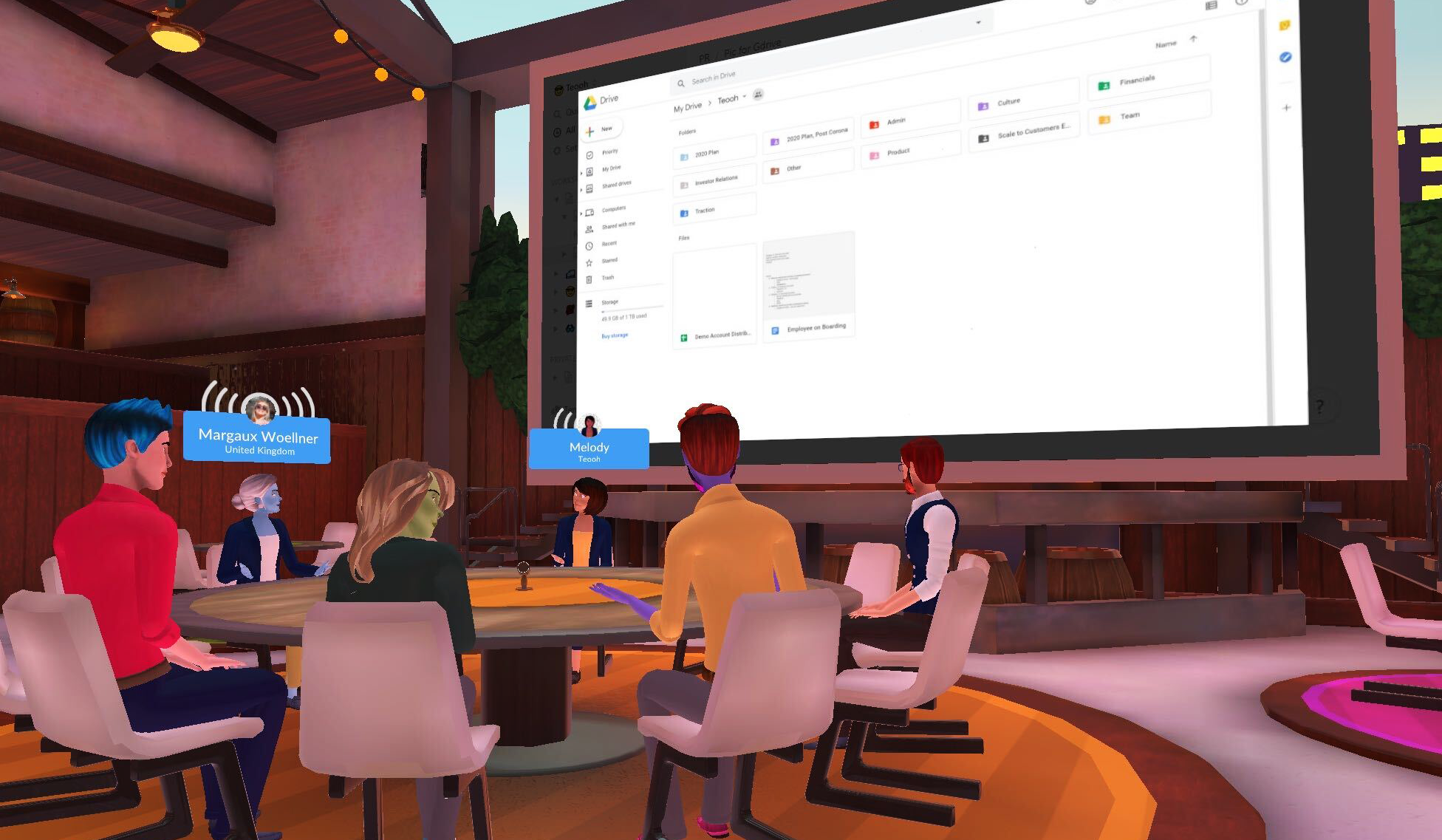
Podcasting, social audio and virtual reality are combining into a potentially new trend, Lucas Matney writes for Extra Crunch this week. “As audio-centric platforms garner investor interest, virtual reality founders of old are trying to push 3D audio as the next evolution, presenting the tech in a way that looks entirely different from today’s voice chat platforms. Though some of these efforts have been in the works for a while, the fledgling platforms are a lot more interesting, as social efforts like Clubhouse take flight and investors continue to eat up audio startups.” Top early examples so far include High Fidelity and Teooh. 

Around TechCrunch

Ready, set, network! CrunchMatch is now open for Early Stage 2020

Everything you could possibly want to learn about fundraising will be covered at TC Early Stage

Marketing, PR and brand building, oh my! TechCrunch Early Stage goes down July 21 and 22

Here’s your chance to meet with Sequoia’s partners at TC Early Stage

Sign up for next week’s Pitchers & Pitches competition on 7/23

TechCrunch talks virtual events and event technology

Learn how to build a company that puts profits and users first, and VCs last, at Disrupt 2020

Bumble founder Whitney Wolfe Herd is coming to Disrupt 2020

Emily Heyward will teach you how to make your brand awesome at TC Early Stage

Across the week

TechCrunch

US beat China on App Store downloads for first time since 2014, due to coronavirus impact

China Roundup: Tech giants take stance on Beijing’s data control in Hong Kong

Legal clouds gather over US cloud services, after CJEU ruling

India smartphone shipments slashed in half in Q2 2020

Equity Monday: India’s digital economy attracts ample attention, three funding rounds and earnings season

Extra Crunch

Extension rounds help some startups play offense during COVID-19

How Thor Fridriksson’s ‘Trivia Royale’ earned 2.5M downloads in 3 weeks

Investors are browsing for Chromium startups

As companies accelerate their digital transitions, employees detail a changed workplace

An unsurprising wave of video-focused startups is trying to make video calls better

#EquityPod

From Alex Wilhelm:

Hello and welcome back to Equity, TechCrunch’s venture capital-focused podcast, where we unpack the numbers behind the headlines.

This week was full of news of all sorts, but as we recorded, both Danny and Natasha “not Tash” Mascarenhas were still locked out of their Twitter accounts after a proletariat revolution on the social platform saw the ruling Blue Checkmark Class forced into silence. That’s not really what happened, but it sounds better than what actually went down at Big Social.

Anyway, Twitter accounts or not, the three of us gathered to parse through a wave of news:

It was a lovely time and there is a bit of show news. Namely that Equity is coming back to YouTube either this week or the next. So if you want to see us talk, soon you will be able to! Again!

Oh, and follow the show on Twitter. If you can, that is.

Equity drops every Monday at 7:00 a.m. PT and Friday at 6:00 a.m. PT, so subscribe to us on Apple PodcastsOvercastSpotify and all the casts.

Powered by WPeMatico