1010Computers | Computer Repair & IT Support

Apple contends Epic’s ban was a ‘self-inflicted’ prelude to gaming the App Store

Apple has filed legal documents opposing Epic’s attempt to have itself reinstated in the iOS App Store, after having been kicked out last week for flouting its rules. Apple characterizes the entire thing as a “carefully orchestrated, multi-faceted campaign” aimed at circumventing — perhaps permanently — the 30% cut it demands for the privilege of doing business on iOS.

Epic last week slyly introduced a way to make in-app purchases in its popular game Fortnite without going through Apple. This is plainly against the rules, and Apple soon kicked the game, and the company’s other accounts, off the App Store. Obviously having anticipated this, Epic then published a parody of Apple’s famous 1984 ad, filed a lawsuit and began executing what Apple describes quite accurately as “a carefully orchestrated, multi-faceted campaign.”

In fact, as Apple notes in its challenge, Epic CEO Tim Sweeney emailed ahead of time to let Apple know what his company had planned. From Apple’s filing:

Around 2am on August 13, Mr. Sweeney of Epic wrote to Apple stating its intent to breach Epic’s agreements:
“Epic will no longer adhere to Apple’s payment processing restrictions.”

This was after months of attempts at negotiations in which, according to declarations from Apple’s Phil Schiller, Epic attempted to coax a “side letter” from Apple granting Epic special dispensation. This contradicts claims by Sweeney that Epic never asked for a special deal. From Schiller’s declaration:

Specifically, on June 30, 2020, Epic’s CEO Tim Sweeney wrote my colleagues and me an email asking for a “side letter” from Apple that would create a special deal for only Epic that would fundamentally change the way in which Epic offers apps on Apple’s iOS platform.

In this email, Mr. Sweeney expressly acknowledged that his proposed changes would be in direct breach of multiple terms of the agreements between Epic and Apple. Mr. Sweeney acknowledged that Epic could not implement its proposal unless the agreements between Epic and Apple were modified.

One prong of Epic’s assault was a request for courts to grant a “temporary restraining order,” or TRO, a legal procedure for use in emergencies where a party’s actions are unlawful, a suit to show their illegality is pending and likely to succeed, and those actions should be proactively reversed because they will cause “irreparable harm.”

If Epic’s request were to be successful, Apple would be forced to reinstate Fortnite and allow its in-game store to operate outside of the App Store’s rules. As you might imagine, this would be disastrous for Apple — not only would its rules have been deliberately ignored, but a court would have placed its imprimatur on the idea that those rules may even be illegal. So it is essential that Apple slap down this particular legal challenge quickly and comprehensively.

Apple’s filing challenges the TRO request on several grounds. First, it contends that there is no real “emergency” or “irreparable harm” because the entire situation was concocted and voluntarily initiated by Epic:

Having decided that it would rather enjoy the benefits of the App Store without paying for them, Epic has breached its contracts with Apple, using its own customers and Apple’s users as leverage.

But the “emergency” is entirely of Epic’s own making…it knew full well what would happen and, in so doing, has knowingly and purposefully created the harm to game players and developers it now asks the Court to step in and remedy.

Epic’s complaint that Apple banned its Unreal Engine accounts as well as Fortnite related ones, Apple notes, is not unusual, considering the accounts share tax IDs, emails and so on. It’s the same “user,” for their purposes. Apple also says it gave Epic ample warning and opportunity to correct its actions before a ban took place. (Apple, after all, makes a great deal of money from the app as well.)

Apple also questions the likelihood of Epic’s main lawsuit (independent of the TRO request) succeeding on its merits — namely that Apple is exercising monopoly power in its rent-collecting on the App Store:

[Epic’s] logic would make monopolies of Microsoft, Sony and Nintendo, just to name a few.

Epic’s antitrust theories, like its orchestrated campaign, are a transparent veneer for its effort to co-opt for itself the benefits of the App Store without paying or complying with important requirements that are critical to protect user safety, security,
and privacy.

Lastly Apple notes that there is no benefit to the public interest to providing the TRO — unlike if, for example, Apple’s actions had prevented emergency calls from working or the like, and there was a serious safety concern:

All of that alleged injury for which Epic improperly seeks emergency relief could disappear tomorrow if Epic cured its breach…All of this can happen without any intervention of the Court or expenditure of judicial resources. And Epic would be free to pursue its primary lawsuit.

Although Apple eschews speculating further in its filings, one source close to the matter suggested that it is of paramount importance to that company to avoid the possibility of Epic or anyone else establishing their own independent app stores on iOS. A legal precedent would go a long way toward clearing the way for such a thing, so this is potentially an existential threat for Apple’s long-toothed but extremely profitable business model.

The conflict with Epic is only the latest in a series going back years in which companies challenged Apple’s right to control and profit from what amounts to a totally separate marketplace.

Most recently Microsoft’s xCloud app was denied entry to the App Store because it amounted to a marketplace for games that Apple could not feasibly vet individually. Given this kind of functionality is very much the type of thing consumers want these days, the decision was not popular. Other developers, industries and platforms have challenged Apple on various fronts as well, to the point where the company has promised to create a formal process for challenging its rules.

But of course, even the rule-challenging process is bound by Apple’s rules.

You can read the full Apple filing below:

Epic v. Apple 4:20-cv-05640… by TechCrunch on Scribd

Powered by WPeMatico

How to raise your first VC fund

Charles Yu
Contributor

Charles is a principal at Bling Capital and manages his own angel investment vehicle. Previously, he was an investor at TI Platform Management and Manhattan Venture Partners. He has quarterbacked investments in nine unicorns over the course of his career.

As a founding member of TI Platform Management, I have quarterbacked more than $200 million in investments into first-time fund managers around the world. That portfolio includes being one of the first institutional checks into Atomic Labs ($170+ million, SaaStr ($160+ million) and Entrepreneur First ($140+ million), among many others.

Having seen successful returns as a fund manager and an early-stage VC (as well as recently raising my own angel fund), I’ve formulated several best practices and strategies for investing in fund managers. If you want to raise your first fund, here’s how.

Understand the mentality of an LP

Just as VCs bucket startup founders into categories, limited partners (the investors in your venture fund, also known as “LPs”) have an unwritten way of categorizing venture managers. The vast majority fit one of three archetypes:

  • Former founder/operator turned VC
  • Spin-off manager from a mega fund
  • Angel investor with a strong track record

Here’s how each is perceived by institutional LPs and the unique blockers they have to overcome:

Former founder/operator turned VC

Having been through the journey of starting a company, former founders/operators often have strong intuition in identifying founders and an empathy/rapport that raises their win-rate on deals. Additionally, having built an innovative company, they can bring special insights in where the market is headed. Building a company, however, requires different skills from founding a fund.

If you’re a former founder/operator turned VC, expect LPs to ask questions that suss out:

Powered by WPeMatico

OpenUnit aims to be Shopify for self-storage facilities

So you’re looking for a storage unit to put some stuff in for a few months. Maybe you’re moving and your new place isn’t ready yet — or maybe you’re just looking to declutter and want to tuck some stuff away for a while and see if you’re really ready to part with it.

As you may find, the process of finding a storage unit can be… not great. While there are a few big storage chains in the market, a huge chunk of the self-storage industry is made up of independent/mom-and-pop shops that don’t necessarily have the time/budget to keep up as tech has evolved. It can involve a lot of poking around out-of-date websites, a lot of phone calls and a lot of paperwork.

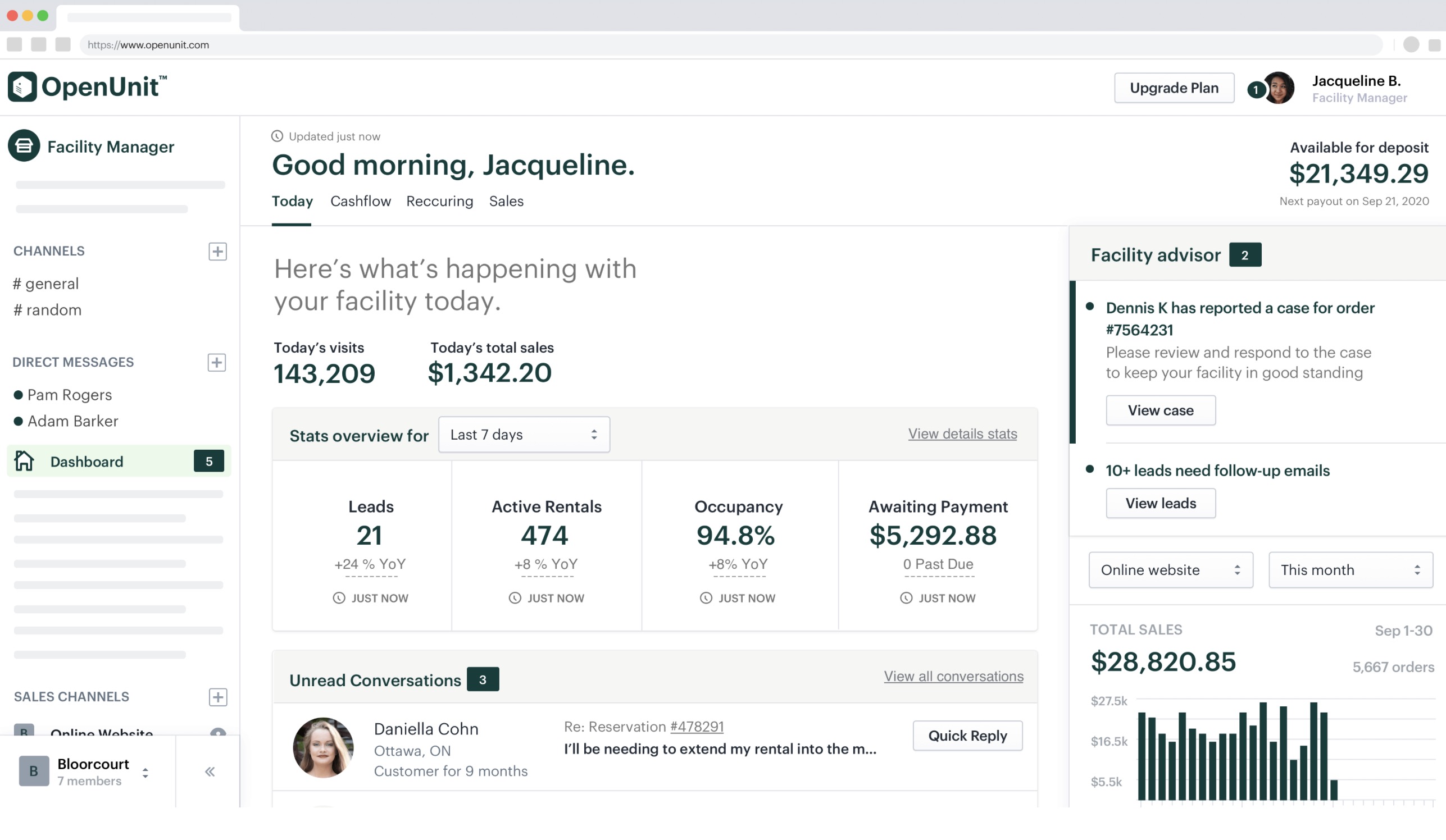
OpenUnit, a startup out of Toronto, wants to fix that. They’re aiming to be Shopify for the self-storage industry, with an all-in-one solution that provides a modern interface to help customers make reservations on the front end, and gives facility managers everything they need to keep things running on the back end.

Their management tool provides things like:

  • A white-labeled site for making reservations
  • Unit inventory management
  • Expense tracking
  • Group chats/DMs to give employees and managers a place to keep in touch
  • Pricing/revenue analytics
  • Digital lease signing
  • A CRM for managing leads and existing relationships

The company isn’t charging facility managers a monthly fee; instead, they’re handling credit card payment processing and taking a cut of 2.9% (+ 30 cents) per transaction.

Co-founders Taylor Cooney and Lucas Playford found their way into self-storage when Taylor’s landlords came to him with an offer: they wanted to sell the place he was renting, and they’d give him a stack of cash if he could be out within just a few days. Pulling that off meant finding a place to keep all of his stuff while he looked for a new home, which is when he realized how antiquated the self-storage process could be.

Image Credits: OpenUnit

The two initially set their sites on something a bit different: a Hotwire-style search system that would find deals on local storage units, negotiating the monthly cost on a customer’s behalf for a small one-time fee. The more they worked with facility managers, the more gaps they found in the tools and systems on the market, so they shifted focus to this facility management suite.

OpenUnit was part of the Winter 2020 Y Combinator class which ended back in March, but the team opted to defer their demo day debut until YC’s Summer 2020 event next week. As March came to an end and the severity of the pandemic was becoming more clear, Canadian Prime Minister Justin Trudeau called upon any citizens abroad to return home sooner than later. Launching a company while rushing to get back home is hardly ideal, so the two chose to hold off their launch until now.

After a few weeks of private testing, OpenUnit is now starting to bring more storage facilities on board. Run a storage company and want to give it a look? They’ve got a waiting list here.

Powered by WPeMatico

Box CEO Aaron Levie says thrifty founders have more control

Once upon a time, Box’s Aaron Levie was just a guy with an idea for a company: 15 years ago as a USC student, he conceived of a way to simply store and share files online.

It may be hard to recall, but back then, the world was awash with thumb drives and moving files manually, but Levie saw an opportunity to change that.

Today, his company helps enterprise customers collaborate and manage content in the cloud, but when Levie appeared on an episode of Extra Crunch Live at the end of May, my colleague Jon Shieber and I asked him if he had any advice for startups. While he was careful to point out that there is no “one size fits all” advice, he did make one thing clear:

“I would highly recommend to any company of any size that you have as much control of your destiny as possible. So put yourself in a position where you spend as little amount of dollars as you can from a burn standpoint and get as close to revenue being equal to your expenses as you can possibly get to,” he advised.

Don’t let current conditions scare you

Levie also advised founders not to be frightened off by current conditions, whether that’s the pandemic or the recession. Instead, he said if you have an idea, seize the moment and build it, regardless of the economy or the state of the world. If, like Levie, you are in it for the long haul, this too will pass, and if your idea is good enough, it will survive and even thrive as you move through your startup growth cycle.

Powered by WPeMatico

How one founder leveraged debt to drive early growth and avoid dilution

Avi Freedman is like any other founder: He wants to build a great company. In this case network analytics platform Kentik, and he needs venture capital to do it. Like pretty much all founders, he doesn’t like the dilution that comes from taking vast sums from VCs in order to grow. There’s always been an alluring solution to this dilemma, but one that comes with its own tradeoffs.

Debt.

The word has negative connotations, but the reality is that just like equity capital, debt is a key tool in the corporate finance toolbox. Judicious use of debt with the right terms and conditions can cut the cost of capital for a startup significantly, saving founders and early-stage investors from serious dilution as a company scales. Used too heavily or improperly however, and debt can turn a bad financial quarter into a dead company, stat.

Founders, particularly those who run companies with recurring revenues, are increasingly hearing the debt pitch from bankers and peers, leading many to consider debt options much earlier than has traditionally been the norm. Boards are also getting more comfortable with the idea of a startup taking on early debt to extend runways and double down on growth.

Let’s walk through how a founder sees debt today and discuss what the market looks like for debt options. Freedman was helpful in illuminating his recent fundraise, including the range of term sheets he got, and was willing to share his experience and thinking on how he approached his latest financing.

Debt and COVID-19

Some context to get started. Kentik is a six-year-old SaaS platform that has raised more than $60 million in venture capital, according to Crunchbase, including a seed round led by First Round Capital and a Series A led by the now-defunct August Capital (plus the company’s most recent equity/debt round we’re talking about today). Freedman himself has been a long-time entrepreneur, building the first ISP in Philadelphia back in 1992. Kentik was his first true “venture-backed” business in the Silicon Valley startup model.

Powered by WPeMatico

CarbonChain is using AI to determine the emissions profile of the world’s biggest polluters

It was the Australian bush fire that finally did it.

For 12 years Adam Hearne had worked at companies that represented some of the world’s largest sources of greenhouse gas emissions. First at Rio Tinto, one of the largest industrial miners, and then at Amazon, where he handled inbound delivery operations across the EU, Hearne was involved in ensuring that things flowed smoothly for companies whose operations spew millions of tons of carbon dioxide into the environment.

Amazon’s business alone was responsible for emitting 51.17 million metric tons of carbon dioxide last year — the equivalent of 13 coal-burning power plants, according to a report from the company.

Then, Hearne’s home country burned.

In 2019 wildfires erupted that engulfed more than 46 million acres of land, destroyed over 9,000 buildings, and killed over 400 people and untold numbers of animals — driving some species to the brink of extinction.

Hearne, along with an old friend from his business school rugby days (Roheet Shah) and computer science and machine learning experts from Imperial College of London (Yuri Oparin and Jeremiah Smith), launched CarbonChain that year. The company, now poised to graduate from the latest Y Combinator cohort, is pitching a service that can accurately account for emissions from the commodities industry — which is responsible for 50% of the world’s greenhouse gas emissions.

The company’s services are coming at the right time. Countries around the globe are poised to adopt much more stringent regulations around carbon dioxide and greenhouse gas emissions. The European Union is slowly working toward passage of sweeping new regulations on climate change that are mirrored in the region’s local economies. Even petrostates like Russia are poised to enact new climate regulations (at least according to Russian officials).

What’s missing in all of this are ways for companies to accurately track their emissions and technologies that can adequately monitor how well emissions offsets are working.

CarbonChain tackles this problem by going to the sectors that are responsible for the largest percentage of greenhouse gas emissions, Hearne said.

“The world needs hard accounting and hard numbers of what commodities companies are producing,” said Hearne in a July interview.

To ensure that emissions reductions and regulations are working, regulators need to go after oil and gas and commodities and minerals producers, according to Hearne. “Those sectors are uniform and carbon intensive and that’s how you quantify them,” he said.

CarbonChain has built models for every single asset in the supply chain for these industries, according to Hearne. The company has created digital twins of every piece of equipment used in heavy industry. If CarbonChain can’t get the information about the equipment from the companies that use it, they go to the engineering firms that built the equipment or facility for the company.

“In order to get a number that doesn’t get laughed out of the room we have to go down to the aluminum smelter that has a power station right next to it,” said Hearne. “Ninety percent of its footprint is its electrical usage.”

According to Hearne, CarbonChain’s system is so precise that it can tell users how much carbon emissions are embedded in a cup of coffee or a glass of wine (which is two pounds of carbon dioxide for imported wine, by the way).

CarbonChain is already selling its services to commodities producers and carbon traders who are operating in existing carbon trading schemes.

So far, the company has received roughly $500,000 from the U.K. government and an investment from one of its (undisclosed) commodities customers.

But CarbonChain’s technology seems to have the most rigorous methodology of any of the companies that’s purporting to do emissions monitoring. Other startups purporting to provide carbon emissions data for companies include Persefoni, which raised $3.5 million for its solution, and another Y Combinator graduate, SINAI Technologies.

If the company can actually measure the embedded emissions of materials down to a single piece of rebar, it could have huge consequences for industry broadly.

The company also slots nicely into the trend of entrepreneurs with deep industry experience building vertical solutions based on the collection of massive data sets using machine learning.

Powered by WPeMatico

As the pandemic creates supply chain chaos, Craft raises $10M to apply some intelligence

During the COVID-19 pandemic, supply chains have suddenly become hot. Who knew that would ever happen? The race to secure PPE, ventilators and minor things like food was and still is an enormous issue. But perhaps, predictably, the world of “supply chain software” could use some updating. Most of the platforms are deployed “empty” and require the client to populate them with their own data, or “bring their own data.” The UIs can be outdated and still have to be juggled with manual and offline workflows. So startups working in this space are now attracting some timely attention.

Thus, Craft, the enterprise intelligence company, today announces it has closed a $10 million Series A financing round to build what it characterizes as a “supply chain intelligence platform.” With the new funding, Craft will expand its offices in San Francisco, London and Minsk, and grow remote teams across engineering, sales, marketing and operations in North America and Europe.

It competes with some large incumbents, such as Dun & Bradstreet, Bureau van Dijk and Thomson Reuters . These are traditional data providers focused primarily on providing financial data about public companies, rather than real-time data from data sources such as operating metrics, human capital and risk metrics.

The idea is to allow companies to monitor and optimize their supply chain and enterprise systems. The financing was led by High Alpha Capital, alongside Greycroft. Craft also has some high-flying angel investors, including Sam Palmisano, chairman of the Center for Global Enterprise and former CEO and chairman of IBM; Jim Moffatt, former CEO of Deloitte Consulting; Frederic Kerrest, executive vice chairman, COO and co-founder of Okta; and Uncork Capital, which previously led Craft’s seed financing. High Alpha partner Kristian Andersen is joining Craft’s board of directors.

The problem Craft is attacking is a lack of visibility into complex global supply chains. For obvious reasons, COVID-19 disrupted global supply chains, which tended to reveal a lot of risks, structural weaknesses across industries and a lack of intelligence about how it’s all holding together. Craft’s solution is a proprietary data platform, API and portal that integrates into existing enterprise workflows.

While many business intelligence products require clients to bring their own data, Craft’s data platform comes pre-deployed with data from thousands of financial and alternative sources, such as 300+ data points that are refreshed using both Machine Learning and human validation. Its open-to-the-web company profiles appear in 50 million search results, for instance.

Ilya Levtov, co-founder and CEO of Craft, said in a statement: “Today, we are focused on providing powerful tracking and visibility to enterprise supply chains, while our ultimate vision is to build the intelligence layer of the enterprise technology stack.”

Kristian Andersen, partner with High Alpha commented: “We have a deep conviction that supply chain management remains an underinvested and under-innovated category in enterprise software.”

In the first half of 2020, Craft claims its revenues have grown nearly threefold, with Fortune 100 companies, government and military agencies, and SMEs among its clients.

Powered by WPeMatico

Sign up to interview with accelerators before Disrupt 2020

Startup founders, brace yourself for a phenomenal opportunity. TechCrunch, in partnership with cela, will host eleven — count ‘em eleven — accelerators in Digital Startup Alley at Disrupt 2020. It gets better: they’re accepting applications for their upcoming virtual accelerator programs, and this is your chance to interview with them.

Do you want in on this potentially life-changing speed networking opportunity? There’s only one requirement: you must be an exhibitor in Digital Startup Alley. If you don’t have one yet, go buy your Digital Startup Alley Package right now.

Not familiar with cela or its mission? The New York City-based company matches early-stage startups to world-class accelerators and incubators — within its global network — that align with a startup’s vertical and business goals.

cela already connected winners of our ongoing Pitchers and Pitches mini pitch-off competitions (register to attend the next one on September 2nd — it’s free) with an appropriate accelerator. Here’s what pitch-off winner Hannah Webb, CEO of Findster Technologies, said about her experience.

“Disrupt and Digital Start Up Alley haven’t even officially started yet, and we’ve already seen great benefits. cela introduced us to multiple accelerators in the NYC area and one is a perfect fit for our company’s situation.”

A good accelerator can give founders an enormous boost. Finding the right one for your startup is crucial, and it can be tricky. That’s where cela’s guidance — and its extensive network — can help.

“During these speed networking events, we will match selected founders to curated, 1:1 meetings with the Managing Directors of some of the world’s most respected accelerator programs. Founders that apply can discuss investment, sales, team building, product development, marketing and any other challenge or opportunity their startup is pursuing.” — John Lynn, co-founder, cela.

Speed networking sessions take place over three days during the week prior to Disrupt 2020. Here’s the schedule, so mark your calendars now and get ready to impress.

Date: September 8

Time: 1 p.m. – 4 p.m. PT

Accelerators: NUMA, Techstars, Entrepreneurs Roundtable Accelerator

Date: September 9

Time: 1 p.m. – 4 p.m. PT

Accelerators: She Gets Sh!t Done, Halo Incubator, Startup Boost Pre- Accelerator, Plug and Play

Date:  September 10

Time: 1 p.m. – 4 p.m. PT

Accelerators: Backstage Capital, Global Startup Ecosystem, StartEd Accelerator, Quake Capital

In a classic “but wait, there’s more” moment, don’t forget to sign up for these other webinars exclusively for Digital Startup Alley exhibitors.

  • August 26 — Fundraising and Hiring Best Practices with panelists Sarah Kunst of Cleo Capital and Brett Berson of First Round Capital.
  • September 2—Leveraging Online Fundraising for Your Business with IFundWomen.

All of this happens before the full week of Disrupt (starting September 14th). That’s a ton of opportunity waiting for you. Don’t wait — buy your Digital Startup Alley Package now, join us for speed networking and get ready to accelerate your success.

Is your company interested in sponsoring or exhibiting at Disrupt 2020? Contact our sponsorship sales team by filling out this form.

Powered by WPeMatico

Energy offset and renewable power developer Arcadia pitches clean power as an employee benefit

Arcadia, the company that gives homeowners and renters a way to offset their carbon footprints through renewable energy credits and clean power developments, is now pitching its services to businesses as an employee benefit.

Companies can offset their employees carbon footprints or subsidize their power bills using Arcadia’s services, the company said. It’s a response to the millions of Americans who are now working from home rather than going in to an office and an acknowledgement that office perks look different when the office is a living room couch, dining room table or bed.

Because commuter benefits and office amenities like free coffee, snacks, sodas or whatever have become as nonexistent as a competent U.S. government response to a global pandemic, companies are trying to come up with new ways to make employees happy (even though folks are lucky to be employed right now).

Energy usage that spikes in offices in the summer have now been distributed to homes around the country, according to data cited by Arcadia, which means that workers will be eating the cost of increased cooling bills that would have been borne by their corporate offices.

For workplaces that opt in to the new potential benefit for employees, Arcadia can either buy renewable energy credits to offset an employee’s emissions or it can take pay for that employee’s energy usage by acquiring blocks of renewable power from energy markets around the country.

The company has already signed up a few marquee customers, including McDonald’s, which is using the service to offset employee’s emissions (but not paying for their power).  

“We’re thrilled to partner with Arcadia on this new initiative,” said Emma Cox, manager of North America Sustainability at McDonald’s, in a statement. “Getting the program up and running is incredibly easy and enables us to empower our employees that are no longer in the office, and is consistent with McDonald’s goals in reducing carbon emissions.”


Powered by WPeMatico

Eric Hippeau discusses D2C growth, brand value and advice for early-stage founders

Eric Hippeau is the founding partner at Lerer Hippeau Ventures, whose portfolio companies include the likes of Axios, BuzzFeed, Casper, Warby Parker, Allbirds, DocSend, Fundera, Everlane, Giphy, Genius and the recently acquired fitness company Mirror.

It would not be an overstatement to say that Hippeau is well-positioned to discuss startups across a wide spectrum of industries, from media to D2C to telehealth to edtech. We spoke with Hippeau for a full hour on a recent episode of Extra Crunch Live to discuss all of the above and get his tactical advice for early-stage startups looking to catch their break.

Below, you’ll find a video of the entire episode and highlights from our conversation. Enjoy!

Advice for super-early-stage founders

As much as you can, in terms of timing and resources, build something. Don’t just talk about building something. Build it. It’s not gonna be perfect, and it might not work the way you might do, but build it because that will give me, as a VC, an indication of what you’re trying to accomplish. It also tells me a lot about you, and that that this is something that you really care about. You’re going to ask your family, and even ask your friends, and you’re going to get resources any way you can because it’s that important to you. And, the product that you build, while not perfect by any of stretch of the imagination, will go a long way for us to figure out what it is.

On the growth of direct-to-consumer

Powered by WPeMatico