1010Computers | Computer Repair & IT Support

WeWork employees used an alarmingly insecure printer password

A shared user account used by WeWork employees to access printer settings and print jobs had an incredibly simple password — so simple that a customer guessed it.

Jake Elsley, who works at a WeWork in London, said he found the user account after a WeWork employee at his location mistakenly left the account logged in.

WeWork customers like Elsley normally have an assigned seven-digit username and a four-digit passcode used for printing documents at WeWork locations. But the username for the account used by WeWork employees was just four-digits: “9999”. Elsley told TechCrunch that he guessed the password because it was the same as the username. (“9999” is ranked as one of the most common passwords in use today, making it highly insecure.)

The “9999” account is used by and shared among WeWork community managers, who oversee day-to-day operations at each location, to print documents for visitors who don’t have accounts to print on their own. The account cannot be used to access print jobs sent to other customer accounts.

Elsley said that the “9999” account could not see the contents of documents beyond file names, but that logging in to the WeWork printing web portal could allow him to release other people’s pending print jobs sent to the “9999” account to any other WeWork printer on the network.

The printing web portal can only be accessed on WeWork’s Wi-Fi networks, said Elsley, but that includes the free guest Wi-Fi network which doesn’t have a password, and WeWork’s main Wi-Fi network, which still uses a password that has been widely circulated on the internet.

Elsley reached out to TechCrunch to ask us to alert the company to the insecure password.

“WeWork is committed to protecting the privacy and security of our members and employees,” said WeWork spokesperson Colin Hart. “We immediately initiated an investigation into this potential issue and took steps to address any concerns. We are also nearing the end of a multi-month process of upgrading all of our printing capabilities to a best in class security and experience solution. We expect this process to be completed in the coming weeks.”

WeWork confirmed that it had since changed the password on the “9999” user account.

Powered by WPeMatico

Is fintech’s Series A market hot, or just overhyped?

Ryan Falvey
Contributor

Ryan Falvey is co-founder and managing partner at Financial Venture Studio, an early-stage fintech venture capital firm.
More posts by this contributor

Theo Katsoulis
Contributor

According to industry reports, venture capital deal-making has notably rebounded since dropping off briefly in March as shelter-in-place orders gripped much of the country.

As seed-stage fintech investors, this has certainly been our experience: “Hot” deals are getting funded faster than ever, and we increasingly see the large multistage global funds competing for the earliest access to companies. However, in our experience and anecdotal conversations with other early-stage investors, that excitement has not been translating to the Series A stage.

We’ve increasingly wondered if the Series A market in fintech is really as hot as it seems. As pre-seed and seed-stage investors, we know that the health of the Series A market is of critical importance.

In early October 2020, the Financial Venture Studio put together a brief survey of the Series A market in fintech and shared it with more than 100 investors with whom we work closely. Despite the high-level numbers indicating a healthy market, our research indicates a market that remains in flux, with significant ramifications for early-stage founders.

Why Series A is so interesting

Although the seed and pre-seed fintech market continues to attract substantial entrepreneurial and investor interest, it is also in some ways one of the easiest parts of the market to fund. The check size is smaller, the velocity of new deals is highest, and while the potential returns are also the highest, this is also the part of the market where information is most scarce. Perhaps counterintuitively, the fact that there is so little information on a business — aside from a plan, a team and maybe some early anecdotal evidence to support the vision — actually makes it easier to “pull the trigger” on deals where those data points align. There just often isn’t a lot more to dig into.

Similarly, by the time a company is raising Series B capital, they typically have some objective evidence that the idea is working. Companies are typically generating revenue, small teams have grown and become more sophisticated in how they operate, and importantly, the governance functions of a company have (hopefully) begun to take shape. The simple existence of a board member with invested capital at stake means that some of the more existential risks of the earliest stage have been mitigated.

In contrast, one of the big milestones for any startup has been to raise a Series A from an institutional investor. Besides an infusion of capital (which is often 2-3x the aggregate capital a company may have raised since its inception), this “stamp of approval” lends credibility to a small company that is trying to hire talent, sell to customers, and, in most cases, raise substantial subsequent capital.

Thus, it’s critical that Series A investors remain active; if not, many of these upstart companies may fail due to a lack of investment, even if they are able to demonstrate early market traction. The Series A funding market is one of — if not the most — critical funding stage in the innovation economy because it acts as a bridge between scrappy early innovation and commercialization at scale.

It stands to reason, then, that dollar amounts invested may not be the best barometer of the ecosystem’s health. What really matters is the volume of companies being funded and the variety of product approaches being pursued.

The post-COVID Series A

Once the initial shock of the pandemic wore off, the VC community had to get back to business, which admittedly is harder to do for funds that write $10 million+ checks and like getting to know founders in person. Still, Series A investors made it a point to let entrepreneurs know they were, and continue to be, “open for business.”

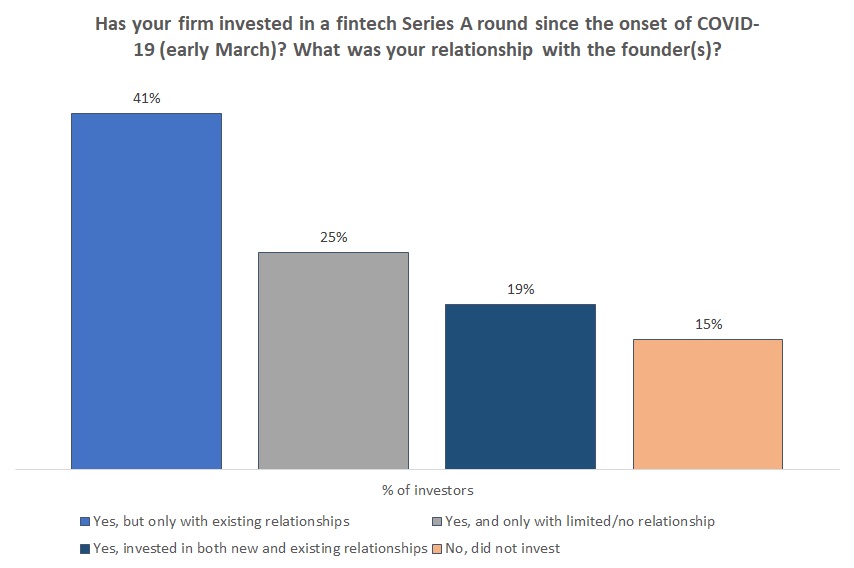
As investors have gotten more comfortable with the new normal, they have been more open to a virtual diligence process. Of the firms we surveyed, only 15% stated they have not completed a Series A investment during COVID-19 work restrictions. Of the firms who completed a Series A investment during COVID-19 (~85%), about half invested in a company whose founder(s) they had a limited or no relationship with prior to the onset of shelter-in-place orders.

The shift to a virtual environment means that process is more important than ever. Numerous investors have cited their renewed focus on following a structured approach to sourcing and diligence. The interpersonal aspect remains important to close a deal, but customer references, referrals from trusted seed-stage investors and a heightened scrutiny of metrics are all at the forefront of investors’ evaluations.

Powered by WPeMatico

Is Wall Street losing its tech enthusiasm?

This is The TechCrunch Exchange, a newsletter that goes out on Saturdays, based on the column of the same name. You can sign up for the email here.

Over the past few months the IPO market made it plain that some public investors were willing to pay more for growth-focused technology shares than private investors. We saw this in both strong tech IPO pricing — the value set on companies as they debut — and in resulting first-day valuations, which were often higher.

One way to consider how far public valuations rose for tech startups, especially those with a software core in 2020, is to ask yourself how often you heard about a down IPO this year. Maybe a single time? At most? (You can catch up on 2020 IPO performance here, if you need to.)

IPO enthusiasm exposed a gap between what many venture capitalists and private investors were paying for tech shares, and what the public market was doing with its own valuation calculations. Insurtech startup Hippo’s $150 million private round from July is a good example. The company was valued at $1.5 billion in the round, a healthy uptick from its preceding private valuation. But if we valued it like the then-newly-public Lemonade, a related company, at the time, Hippo was priced inexpensively.

This week, however, the concept of private investors being more conservative than public investors in certain cases (some eight-figure private rounds happened this year at valuations that were even more bullish than public investor treatment of IPOs, to be clear) took a ding as most big tech companies lost ground, SaaS stocks sold off, and other tech firms struggled to keep up with investor enthusiasm.

Not only tech companies took a beating, but as I write to you on this Friday afternoon, the American stock markets were on a path for their worst week since March, CNBC reported, “led by major tech shares.”

A change in the wind? Perhaps. 

Notable is that it was just in September that VCs seemed resigned to having startup valuations pulled higher by public markets’ endless optimism for related companies. Canaan’s Maha Ibrahim told me during Disrupt 2020 that it was a time when VCs had to “play the game” and pay up for startups, so long as companies were being “rewarded in the public markets for high growth the way that Snowflake” was at the time. A16z’s David Ulevitch concurred.

Perhaps that dynamic is changing as stocks dip. If so, startup valuations could decline en masse, along with the more exotic areas of startup-related finance. The SPAC boom, for example, may wane. Chatting with Hippo’s CEO Assaf Wand this week, he posited that SPACs were a market-response to the public-private valuation gap, an accelerant-cum-bridge to help startups get public while demand was hot for their equity.

Without the same red-hot demand for growth and risk, SPACs could cool. So, too, could private valuations that the hottest startups have taken for granted. Whether what we’re feeling in the wind this week is a hiccup or tipping point is not clear. But the public market’s fever for tech equities may have broken at a somewhat awkward time for Airbnb, Coinbase, DoorDash and other not-quite-yet-IPOs.

Market Notes

It started to snow this week where I live, putting a somewhat sad cap on an otherwise turbulent week. Still! There’s lots from our world to get into. Here’s our week’s market notes:

  • Remember when we dug into how quickly startups grew in Q3? Another company that I’ve covered before, Drift, wrote in. The Boston-based marketing software company reported to The Exchange that it grew more than 50% in Q3 compared to the year-ago quarter, with its CEO adding that June and Q3 were the strongest month and three-month periods in its history.
  • The fintech boom continued with DriveWealth raising nearly $57 million this week, with the startup being yet another API-driven play. That a company sitting in-between two key startup trends of the year is doing well is not surprising. DriveWealth helps other fintech companies provide users access to the American equities markets. Alpaca, which also recently raised, is working along similar lines.

This week featured two IPOs that we cared about. MediaAlpha’s debut, giving the advertising-and-insurtech company a $19 per-share IPO price, quickly exploded out of the gate. Today the company is worth nearly $38 per share. Why? On its IPO day MediaAlpha CEO Steve Yi said that he had chosen the current moment because public markets had garnered an appreciation for insurtech. His share price growth seems to concur.

Until we look at Root, to some degree. Root, a neo-insurance provider focused on the automotive space, priced at $27 when it debuted this week, $2 above the top-end of its range. The company is now worth less than $24 per share. So, whatever wave MediaAlpha caught appears to have missed Root. 

I honestly don’t know what to make of the difference in the two debuts, but please email in if you do know (you can just reply to this email, and I’ll get your note).

Regardless, I chatted with Root CEO Alex Timm after his company went public. The executive said that Root had laid down plans to go public a year ago, and that it can’t control market noise around the time of its debut. Timm stressed the amount of capital that Root added to its coffers — north of $1 billion — is a win. I asked how the company intended to not fuck up its newly swollen accounts, to which Timm said that his company was going to stay “laser focused” on its core automotive insurance opportunity.

Oh, and Root is based in Ohio. I asked what its debut might mean for Midwest startups. Timm was positive, saying that the IPO could highlight that there are a lot of smart folks and GDP in the middle of the country, even if venture capital tallies for the region remain underdeveloped.

  • I know that by now you are tired of earnings, but Five9 did something that other companies struggled to accomplish, namely, beat expectations and bolstered its forward guidance. Its shares soared. The Exchange got on the phone with the call center software company to chat about its latest acquisition and earnings. How did it crush expectations as it did? By selling a product that its market needed when COVID-19 hit, the accelerating digital transformation more broadly, and rising e-commerce spend, which is driving more customer support work onto phone lines, it said. A lot of stuff at once, in other words. 
  • Five9 took on a bunch of convertible debt earlier this year, despite making gobs of adjusted profit. I asked its CEO Rowan Trollope how he was going to go about investing cash to take advantage of market tailwinds, while not overspending. He said that the company takes very regular looks at revenue performance, helping it tailor new spend nimbly. It’s apparently working.
  • What else? Peek this week at big, important rounds from SimilarWeb, PrimaryBid and EightFold, a company that I have known for some time. Oh, and I covered The Wanderlust Group’s Series B and Teampay’s Series A extension, which were good fun.

Various and Sundry

  • What’s going on in the world of venture debt as VC gets back to form? We dug in.
  • For the Europhiles amongst us, here’s what’s up with the continent’s VC receipts.
  • Here are 10 favorites from recent Techstars demo days.
  • And here’s some mathmagic about Databricks, after it was rumored to have an H1 2021 IPO target.
  • We’re way out of space this week, but I have some fun stuff in the tank for later, including a Capital G investor’s take on RPA, a call with the CEO of Zapier about no-code/low-code growth and notes from a chat about developer ecosystems with Dell Capital. More on all of that when the news calms down.

Stay safe, and vote.

Alex

Powered by WPeMatico

MG Siegler talks portfolio management and fundraising 6 months into the COVID-19 pandemic

This week, GV General Partner (and TechCrunch alum) MG Siegler joined us on Extra Crunch Live for a far-ranging chat about what it takes to foster a good relationship between investor and startup, how portfolio management and investing has changed as the COVID-19 crisis drags on, and what Siegler expects will and won’t stick around in terms of changes in behavior in investment and entrepreneurship once the pandemic passes.

We last caught up with Siegler on the heels of his investment in Universe, a mobile-focused, e-commerce business-building startup. The coronavirus pandemic was relatively new and no one was sure how long it would last or what measures to contain it would look like. Now, with a few months of experience under his belt, Siegler told me that things have relatively settled into a new normal from his perspective as an investor – sometimes for worse, sometimes for better, but mostly just resulting in differences that require adaptation.

This select transcript has been edited for length and clarity. Aside from section headers, all text below is taken from MG Siegler’s responses to my questions.

Business impacts of coping with the pandemic six months on

Just talking about the business side of the equation, I do think that things have sort of stabilized in the day-to-day world here. For us, certainly, I think it’s it’s just as much of a factor though, of just learning how to operate in this in this weird and surreal environment, and knowing how to do remote meetings better. Knowing how to hop on quick Zoom calls, Hangouts, and phone calls, with portfolio companies, to help put out fires, and doing all board meetings remotely, and all that sort of stuff.

That seems like it’s pretty straightforward on paper, but in day-to-day operations, these are all different little learning things that you have to do and come across. I do feel like things are operating in a pretty streamlined manner, or as much as they can be at this point. But, you know, there’s always going to be some more wildcards – like we’re a week away, today, from from the US election.

Powered by WPeMatico

The 2020s promise better tech solutions to humanity’s biggest problems

Editor’s note: Get this free weekly recap of TechCrunch news that any startup can use by email every Saturday morning (7 a.m. PT). Subscribe here.

Let’s think beyond Monday, for a minute, to the trends playing out in technology this coming decade. While humanity’s problems have never been greater, our tools have never been better. Here’s more, from Danny Crichton:

The 2010s were all about executing on the dreams of mobile, cloud, and basic data. Those ideas had historical antecedents going back in some cases decades or more (Vannevar Bush’s description of the internet dates to the 1940s, for instance). But for the first time, we had the infrastructure and the users to actually build these products and make them useful. It was quite possibly the most extensive greenfield opportunity in the history of technology.

Yet, that greenfield is increasingly fallow. Business has cycles and seasonality as much as media reporting does. The easy stuff has been done. Building an app to text people has been done by dozens before. There are a multitude of analytics packages, and payroll providers, and credit card issuers, and more. What’s required this decade is to start to encroach on the harder questions, topics like how we build a better society, make people more empowered to do deep and creative work, and how we can build a more resilient and sustainable planet for all.

None of these topics have pure point solutions — but that is what is going to make this coming decade so damn interesting. It’s going to take intense collaboration, multiple inventions and products, as well as legal and cultural changes, to realize these next improvements. If you have grown sick (as I have) of the latest apps and SaaS products du jour, this decade is going to be an amazing one to experience and build.

In a companion article for Extra Crunch, he explores five key areas of the future, that he calls: Wellness, Climate, Data Society, Creativity and Fundamentals. Here’s an excerpt from the Data Society part:

Data may be ubiquitous, but it’s amazing how much work it can still be to calculate an LTV, or the return on an advertising campaign. No-code tools solve some of these problems, but what we need is a whole revolution in our data tools. We need to be able to sketch out lines of inquiry and have our tools augment our thinking from data. What are we missing? What gaps in our thinking should we be filling in? What data am I lacking to make a fully-formed decision? Am I overly biased toward one statistic versus a more holistic depiction of my situation? From personal decisions to business strategy, we need better tools to abstract the complexity of today’s modern society.

We also need better thinking around how to network knowledge. Roam Research and some other tools are starting to get better at helping users think in terms of a knowledge graph, but there is an incredible amount of potential if these ideas can be democratized and packaged into easier-to-use interfaces. How do we handle the increasing depth of most fields of knowledge and allow more people to get to the frontiers as quickly as possible?

Finally, we need to further our understanding of complexity and chaos and build those theories into the fundamental structures of our society. How do we make governance more adaptable and resilience, so that when massive crises like COVID-19 happen, we don’t see a complete breakdown in our society? Can we create more flexible systems around ownership and property that can create more diverse housing, or material ownership, or intellectual property? Empowering technology (“blockchain!” but could be all kinds of things) coupled with legal changes could dramatically evolve these core elements of our society.

Even today, we are still locked into a mental model built around paper, titles, and maybe if you are lucky, an Excel spreadsheet. There is so much work to be done to empower each of us through data this decade.

Data education

The building blocks of the Data Society concept are getting remade faster than ever this year, as the pandemic has shuttered traditional commerce and education, and forced open alternative approaches. For example, somebody starting a small business today basically has to use a lot of software. But crossing this initial barrier means they can do things like automatically track the lifetime value of each customer. Previous generations of small businesses simply did not have the resources and skills to do such things with the low-tech options available.

That’s the generational power of no-code, as Danny detailed separately on TechCrunch:

In business today, it’s not enough to just open a spreadsheet and make some casual observations anymore. Today’s new workers know how to dive into systems, pipe different programs together using no-code platforms and answer problems with much more comprehensive — and real-time — answers.

It’s honestly striking to see the difference. Whereas just a few years ago, a store manager might (and strong emphasis on might) put their sales data into Excel and then let it linger there for the occasional perusal, this new generation is prepared to connect multiple online tools to build an online storefront (through no-code tools like Shopify or Squarespace), calculate basic LTV scores using a no-code data platform and prioritize their best customers with marketing outreach through basic email delivery services. And it’s all reproducible, as it is in technology and code and not produced by hand.

There are two important points here. First is to note the degree of fluency these new workers have for these technologies, and just how many members of this generation seem prepared to use them. They just don’t have the fear to try new programs, and they know they can always use search engines to find answers to problems they are having.

Second, the productivity difference between basic computer literacy and a bit more advanced expertise is profound. Even basic but accurate data analysis on a business can raise performance substantially compared to gut instinct and expired spreadsheets.

How do we realize this future? Zooming in from the generational perspective, Natasha Mascarenhas takes a closer look at how school teachers are adapting to the pandemic — and the emerging online education world they are entering. Some, at least, seem to be moving into supplemental part-time teaching. While the educational experience is not the same as in-person, it clearly has its own value. Here’s one company as an example:

Outschool is a platform that sells small-group classes led by teachers on a large expanse of topics, from Taylor Swift Spanish class to engineering lessons through Lego challenges. In the past year, teachers on Outschool  have made more than $40 million in aggregate, up from $4 million in total earnings the year prior.

CEO Amir Nathoo estimates that teachers are able to make between $40 to $60 per hour, up from an average of $30 per hour in earnings in traditional public schools. Outschool itself has surged over 2,000% in new bookings, and recently turned its first profit.

Outschool makes more money if teachers join the platform full-time: teachers pocket 70% of the price they set for classes, while Outschool gets the other 30% of income. But, Nathoo views the platform as more of a supplement to traditional education. Instead of scaling revenue by convincing teachers to come on full-time, the CEO is growing by adding more part-time teachers to the platform.

Maybe one day soon, a class about online business will be a graduation requirement for a high school diploma. And we’ll see that sort of education drive more success in the next generation of your local Main Street.

The problems of the coming decade might be harder than ever, but the solutions are there for the making.

Isometric Business data analytics process management or intelligence dashboard showing sales and operations data statistics charts and key performance indicators concept. (Isometric Business data analytics process management or intelligence dashboard

Image Credits: Intpro / Getty Images

How to execute a bottom-up SaaS growth plan

The combination of consumer tech product skills and enterprise revenue models fueled this decade’s explosion of SaaS success stories. This week, Caryn Marooney and David Cahn of Coatue management distilled the lessons of this model into a popular how-to article for Extra Crunch. Here’s an excerpt, showing how market leaders approach key metrics and pricing:

The MAP customer value framework:

Metrics: What are the key metrics the customers care about? Is there a threshold of value associated with this metric? Metrics can include things like minutes, messages, meetings, data and storage. Examples:

  • Zoom — Minutes: Free with a 40-minute time limit on group meetings.
  • Slack — Messages: Free until 10,000 total messages.
  • Airtable — Records: Free until 1,200 records.

Activity: How do your customers really use your product? Are they creators? Are they editors? Do different customers use your product differently? Examples:

  • Figma — Editors versus viewers: Free to view, starts changing after two edits.
  • Monday.com — Creators versus viewers: Free to view, creators are charged $30+/month.
  • Smartsheet — Creators versus viewers: Free to view, creators are charged $10+/month.

People: How do your customers fit into a broader organization? Are they mostly individuals? Groups? Part of an enterprise? Examples:

  • Superhuman — Individuals only: No free version, $30/month.

  • Asana — Small team versus bigger teams: Teams of <15 people can use the product free.

  • Atlassian — Free versus team versus enterprise: Pricing scales with size of team.

Root keeps the IPO market warm

The stock market was off this week, but not entirely. Root Insurance was the big IPO this week, ending at $24 per share. That’s a bit below its aggressive $27 opening price per share, but is still in the range of its target pricing from the other week. It is, in other words, a success already for the company  — and we’ll see what happens when the entire market stops gyrating around the elections.

“For the Midwest, Ohio-based Root’s IPO is a win,” Alex Wilhelm wrote for Extra Crunch. “The company shows that it is possible to build high-growth technology companies worth billions of dollars far from coastal hubs. For the broader insurtech space, Root’s IPO is a win. The company follows Lemonade to the public markets, setting a strong valuation mark again for the neo-insurance startup market. For similar companies like Clearcover, MetroMile and all startups that related to Root and Lemonade, it’s a good day.”

It’s still looking good for any software company with a growth story, as Alex goes on to say, and it’s looking good for more IPOs this year. Like Airbnb.

But enough about IPOs this year — Alex also built on previous coverage to explore Databricks going public next year, which sounds quite likely at this point.

Across the week

TechCrunch

Why you have to pay attention to the Indian startup scene

Yale may have just turned institutional investing on its head with a new diversity edict

Cloud infrastructure revenue grows 33% this quarter to almost $33B

We need new business models to burst old media filter bubbles

Former Facebook and Pinterest exec Tim Kendall traces ‘extractive business models’ to VCs

Extra Crunch

Good and bad board members (and what to do about them)

New GV partner Terri Burns has a simple investment thesis: Gen Z

As venture capital rebounds, what’s going on with venture debt?

In the ‘buy now, pay later’ wars, PayPal is primed for dominance

Dear Sophie: Any upgrade options for E-2 visa holders interested in changing jobs?

#EquityPod

From Alex:

Hello and welcome back to Equity, TechCrunch’s venture capital-focused podcast (now on Twitter!), where we unpack the numbers behind the headlines.

A few notes before we get into this. One, we have a bonus episode coming this Saturday focused on this week’s earnings reports. And, second, we did not record video this week. So, if you like watching the show on YouTube, this is not the week for that!

Right, here’s what NatashaDanny and your humble servant got into this week:

We capped off with the latest from r2c, and then got the hell off the mics. Catch you all Saturday, and then back to regular programming on Monday morning.

Equity drops every Monday at 7:00 a.m. PDT and Thursday afternoon as fast as we can get it out, so subscribe to us on Apple PodcastsOvercastSpotify and all the casts.

Powered by WPeMatico

Equity shot: Boo! It’s the Halloween earnings special!

Hello and welcome back to Equity, TechCrunch’s venture capital-focused podcast (now on Twitter!), where we unpack the numbers behind the headlines.

As promised, the whole gang is back, this time to chew on the biggest, baddest, worstest, and most troubling earnings reports from the current cycle. This week saw Amazon and Alphabet and Microsoft and Apple and Facebook report, along with a host of smaller companies.

Spoiler alert: there were more tricks than treats.

  • Danny, Natasha and Alex wanted to get to the bottom of the big tech results, asking what really mattered from each of them?
  • Then it was time to dig into themes. We saw plan price increases coming from Netflix and Spotify, advertising getting a boo-st from politics and 2020’s overall meltdown, and boo-ming billions of consumer interest in…desktops.
  • After that, a dive into the results of smaller SaaS and cloud companies, picking out trends that might help us see around the corner a bit; is the tech boom slowing, or is corporate growth merely failing to keep up with inflated investor expectations?
  • This week felt like a shudder ran through the spine of our economy. The earnings paint a neutral picture, which isn’t exactly an exhale to rejoice over. The coronavirus continues to be a threat that poses a risk to public businesses. For startups, that could mean a less frothy exit market nad lower valuations. And for the public, it means that the uncertain is still ahead of us. So wear a mask.

And with that, the show is back Monday morning. Have a good weekend, everyone.

Equity drops every Monday at 7:00 a.m. PDT and Thursday afternoon as fast as we can get it out, so subscribe to us on Apple PodcastsOvercastSpotify and all the casts.

Powered by WPeMatico
Here’s how to start a venture fund if you’re not rich

For years — decades, even — there was little question about whether you could become a venture capitalist if you weren’t comfortable financially. You couldn’t. The people and institutions that invest in venture funds want to know that fund managers have their own “skin in the game,” so they’ve long required a sizable check from the investor’s own pocket before jumping aboard. Think 2% to 3% of the fund’s total assets, which often equates to millions of dollars.

In fact, five years ago, I wrote that the real obstacle to becoming a venture capitalist has less to do with gender than with financial inequality. I focused then on women, who are paid less (especially Black and Hispanic women), and who possess less wealth. But the same is true of anyone of lesser means.

🤔LPs: The ≧1% of a fund capital commitment you expect from GPs makes it hard for POCs to raise funds.


Consider that “for a $20M fund, a 2% commitment with 2 GPs is still a $200K commitment for each partner.” This is out of reach for many of us. https://t.co/bguXpa3CiY

— lolitataub (@lolitataub) October 29, 2020

Thankfully, things are changing, with more ways to help aspiring VCs raise that initial capital commitment. None of these approaches can guarantee success in raising a fund, but they’re paths that other VCs have effectively used and are good to understand better.

First, find investors, i.e. limited partners, who are willing to take less than 2% or 3% and maybe even less than 1% of the overall fund size being targeted. You’ll likely find fewer investors as that “commit” shrinks. But for example Joanna Rupp, who runs the $1.1 billion private equity portfolio for the University of Chicago’s endowment, suggests that both she and other managers she knows are willing to be flexible based on the “specific situation of the GP.”

Says Rupp, “I think there are industry ‘norms,’ but we haven’t required a [general partner] commitment from younger GPs when we have felt that they don’t have the financial means.”

Bob Raynard, founder of the fund administration firm Standish Management, echoes the sentiment, saying that a smaller general partner commitment in exchange for special investor economics is also fairly common. “You might see a reduced management fee for the LP for helping them or reduced carry or both, and that has been done for years.”

Explore management fee offsets, which investors in venture funds often determine to be reasonable. These aren’t uncommon, says Michael Kim of Cendana Capital, a firm that has stakes in dozens of seed stage funds, because they also offer tax advantages (though the IRS has talked about doing away with these).

How do these work? Say your “commit” was $1 million over 10 years (the standard life of a fund). Instead of trying to come up with $1 million that you presumably don’t have, you can offset up to 80% of that, putting in $200,000 instead but reducing your management fees by that same amount over time so that it’s a wash and you’re still getting credit for the entire $1 million. You’re basically converting fee income into the investment you’re supposed to make.

Use your existing portfolio companies as collateral. Kim had at least two highly regarded managers launch a fund not with a “commit” but rather by bringing to the table ownership stakes in startups they’d funded as angel investors.

In both of these cases, it was a great deal for Kim, who says the companies were quickly marked up. For the fund managers’ part, it meant not having to put more of their own money into the funds.

Make a deal with wealthier friends if you can. When Kim launched his fund of funds to invest in venture managers after working for years as a VC himself, he raised $1 million in working capital from six friends to get it off the ground. The money gave Kim, who had a mortgage at the time and young children, enough runway for two years. Obviously, your friends have to be willing to gamble on you, but sweeteners certainly help, too. In Kim’s case, he gave his friends a percentage of Cendana’s economics in perpetuity.

Get a bank loan. Rupp said she would be uncomfortable if a GP funded his or her commit through a bank loan for several reasons. There’s no guarantee a fund manager will make money from a fund, a loan adds risk on top of risk, and should a manager need liquidity related to that loan, he or she might sell a strongly performing position too early.

That said, loans aren’t uncommon, says Raynard. He says banks with venture capital relationships like Silicon Valley Bank and First Republic are typically happy to lend a fund manager a line of credit to help him or her make capital calls, though he says it does depend on who else is involved with the fund. “As long as it’s a diverse group of LPs,” the banks are comfortable moving forward in exchange for winning over a new fund’s business, he suggests.

Consider the merits of so-called front loading. This is a technique with which “more creative LPs can sometimes get comfortable,” says Kim. It’s also how investor Chris Sacca, now a billionaire, got started when he first turned to fund management. How does it work? Some beginning managers blend their annual management fee of 2.5% of assets under management and pay themselves a higher percentage  — say 5% for each of its first three years — until by the end of the fund’s life, the manager is receiving no management fee at all.

That could mean no income if you aren’t yet seeing profits from your investments. But presumably — especially given pacing in recent years — you, the general partner, have raised another fund by the time that happens so have resources coming in from a second fund.

These are just a few of the ways to get started. There are other paths to take, too, notes Lo Toney of Plexo Capital — which, like Cendana Capital — has stakes in many venture funds. One of these is to use a self-directed IRA to finance that GP commit. Another is to sell a portion of the management company or sell a greater percentage of your carry and use those proceeds to pay your commit. (VCs Charles Hudson of Precursor Ventures and Eva Ho of Fika Ventures avoided that path and suggested that first-time managers do the same if they can.)

Either way, suggests Toney, a former partner with Alphabet’s venture arm, GV, it’s important to keep in mind that there’s no one right way to raise a fund — and no disadvantage in using these strategies. Said Toney via email this week: “I have not seen any data on the front end of a VC’s career that wealth indicates future success.”

Powered by WPeMatico

iPhones can now tell blind users where and how far away people are

Apple has packed an interesting new accessibility feature into the latest beta of iOS: a system that detects the presence of and distance to people in the view of the iPhone’s camera, so blind users can social distance effectively, among many other things.

The feature emerged from Apple’s ARKit, for which the company developed “people occlusion,” which detects people’s shapes and lets virtual items pass in front of and behind them. The accessibility team realized that this, combined with the accurate distance measurements provided by the lidar units on the iPhone 12 Pro and Pro Max, could be an extremely useful tool for anyone with a visual impairment.

Of course during the pandemic one immediately thinks of the idea of keeping six feet away from other people. But knowing where others are and how far away is a basic visual task that we use all the time to plan where we walk, which line we get in at the store, whether to cross the street and so on.

The new feature, which will be part of the Magnifier app, uses the lidar and wide-angle camera of the Pro and Pro Max, giving feedback to the user in a variety of ways.

The lidar in the iPhone 12 Pro shows up in this infrared video. Each dot reports back the precise distance of what it reflects off of.

First, it tells the user whether there are people in view at all. If someone is there, it will then say how far away the closest person is in feet or meters, updating regularly as they approach or move further away. The sound corresponds in stereo to the direction the person is in the camera’s view.

Second, it allows the user to set tones corresponding to certain distances. For example, if they set the distance at six feet, they’ll hear one tone if a person is more than six feet away, another if they’re inside that range. After all, not everyone wants a constant feed of exact distances if all they care about is staying two paces away.

The third feature, perhaps extra useful for folks who have both visual and hearing impairments, is a haptic pulse that goes faster as a person gets closer.

Last is a visual feature for people who need a little help discerning the world around them, an arrow that points to the detected person on the screen. Blindness is a spectrum, after all, and any number of vision problems could make a person want a bit of help in that regard.

The system requires a decent image on the wide-angle camera, so it won’t work in pitch darkness. And while the restriction of the feature to the high end of the iPhone line reduces the reach somewhat, the constantly increasing utility of such a device as a sort of vision prosthetic likely makes the investment in the hardware more palatable to people who need it.

This is far from the first tool like this — many phones and dedicated devices have features for finding objects and people, but it’s not often that it comes baked in as a standard feature.

People detection should be available to iPhone 12 Pro and Pro Max running the iOS 14.2 release candidate that was just made available today. Details will presumably appear soon on Apple’s dedicated iPhone accessibility site.

Powered by WPeMatico

Q3 earnings find Apple and Google looking to the future for hardware rebounds

“5G is a once-in-a-decade kind of opportunity,” Tim Cook told the media during the Q&A portion of Apple’s Q3 earnings call. “And we could not be more excited to hit the market exactly when we did.”

The truth of the matter is its timing was a mixed bag. Apple was, by some accounts, late to 5G. By the time the company finally announced that it was adding the technology across its lineup of iPhone 12 variants, much of its competition had already beat the company to the punch. Of course, that’s not a huge surprise. Apple’s strategy is rarely a rush to be first.

5G networks are only really starting to come into their own now. Even today, there are still wide swaths of users who will have to default to an LTE connection the majority of the time they use their handsets. The arrival of 5G on the iPhone was really as much about future-proofing this year’s models as anything. Consumers are holding onto phones longer, and in the three or four years before it’s time for another upgrade, the 5G maps will look very different.

Clearly, the new iPhone didn’t hit the market exactly when Apple had hoped; the pandemic saw to that. Manufacturing bottlenecks in Asia delayed the iPhone 12’s launch by a month. That’s going to have an impact on the bottom line of your quarterly earnings. The company saw a 20% drop for the quarter, year-over-year. That’s hugely significant, causing the company’s stock to drop more than 4% in extended trading.

Apple’s diverse portfolio helped curb some of those revenue slides. While the pandemic has generally had a profound impact on consumer spending on “non-essentials,” changing where and how we work has helped bolster Mac and iPad sales, which were up 28% and 46%, respectively, year-over-year. It wasn’t enough to completely stop the iPhone stumble, but it certainly brings the importance of a diverse hardware portfolio into sharp relief.

China was a big issue for the company this time around — and the lack of a new, 5G-enabled iPhone was a big contributor. In greater China (including Taiwan and Hong Kong), the company saw a 28% drop in sales. There are a number of reasons to be hopeful about iPhone sales in Q4, however.

As I noted this morning, smartphone shipments were down almost across the board in China for Q3, per new figures from Canalys. Much of that can be chalked up to Huawei’s ongoing issues with the U.S. government. Long the dominant manufacturer in mainland China, the company has been hamstrung by, among other things, a ban on access to Android and other U.S.-made technologies. Apple’s numbers remained relatively steady compared to the competition and Huawei’s issues could present a big hole in the market. With 5G on its side, this next quarter could prove a banner year for the company.

Powered by WPeMatico

Dear Sophie: Would a Trump win abolish the H-1B visa lottery?

Sophie Alcorn
Contributor

Sophie Alcorn is the founder of Alcorn Immigration Law in Silicon Valley and 2019 Global Law Experts Awards’ “Law Firm of the Year in California for Entrepreneur Immigration Services.” She connects people with the businesses and opportunities that expand their lives.

Here’s another edition of “Dear Sophie,” the advice column that answers immigration-related questions about working at technology companies.

“Your questions are vital to the spread of knowledge that allows people all over the world to rise above borders and pursue their dreams,” says Sophie Alcorn, a Silicon Valley immigration attorney. “Whether you’re in people ops, a founder or seeking a job in Silicon Valley, I would love to answer your questions in my next column.”

Extra Crunch members receive access to weekly “Dear Sophie” columns; use promo code ALCORN to purchase a one- or two-year subscription for 50% off.


Dear Sophie:

I heard the randomness of the H-1B lottery is going away. What will this mean for our startup’s ability to get an H-1B visa for one of our co-founders?

— Curious in Cupertino

Dear Curious:

Lots going on in immigration this week (as usual!). First, good news for green card applicants: the November 2020 Visa Bulletin did not change from October, when the dates for filing for Adjustment of Status sped up significantly for individuals born in India and China.

About the H-1B lottery: The Department of Homeland Security (DHS), which oversees U.S. Citizenship and Immigration Services (USCIS), this week proposed a rule that ends the random H-1B lottery; instead, USCIS will determine who can apply for an H-1B visa based on the highest salary. DHS says this change will “incentivize employers to offer higher wages.”

The number of H-1B visas issued each year is capped at 85,000. Currently, when demand for H-1Bs outstrips the annual supply, which has been the case since 2013, USCIS uses an electronic random lottery to determine who can apply for an H-1B. For the first time this year, sponsoring companies electronically registered each H-1B candidate for the lottery in March.

Powered by WPeMatico