1010Computers | Computer Repair & IT Support

Sony’s PlayStation 5 won’t be available in-store at launch

A small wrinkle in the console wars. Sony took to Twitter today to note that the PlayStation 5 won’t be available for in-store purchase on launch day (November 12 or 19, depending on which part of the world you live in). Instead, users will only be able to buy it online at that date. The next-gen console went up for pre-order in mid-September, though a rush on purchasing caused a bit of a hiccup early on.

Sony specifies in a blog post that the decision was made — at least in part — over safety concerns surrounding the ongoing COVID-19 pandemic.

Update: All PS5 console sales on launch day, November 12 or November 19 depending on your region, will be online-only. No units will be available in-store for purchase.

More info: https://t.co/SikqDMEW9X pic.twitter.com/zXDCppsWm6

— PlayStation (@PlayStation) November 5, 2020

“In the interest of keeping our gamers, retailers, and staff safe amidst COVID-19, today we are confirming that all day-of launch sales will be conducted through the online stores of our retail partners,” the company writes. “[P]lease don’t plan on camping out or lining up at your local retailer on launch day in hopes of finding a PS5 console for purchase. Be safe, stay home, and place your order online.”

Microsoft’s latest — the Xbox Series X/S — will launch globally two days prior. Lucas posted a review of the system earlier today. On the Sony side, Devin has thus far featured this hands-on with the console’s controller.

Powered by WPeMatico

Alibaba passes IBM in cloud infrastructure market with over $2B in revenue

When Alibaba entered the cloud infrastructure market in earnest in 2015 it had ambitious goals, and it has been growing steadily. Today, the Chinese e-commerce giant announced quarterly cloud revenue of $2.194 billion. With that number, it has passed IBM’s $1.65 billion revenue result (according to Synergy Research market share numbers), a significant milestone.

But while $2 billion is a large figure, it’s one worth keeping in perspective. For example, Amazon announced $11.6 billion in cloud infrastructure revenue for its most recent quarter, while Microsoft’s Azure came in second place with $5.9 billion.

Google Cloud has held onto third place, as it has for as long as we’ve been covering the cloud infrastructure market. In its most recent numbers, Synergy pegged Google at 9% market share, or approximately $2.9 billion in revenue.

While Alibaba is still a fair bit behind Google, today’s numbers puts the company firmly in fourth place now, well ahead of IBM . It’s doubtful it could catch Google anytime soon, especially as the company has become more focused under CEO Thomas Kurian, but it is still fairly remarkable that it managed to pass IBM, a stalwart of enterprise computing for decades, as a relative newcomer to the space.

The 60% growth represented a slight increase from the previous quarter’s 59%, but basically means it held steady, something that’s not easy to do as a company reaches a certain revenue plateau. In its earnings call today, Daniel Zhang, chairman and CEO at Alibaba Group, said that in China, which remains the company’s primary market, digital transformation driven by the pandemic was a primary factor in keeping growth steady.

“Cloud is a fast-growing business. If you look at our revenue breakdown, obviously, cloud is enjoying a very, very fast growth. And what we see is that all the industries are in the process of digital transformation. And moving to the cloud is a very important step for the industries,” Zhang said in the call.

He believes eventually that most business will be done in the cloud, and the growth could continue for the medium term, as there are still many companies that haven’t made the switch yet, but will do so over time.

John Dinsdale, an analyst at Synergy Research, says that while China remains its primary market, the company does have a presence outside the country too, and can afford to play the long game in terms of the current geopolitical situation with trade tensions between the U.S. and China.

“Alibaba has already made some strides outside of China and Hong Kong. While the scale is rather small compared with its Chinese operations, Alibaba has established a data center and cloud presence in a range of countries, including six more APAC countries, U.S., U.K. and UAE. Among these, it is the market leader in both Indonesia and Malaysia,” Dinsdale told TechCrunch.

In its most recent data released a couple of weeks ago, prior to today’s numbers, Synergy broke down the market this way: “Amazon 33%, Microsoft 18%, Google 9%, Alibaba 5%, IBM 5%, Salesforce 3%, Tencent 2%, Oracle 2%, NTT 1%, SAP 1% – to the nearest percentage point.”

Powered by WPeMatico

Ayar raises $35M for optical interconnect tech to overcome computing bottlenecks in the CPU

The race is on to build more efficient chip technology for faster and less power-intensive computing, and today an innovative startup that’s built one solution based on in-package optical interconnect (optical I/O) technology is announcing a round of growth funding from a number of strategic investors that speaks to how its approach is getting traction.

Ayar Labs, which makes chip solutions based on optical networking principals — architecture that promises both faster computing speeds and far less power consumption (and heat) in the process — has picked up $35 million in a Series B round of funding. Co-led by Downing Ventures and BlueSky Capital, the round also includes Applied Ventures (the VC arm of Applied Materials), Castor Ventures and SGInnovate (the Singaporean government’s deep tech fund), with participation also from existing investors Founders Fund, GLOBALFOUNDRIES, Intel Capital, Lockheed Martin Ventures and Playground Global.

Charles Wuischpard, CEO of Ayar Labs, style=”letter-spacing: -0.1px; font-size: 1.125rem;”> said that the funding will be used to continue developing its product as well as working on further commercialization. “The main application area for our technology is next-generation computing, anywhere that there is massive movement of data,” he said.

That includes aerospace and government applications, artificial intelligence and high-performance computing, telecoms and cloud applications, and lidar for self-driving car and other autonomous systems. Currently Wuischpard said that most of Ayar’s work is in the areas of AI and HPC — it’s a key partner of Intel’s in its work on AI computers for Darpa (see here and here) — and in telecoms/cloud.

Ayar’s focus on optical technology — specifically using silicon photonics and processing to build an optical communication device that can be built into a CPU — is emerging as a key area for chipmakers. Just last week, Marvell announced that it would buy Inphi, an optical networking specialist, for $10 billion.

As Wuischpard describes it, the big breakthrough that Ayar has brought to bear has been bringing down the size and scale of the technology to work within a computer’s core chip architecture, its CPU, which impacts and controls memory, control unit and processing/logic, helping to speed up computing for the most demanding applications.

(The company was co-founded by Mark Wade, Chen Sun, Vladimir Stojanovic and Alexandra Wright-Gladstein based on work at MIT, and they brought in Wuischpard, an engineer by training and also a veteran exec from Intel, to help figure out how to build a commercialised business around that.)

“Optics has been around for a long time,” he points out, first in subsea cabling, then between data centers and then inside the data center. “We think of ourselves as the last or first mile, bringing optical tech into the CPU.”

As he describes it, the company has devised a new type of modulator to turn electrons into photons, a “microing modulator” as he calls it. “There have been 1,000 research papers on this, but it’s typically difficult to manufacture and operate over a wide range of temperatures, and this is where a lot of our patents come in, to develop that into a single chiplet,” he said. The amount of bandwidth the tech can handle, 2 terabits/second, “would fill a whole server, but we are doing it in 5×9 millimeters.”

He adds that the opportunities here are such that there are others also working on the same kind of technology. “There are bigger companies and one or two smaller ones, but they are all still a couple of years behind us in commercialization,” he said. “It’s one thing to build one, versus a million.” Having GLOBALFOUNDRIES as an investor — it’s also fabricating hardware for Ayar — is key in this regard.

The company seems like it would be a key acquisition target, I pointed out, not least because of the race for having ownership of technology that can give a company a leading edge over another, but also because of the trend of consolidation in the chip industry. (Intel’s acquisition of Habana Labs also underscores the interest it has in optical tech.)

Wuischpard laughs a little ironically and says that COVID-19 has been a “help” in this regard: acquisitions have slowed down, giving the startup more time and less pressure to sell up.

“Ayar Labs represents the future of interconnects which have eventual applicability to every electronic device on earth”, said Warren Rogers, partner and head of Ventures at Downing Ventures, in a statement. “We have the highest confidence that when their optical I/O technology is applied to computing, the industry will finally break away from Moore’s Law and redefine the boundaries of computing.”

“We’ve been an investor in Ayar Labs since the beginning and have been looking for opportunities to increase our ownership in the company” added Madison Hamman, managing director of BlueSky Capital. “We are very excited about Ayar Labs and believe in their patented technology and execution of a plan that makes it a core building block of future computing systems.”

Powered by WPeMatico

Nvidia reportedly bringing Fortnite back to iOS through its cloud gaming service

Nvidia is bringing Fortnite back to iPhones and iPads, according to a report from the BBC.

The British news service is reporting that Nvidia has developed a version of its GeForce cloud gaming service that runs on Safari.

The development means that Fortnite gamers can play the Epic Games title off of servers run by Nvidia. What’s not clear is whether the cloud gaming service will mean significant lag times for players that could effect their gameplay.

Apple customers have been unable to download new versions of Epic Games’ marquee title after the North Carolina-based company circumvented Apple’s rules around in-game payments.

Revenues and rules are at the center of the conflict between Epic and Apple. Epic had developed an in-game marketplace where transactions were not subject to the 30% charges that Apple places on transactions conducted through its platform.

The maneuver was a clear violation of Apple’s terms of service, but Epic is arguing that the rules themselves are unfair and an example of Apple’s monopolistic hold over distribution of applications on its platform.

The ongoing legal dispute won’t even see the inside of a courtroom until May and it could be years before the lawsuit is resolved.

That’s going to create a lot of hassles for the nearly 116 million iOS Fortnite players, especially for the 73 million players that only use Apple products to access the game, according to the BBC report.

Unlike Android, Apple does not allow games or other apps to be loaded on to its phones or tablets via app stores other than its own.

Nvidia already offers its GeForce gaming service for Mac, Windows, Android and Chromebook computers, but the new version will be available on Apple mobile devices as well, according to the BBC report.

If it moves ahead, Nvidia’s cloud gaming service would be the only one on the market to support iOS users. Neither Amazon’s Luna cloud-gaming platform nor Google’s Stadia service carry Fortnite.

Powered by WPeMatico

Review: Microsoft’s Xbox Series X is ahead of its time

Arriving seven years after the Xbox One first launched, the new Microsoft Xbox Series X console lands in a different world and a very different Xbox ecosystem. Microsoft is embracing subscription bundling with its Game Pass service and cloud-streaming with xCloud; nevertheless, they are still committed to building huge metal boxes with tremendous power designed to carry new boundary-pushing gaming titles into consumers’ homes.

Right off the bat, I will say that the $499 Series X and $299 Series S were tough systems to review. Launch lineups for brand-spanking-new consoles always leave a little to be desired, but this generation has been particularly prone to launch title delays, and a handful of the launch-day Series X titles weren’t even available to reviewers ahead of launch. The former can be pinned on COVID-19-related delays impacting already aggressive timelines, but the latter seemed to be a bit of an unnecessary limit placed on reviewers.

Nevertheless, I’ll look to update this review next week when more of these titles are able to be played.


Image Credits: Lucas Matney

This thing has a lot of specs behind it. It’s got lots of cores and lots of teraflops. There aren’t any futuristic/gimmicky features that Microsoft is pushing; there’s no bundled Kinect, there’s no VR headset. The Series X is just a giant black box that plays games better than any Xbox before it.

Quickly, here are the high-level differences between the Series X and Series S (this review mostly focuses on the Series X):

  • Series X
    Plays titles in 4K at up to 120fps, with eventual 8K support at up to 60fps* 
    1TB storage
    4K UHD Blu-ray drive
    Very big
    *developers decide how hard you can push their titles
  • Series S
    Plays titles at up to 1440p at up to 120fps
    512GB storage
    No optical drive
    Not nearly as big

This previous generation of hardware really shook up the idea of what a console generation actually was. In the past, mid-generation updates to hardware were largely cosmetic — slimmed-down packages with the same power — but with the Xbox One S and One X, Xbox delivered mid-generation console upgrades that improved performance, breaking the rules in an aim to steal users away from PlayStation with the promise that they could make the most of their brand new 4K televisions.

A result of that is that this doesn’t immediately feel like a mind-bending upgrade over Microsoft’s previous release, the One X. It’s twice as fast teraflops-wise, but there isn’t a title that really showcases those internals. It feels ahead of its time, and I think consumers that buy the device on day one will have to wait quite a while before they can harness its full capabilities.

While I’m not convinced that users are going to be staring mouth agape at a launch title that blows their mind graphics-wise, I think that all of this power will eventually go a long way to eliminating some huge annoyances that have been accepted as commonplace in the world of console gaming.

Image Credits: Lucas Matney

The load-time reductions that are largely thanks to the new SSD storage are very substantial and are probably the biggest thing you’ll notice off the bat. Another advantage of barely meeting its potential out-of-the-box is that I barely heard a peep from the Series X when I got into the thick of a game as the console’s fans were whisper quiet. Another big quality-of-life improvement is Quick Resume, which allows users to quickly hop back into a game they were playing a while ago without reloading the entire game and wandering through start menus. This feature is killer, and is one that PlayStation 5 users are missing, at least for the time being.

With all of this in mind, I’d say that the reality is — and this is on paper — there also isn’t a ton separating the Series X and Sony’s PS5 consoles in terms of playability. Both are getting much better internals, SSDs that will drastically reduce loading times, better UIs and newer controllers.

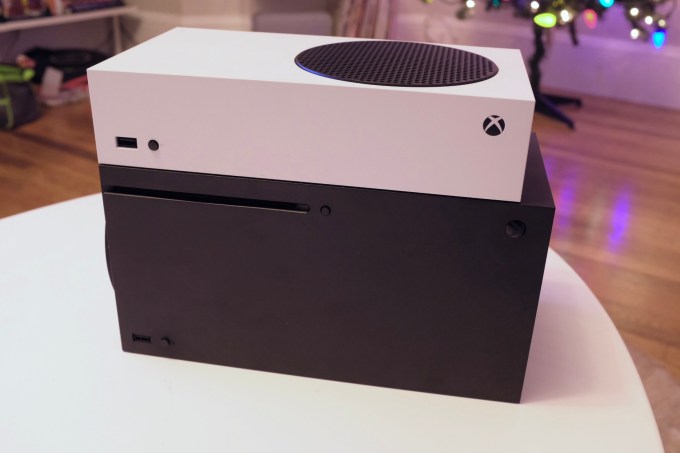
They definitely look different. The Series X itself is quite large (though not quite as hulking as the PS5) and will require plenty of prospective owners to bust out the measuring tape and check if it can even fit it horizontally in their media cabinet. It feels more like a well-designed gaming PC than a console. The chassis is very solid and dense — it’s one of the least-fragile designs I’ve seen on a console. On the note of hardware, I will also say that while the Series X/S controllers are very similar to the previous generation, I think that the subtle improvements, especially in regards to the feel and texturing of it, are going to be popular with users.

Most of the people reading this, I’m sure, already have a pretty solid idea whether or not they’re going to buy the Series X, and many of those people will buy it simply because it is new and they know that regardless of whether they currently need the power or are able to harness it with their other gear, they are getting access to new titles and future-proofing themselves. That’s certainly not a bad reason.

Image Credits: Lucas Matney

Others might be on the fence about getting a Series X/S or a PlayStation 5. Much like American politics, I’m not so convinced there are quite as many undecideds here as is believed. People have a good idea of which franchises are PlayStation exclusives and which titles are only going to ship on Xbox. There have been decades to drill down the flavors that both Sony and Microsoft are pushing, though Microsoft has been getting more aggressive about studio acquisitions over the past couple years, so that list of exclusives is likely going to start getting longer more quickly as they seek to build up a huge library of titles for their Game Pass subscription service.

But, yeah, most of the people on the fence end up going for the system that is going to have the games on it that they really, really want to play. But it’s a little harder to tell that right now because chances are there isn’t a launch title for the PS5 or Series X that you’re dying to play, or at least one that couldn’t also be played on a previous-gen console, albeit in less optimized fashion. The promised Series X holiday showstopper Halo Infinite was delayed until 2021, and the reality is a game that really shows off this hardware probably won’t be coming around until late next year.

Really most people won’t be able to take full advantage of the Series X until next year anyway. There’s an overwhelming chance that your TV or AV receiver are not positioned to maximize what the Series X can offer, namely 8K gaming or high frame rate (120fps) 4K gaming. Hitting the high end requires a technology called HDMI 2.1 which only a select few newer TVs have adopted. It’s likely to be more standard across the board come next year, but for the time being there aren’t many of these TVs or AV receivers that are actually in people’s homes. With HDMI 2.0, which your 4K TV does support, you can play Series X titles at 4K resolution at up to 60fps, closer to what the previous-generation Xbox One X was capable of.

Being super early to a technology as a consumer often leads to trade-offs, and that’s definitely the case with the Series X/S. While operating at the cutting edge of video standards will benefit the console’s longevity, it does mean that consumers might be in a less optimal spot for a bit if they don’t have the latest AV hardware. What will be more frustrating to day-one buyers is the generally light library of new content. There are some multi-platform hits that will be landing, but it doesn’t seem like there will be a must-play title that makes the most of its power. For consumers that are buying a system so focused on performance, that’s disappointing, but over time, I have few doubts that the Series X/S library will grow robust. The questions for consumers is whether all of the quality-of-life improvements are enough for them to take the plunge in 2020.

Powered by WPeMatico

Dear Sophie: How will this election nail-biter affect immigration?

Sophie Alcorn
Contributor

Sophie Alcorn is the founder of Alcorn Immigration Law in Silicon Valley and 2019 Global Law Experts Awards’ “Law Firm of the Year in California for Entrepreneur Immigration Services.” She connects people with the businesses and opportunities that expand their lives.

Here’s another edition of “Dear Sophie,” the advice column that answers immigration-related questions about working at technology companies.

“Your questions are vital to the spread of knowledge that allows people all over the world to rise above borders and pursue their dreams,” says Sophie Alcorn, a Silicon Valley immigration attorney. “Whether you’re in people ops, a founder or seeking a job in Silicon Valley, I would love to answer your questions in my next column.”

Extra Crunch members receive access to weekly “Dear Sophie” columns; use promo code ALCORN to purchase a one or two-year subscription for 50% off.


Dear Sophie:

The last 24 hours have been a nail-biter; I feel powerless and I’m angry that we’ve come to this. I’m worried things won’t improve and I’m confused about where we even stand.

Sometimes I just feel so very, very tired of the struggle. I am just so ready to let go. I want to live in a world where we can create harmony, peace and opportunity for all. Can I still find that in the United States?

— Wanting in Walnut Creek

Dear Wanting,

I hear you.

The good news is that there is great potential, even as the world watches the U.S. presidential election results. If anything, what the last four years have taught me is that two clichés are really true: necessity is the mother of invention, and, where there is a will, there is a way. I can relate to many folks around the world because I know what it’s like to have the world of Silicon Valley feel so close, yet so far away, at a time when I felt powerless to make a difference.

Looking back over the past four years, amazing things have been possible for our clients and my team at Alcorn Immigration Law. I founded the firm out of my kitchen just years ago when my kids were toddlers. I would look out my kitchen window hand-washing tiny baby dishes. I can still remember the feeling of the suds on my fingers as I gazed longingly at the tall building on Castro Street in downtown Mountain View where 500 Startups used to sit on the top floor. YC was just down the street.

I felt so powerless. I desperately wanted to make the world a better place, and reaching the world of Silicon Valley, even though it was just past my backyard, seemed like getting to Mars.

From those humble beginnings to now, as I founded and bootstrapped Alcorn Immigration Law on my own journey of becoming a single mom, I know what’s possible, even during the last four years of the Trump administration. We’ve had amazing success — claiming thousands of victories in supporting companies, people and families to live and work legally in the United States. If I was able to grow my firm during the last four years, I know that it’s possible for anybody to follow their heart and succeed. It’s our human essence to long to be a creator in this world, and anybody can and deserves to make a difference.

And here is what else I know: immigration law is created by acts of Congress and signed into law by the president. Mere tweets may be intended to try to bend the rules, but they cannot break them. That is what democracy is about.

In democracy, we have agreed to abide by basic laws, such as the inviolable dignity of the human being and that we want to agree on procedures for how we make decisions, like the process of passing a law about immigration. Democracy is not about majority tyranny. Democracy is about the fact that we uphold a few principles and we agreed on a decision-making process. When Trump ignores our basic laws and he ignores our legal processes, democracy is in peril.

But democracy does not need to be disrupted, it only requires small adjustments to thrive. In any group it is possible to make jointly supported decisions, taking the needs and resources of all into consideration. “Although the world is complex and decision making is complex, the components of decision making are simple,” according to Richard Graf, founder of K-i-E. Simple tools like the DecisionMaker can allow a miracle to happen — in an environment of openness and anonymity, we can all safely share our needs and concerns so that proposals can be formed based on collective best practices, knowledge, experience, intelligence and intuition. Even if it’s a complex situation, the way forward can immediately become clear.

And in our democracy, the paths to live and work in the U.S. will always remain viable, even if we need to remove a branch or navigate around a new boulder. Here at Alcorn, despite the furor and fear-mongering present in the world surrounding immigration, we are continually securing real victories for our clients. Not a client yet? Global founders can still create a startup, pitch it to investors and secure pathways to live and work legally in the United States with visas, green cards and citizenship.

So I know this and will repeat: Whatever the election results, there will still be many ways for people to legally navigate the U.S. immigration process and access the opportunity and security of life here. For more insight on these ways, please join my Election Results Webinar next week.

In the meantime, here are my thoughts on how the election results will affect the future of U.S. immigration:

Looking ahead, if Biden takes the victory, he has pledged to undo all Trump-era immigration regulations in the first 100 days and support comprehensive immigration reform. He promised to promote immigrant entrepreneurship, which could finally mean a startup visa! He also wants to speed up naturalization, rescind the Muslim travel bans, pass legislation to expand the number of H-1Bs, increase the amount of employment-based green cards, exempt international STEM PhD graduates from needing to await a priority date, create a new type of green card to promote regional economic development and support immigrant entrepreneur incubators.

Alternatively, we can expect that a Trump administration would continue restricting immigration, leading to litigation and judges deciding the fate of many recent policies. We can foresee a continued COVID freeze on green card interviews at consulates.

Also, DHS recently announced its intent to remove the randomness from the H-1B lottery and prioritize the annual H-1B selection process from highest to lowest wage starting in spring 2021. I’m sure there will be litigation about this; in the meantime, Alcorn Immigration Law continues to recommend that all employers proceed with registering employees and candidates in the lottery as usual. These details will take time to shake out and we don’t want anybody to lose a chance at being selected.

In other updates, immigration is just continuing along and there is actually some great news for folks: The State Department recently released the November Visa Bulletin and it stayed the same from October. (If you think your priority date is current or may be current soon, please contact your attorney as soon as possible to discuss filing your I-485 this month to avoid the possibility of retrogression in December!)

And if you need the freedom to build your startup, but were told that you don’t yet qualify for an O-1A visa, EB-1A or EB-2 NIW green card, you can join me in Extraordinary Ability Bootcamp with promo code DEARSOPHIE to receive 20% off.

We’re optimistic about the future. Life always offers us opportunities to grow through contrast and uncertainty, and we remain passionate about our mission to create greater freedom, empowerment, knowledge and love in the world.

Sophie


Have a question? Ask it here. We reserve the right to edit your submission for clarity and/or space. The information provided in “Dear Sophie” is general information and not legal advice. For more information on the limitations of “Dear Sophie,” please view our full disclaimer here. You can contact Sophie directly at Alcorn Immigration Law.

Sophie’s podcast, Immigration Law for Tech Startups, is available on all major podcast platforms. If you’d like to be a guest, she’s accepting applications!

Powered by WPeMatico
B2B marketplaces will be the next billion-dollar e-commerce startups

Merritt Hummer
Contributor

Merritt Hummer is a partner at Bain Capital Ventures, where she invests in the fintech, e-commerce and proptech sectors.

Startups involved in B2B e-commerce such as Faire and Mirakl have burst out of the gates in 2020. Almost overnight, these startups transformed into consequential platforms, earning billion-dollar valuations along the way. The B2B e-commerce industry has broad reach, encompassing everything from commerce infrastructure and payments technology to procurement and supply-chain solutions. But one area of the B2B e-commerce sector holds outsized promise: marketplaces.

These venues for buyers and sellers of business-related products are exploding in popularity, fueled by better infrastructure, payments and security on the back-end and companies’ increased need to conduct business online during the pandemic.

Even before the pandemic, B2B marketplaces were expected to generate $3.6 trillion in sales by 2024, up from an estimated $680 billion in 2018, according to payments research firm iBe TSD. They were already growing more quickly than most B2C marketplaces that predated them, and when COVID shutdowns hit, many companies scrambled to shift all purchasing online. A survey of business buyers conducted by Digital Commerce 360 found that 20% of purchasing managers spent more on marketplaces, and 22% spent significantly more, during the pandemic.

For many entrepreneurs running B2B marketplaces, the pandemic created new demand for their platforms. Yet to convince businesses to make a permanent shift to online purchasing, B2B marketplaces cannot simply remain stagnant, serving as simple transactional platforms. Those that innovate now to introduce adjacent services will emerge as winners in the next few years, with some inevitably becoming billion-dollar companies.

As a venture capital investor in B2B e-commerce companies, I’m carefully watching the industry and have seen several forward-thinking business models emerge for B2B marketplaces. The predominant revenue model of B2C marketplaces, the gross merchandise value (GMV) take rate, or percentage of each transaction, doesn’t always translate well in the B2B world. Instead, B2B marketplaces are discovering creative new ways to monetize their networks, ensuring their approach is tailored to the complex and nuanced world of B2B e-commerce. I’ll delve into each of these models below, providing examples of marketplaces that have successfully begun implementing them.

What makes B2B transactions unique? Before discussing how B2B marketplaces can deploy new business models, it’s important to think about how B2B transactions typically work.

Payment methods: There are four main ways to make a B2B payment: paper check, ACH transfer, electronic fund transfer (wires), and credit/debit cards. Nearly half of B2B payments are still made by paper check, but digital payment solutions are quickly gaining.

Financing: It is customary in B2B transactions to pay “with terms,” such as net 30 or net 60, effectively giving a line of credit to the business buyer that enables them to send payment after delivery of the good or service. Supply-chain financing and dynamic discounting are two mechanisms business buyers use to settle invoices with suppliers on preferred timelines.

Bulk discounts: Business buyers often expect and receive discounts in return for placing high-volume orders. While not a concept unique to B2B, negotiated or custom volume discounts can complicate the checkout process.

Contractual pricing: Businesses often enter into enterprise-level pricing agreements with their suppliers. In some B2B verticals, such as the veterinary supplies market, there is little consistency and transparency regarding the market price of any given item; instead, each buyer pays a bespoke price tied to contractual agreements. This dynamic typically benefits suppliers, which can price discriminate based on buyers’ ability and willingness to pay.

Delivery method and timing: Unlike consumers, businesses may place orders for goods but delay delivery for weeks or months. This is particularly common in the commodities market, where futures contracts specify a commodity to be delivered on a certain date in the future. B2B transactions typically include a negotiation on delivery method and timing.

Insurance: Business buyers frequently purchase insurance as part of their transactions, particularly in high-value verticals such as jewelry. Insurance is designed to protect against damage to the goods in transit or theft.

Compliance: In some verticals, particularly those related to healthcare and chemicals, there is a heavy compliance burden to ensure goods are properly sourced and transported. Is the seller legally registered to sell and transport sensitive goods such as medical equipment or pharmaceuticals?

With all of these considerations, it’s no wonder B2B e-commerce has been slower to digitize than B2C. From product discovery through the checkout process, a consumer buying a bag of licorice looks nothing like a retailer buying 100,000 bags of licorice from a distributor. The good news for B2B marketplace founders is that, based on the parameters above, there are many creative ways to extract value from transactions that go beyond the GMV take rate. Let’s explore some of the creative ways to monetize a B2B marketplace.

Powered by WPeMatico

Zynga reports record revenue and strong user growth while still losing $122M

Zynga’s revenue grew to a record $503 million (up 46% year-over-year) in the third quarter, with bookings of $628 million (up 59%), according to its latest earnings report. It also had its best mobile daily active user (31 million) and monthly active user (83 million) numbers in six years.

But things weren’t all rosy: The company also reported a net loss of $122 million. That compares to net income of $230 million during the same period last year, though that was boosted by the sale of Zynga’s building in San Francisco. As of 4:44 p.m. Eastern, shares were down 4.9% in after-hours trading.

Before earnings were released, CEO Frank Gibeau told me that although growth has become more normal after the pandemic caused “that huge jump” in usage during the late spring and early summer, “Engagement remains elevated and monetization remains elevated. Folks that discovered mobile gaming for the first time returned to it and kept doing it.”

The company predicted further growth in Q4, with revenue up 55% to $570 million. Gibeau pointed to a “digital holiday” that could have big benefit in mobile gaming, with new mobile on the market, plus social distancing and lockdowns resulting in the fact that “a lot of folks aren’t going to be able to go to stores and buy gifts.”

During the third quarter, Zynga also closed its acquisition of Istanbul-based hyper-casual game publisher Rollic. Gibeau said the team is “fully integrated at this point from an operating standpoint,” but the company won’t start including Rollic in its user numbers until the next quarter.

“We are well-positioned for further M&A,” he added.

Powered by WPeMatico

Learn how to score your first check with TMV’s Soraya Darabi on November 10

When it comes to financing a startup, the most important — and hardest — check to land is the very first one.

The growth of accelerators, rolling funds, community funds, hungry angels and institutional investors has given founders more options than ever before, but for women and people of color, access to funding continues to be a struggle.

On Tuesday, November 10 at 11:00 a.m. PT/2:00 p.m. ET, we’re bringing venture capitalist Soraya Darabi of TMV to the Extra Crunch Live stage to talk about how to get that first “yes” as an early-stage company and which founder mistakes often lead her to say “no.” We’ll walk through her theses, which range from future work and edtech, and double-click into what she needs to see in terms of metrics and product upon first pitch.

Darabi founded TMV, formerly Trail Mix Ventures, in 2016, and has built a portfolio that is majority women and minority-owned, including employee wellness platform Bravely, holistic healthcare company Parsley Health and waste reduction upstart Ridwell. TMV is often the first institutional check that a company might raise.

Before TMV, Darabi spent time at The New York Times as the manager of digital partnerships and social media marketing. She also was the co-founder of two companies: Zady, which helps with sustainable fashion manufacturing, and Foodspotting, a visual guide that helps locals find dishes near them that was acquired by OpenTable.

There’s an excess of capital in startupland, which could look remarkably different in the coming months. Join us to learn more about how a venture capitalist is thinking about the next few months, and dare we say, the end of 2020.

Details after the jump:

Powered by WPeMatico

Will new SEC equity crowdfunding rules encourage more founders to pass the hat?

The flow of venture capital in 2020 has been surprisingly strong given the year’s general uncertainty, but while investors have showered plenty of dough on growth-stage companies, seed-stage startups are down 32% last quarter compared to the year before.

There have been plenty of recent conversations about alternative funding routes for founders, and one of those oft-overlooked paths has been equity crowdfunding. While crowdfunding platforms like Kickstarter push consumers to back unrealized projects in exchange for products or other services, equity crowdfunding allows consumers to actually invest cash and receive a piece of the company. It’s not a conventional path, but it can be a viable option for companies that have a close relationship with an engaged customer base.

The Security and Exchange Commission’s Regulation Crowdfunding guidelines were adopted under Title III of the JOBS Act back in 2016, but because many entrepreneurs were unfamiliar with how to participate, many of the startups that have taken advantage of it haven’t been the highest quality. The tide could be turning: This week, the SEC updated some of its guidance on crowdfunding, eliminating some ambiguities and increasing the amount of capital companies can raise from both accredited and nonaccredited investors. Additionally, companies can now raise $5 million per year using equity crowdfunding, compared to the previous limit of $1.07 million.

But life has gotten easier in other ways as well for founders pursuing this fundraising type and the platforms that seek to simplify it.

Wefunder is one of a handful of equity crowdfunding platforms that have popped up in the last few years. Before a company can raise on its platform, Wefunder vets them before allowing them to tap into their network of amateur investors who can invest as little as $100 with the median investment sitting at $250. Last month, 40 companies launched on Wefunder and collectively raised $12 million, according to Wefunder CEO Nicholas Tommarello.

Powered by WPeMatico