1010Computers | Computer Repair & IT Support

Only 72 hours left until early-bird savings end for TC Sessions: Space 2020

We’re just about a month away from TC Sessions: Space 2020, a two-day conference dedicated to bold visionaries with the passion, audacity and technical skills to chart a new course in space. Fun fact: A bold visionary likes a good deal as much as the next one.

But timing is everything. The deadline for securing the early-bird price expires in just 72 hours. Buy your pass before prices go up on stardate 98468.52 (aka 11.13.20 at 11:59 p.m. PST) and save $100.

If you’re looking for more ways to save, we’ve got you covered. We offer group discount passes ($100 each — bring four team members and get the fifth one free); student discounts ($50); and discounts for government, military and nonprofits ($95). If you subscribe to Extra Crunch, knock an extra 20% off the price of admission.

Your pass provides access to all live sessions and video on demand, making it easy to network with attendees or conduct other business during your day. Plus, you don’t have to choose between presentations that air simultaneously.

What can you expect on this space odyssey? You’ll hear from — and get to engage with — some of the most important movers and shakers across public, private and defense sectors. Enjoy interviews, panel discussions, breakout sessions and interactive Q&As geared to help early-stage startups build and succeed.

Here’s a taste of what we have on tap. Check out the event agenda to strategize your schedule.

Fast Money — The Space Force Accelerators: Learn how the Hyperspace Challenge, Catalyst Space Accelerator and other government accelerators can connect you to the U.S. Space Force.

Ground Control to Major Tom: Data connectivity and communications are key to commercial space monetization and the strategic plans for further space exploration and development. Hear from the key players about the state of play in the industry.

In Space, No One Can Change Your Oil — Yet: Once a spacecraft is in orbit, it’s on its own — but what if it could be refueled, repaired, refurbished and, if necessary, retired? OrbitFab founder Daniel Faber and Astroscale U.S. President Ron Lopez discuss how in-space operations could upend today’s engineering and business models.

Hot Tip: Looking to increase engagement and exposure for your space startup? Buy a Startup Exhibitor Package and you’ll get five minutes to pitch your company live to thousands of global attendees.

No matter where you fall in the early-stage startup ecosystem, TC Sessions: Space 2020 is dedicated to helping visionaries like you succeed. Join your people at the best possible rate and secure your pass before the early-bird deal expires in 72 hours on 11.13.20 at 11:59 p.m. PST. Make it so.

Is your company interested in sponsoring TC Sessions: Space 2020? Click here to talk with us about available opportunities.


Powered by WPeMatico

As edtech crowds up, Campuswire bets big on real-time learning

Campuswire was in a fortuitous spot when colleges and universities across the world shut down on short notice because of the threat of coronavirus. Founded by Tade Oyerinde in 2018, Campuswire is a virtual solution for any teacher who wants to digitize their internal classroom communications, from Q&A time to the lecture itself.

The strategy, for the most part, has worked. Campuswire is now used at more than 300 universities among 200,000 students, Oyerinde tells me.

While Campuswire’s pitch was set to boom overnight, the founder instead saw a bigger challenge approaching: more competition. As professors moved online, lectures moved to Zoom or tools built atop of Zoom. Microsoft Teams and Google Hangouts filled in the gap for classrooms that couldn’t afford fancy licenses. Campuswire’s key monetization strategy, which was selling pro licenses for its online class software, felt threatened by alternatives.

So, after months of iterating, Campuswire has adapted its monetization strategy and today announced that it is launching live courses taught by professors. Instead of solely working with professors to streamline internal class communications, Campuswire will now help teachers produce classes that students can then take for a fee. The tuition revenue will be split between the teacher and Campuswire.

Campuswire courses kick off with an angel investing class taught by Charles Hudson, the founder and general partner of Precursor Ventures. Hudson lectures at Stanford occasionally, and working with Campuswire allows him to teach a broader set of students.

Meanwhile, Campuswire software will be free to use starting in January 2021.

The move marks Campuswire’s further dive into synchronous learning. Campuswire’s model is built on how existing classrooms work in universities and colleges. Classes on Campuswire are capped at 500 to promote conversation, and large lectures are supplemented with teacher assistant (TA) classes to hammer home confusing concepts.

Meanwhile, it’s clear amid the pandemic that asynchronous learning has its perks (students can learn on their own schedule, while educators are able to work more flexible hours). Still, Oyerinde thinks a pre-recorded format is not effective for pedagogy purposes.

“This is kind of the hill we’re going to die on,” he said. “Real, lasting learning has to be synchronous for the majority of people.”

In other words, while there’s a small group of gifted-and-talented students who can watch a one-hour lecture and absorb every factoid and nuance, the majority of students need engagement, interaction and motivation to understand a topic, he argues. It’s the reason why MOOCs, or massive open online course providers, only have a 2-3% completion rate on their courses, he argues.

At its core, Campuswire has evolved from a platform trying to compete with Zoom to a platform that is trying to compete with these MOOCS through engaging content taught by experienced professors. Its main differentiation from MOOCs is that it’s live and has teacher assistants.

There are a number of startups that are trying to create engaging, celebrity professor-taught classes through hybrid plays. MasterClass, which just raised $100 million a few months ago, sells entertainment and education in one go, offering cooking classes from Gordon Ramsay and tennis lessons from Serena Williams. While you can’t interact with Ramsay or Williams, you can chat with fellow classmates.

BookClub connects readers to the authors they are reading, giving bookworms an opportunity to ask about cliffhangers and character development. The upstart is still in its early stages, but founder David Blake says that readers could talk directly to authors down the road. There’s also Teachable, which got acquired by Hotmart earlier this year. Teachable helps any expert who wants to create a business around their expertise do so with a virtual course. Arlan Hamilton, a seed-stage investor, has a course on the platform.

Today’s pivot signals the founder’s mindset that, in order to grow to the billion-dollar business mark in edtech, you need to sell more than software that Google and Microsoft will always give away for free.

“Online learning can be 100 times bigger than it is today,” Oyerinde said. “Once you actually support synchronicity, you actually support people getting to actually interact with UCLA/Princeton/Cornell professors, not just watching them on pre-recorded videos.”

Powered by WPeMatico

Square and PayPal earnings bring good (and bad) news for fintech startups

Earnings season is racing past us, with the big ride-hailing companies’ numbers in, all of the Big Five having wrapped their reporting and lots of SaaS numbers in the market. But amidst all the noise, The Exchange has kept an eye on two companies in particular: PayPal and Square.

We’re not really concerned with their overall revenue and profit metrics. Instead, we’ve been hunting around in their numbers for hints and notes about what is going on inside of fintech itself. Why? There are a host of hugely valuable fintech unicorns that have to go public in the future that also share some market space with one or both of our public charges.

What can we learn from looking at what PayPal and Square reported to their own investors?


The Exchange explores startups, markets and money. Read it every morning on Extra Crunch, or get The Exchange newsletter every Saturday.


Lots, it turns out.

As TechCrunch reported when PayPal dropped its Q3 numbers, the public company had bullish results from its Venmo service, payment processing and consumer activity metrics. The numbers pointed to strong consumer adoption of fintech services during the pandemic, something that we presumed was not unique to PayPal itself, but was likely indicative of a generally warm environment for consumer fintech services.

Square continued the trend, posting a set of results that contains nearly all positive data for consumer fintech activity — with one critical caveat for Q4 that we’ll get to at the end.

Still, what the majors tell us about the fintech space indicates a warmth in activity that explains why Chime, Robinhood and others have had such fun in 2020, accreting tectonic capital to keep their growth hot.

Digging through Square’s earnings gives us a window into consumer payment activity, card usage, stock purchases and more. Let’s see what we can learn, and to which unicorns it might apply.

A very fintech 2020

Let’s start by talking about the broader fintech market before niching down.

Powered by WPeMatico

Fishtown Analytics raises $29.5M Series B for its data engineering platform

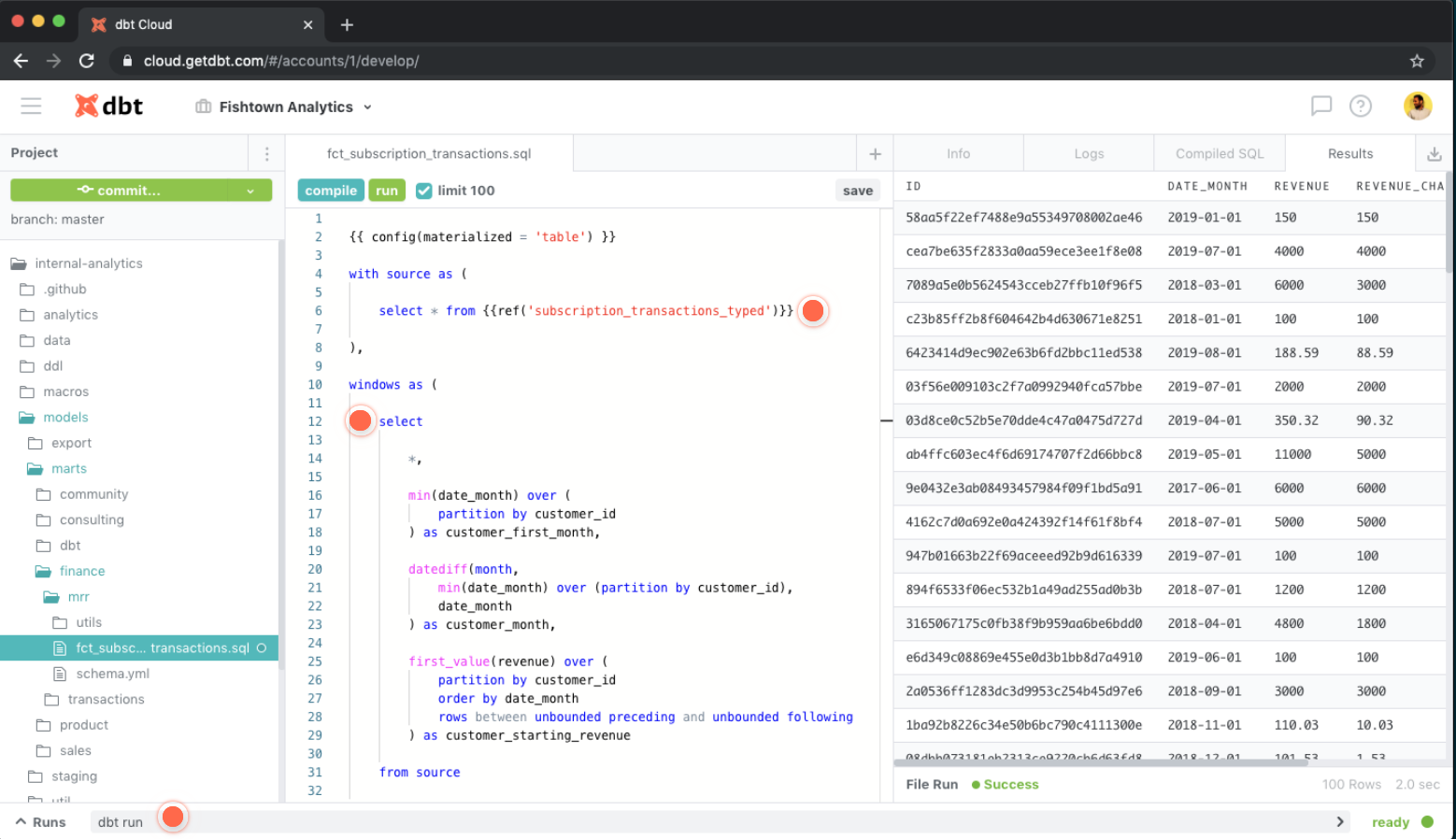
Fishtown Analytics, the Philadelphia-based company behind the dbt open-source data engineering tool, today announced that it has raised a $29.5 million Series B round led by Sequoia Capital, with participation from previous investors Andreessen Horowitz and Amplify Partners.

The company is building a platform that allows data analysts to more easily create and disseminate organizational knowledge. Its focus is on data modeling, with its dbt tool allowing anybody who knows SQL to build data transformation workflows. Dbt also features support for automatically testing data quality and documenting changes, but maybe most importantly it uses standard software engineering techniques to help engineers collaborate on code and integrate changes continuously.

If this all sounds a bit familiar, it’s probably because you saw that Fishtown Analytics also announced a $12.9 million Series A round in April. It’s not often we see both a Series A and B round within half a year, but that goes to show how the market for Fishtown’s service is expanding as companies continue to grapple with how to best make use of their data — and how much investors want to be part of that. 

Image Credits: Fishtown

“This was a very productive thing for us,” Fishtown Analytics co-founder and CEO Tristan Handy told me when I asked him why he raised again so quickly. “It’s standard best practice to do quarterly catch-ups with investors and eventually you’ll be ready to fundraise. And Matt Miller from Sequoia showed up to one of these quarterly catch-ups and he shared the 40-page memo that he had written to the Sequoia partnership — and he came with the term sheet.”

Initially, Handy declined. “We’re very bullheaded people, I think, as many founders are. It took some real reflection and thinking about, ‘is this what we want to be doing right now?’ ”

In the end, though, the team decided to go ahead with this round — mostly because this round allowed the team to think long-term and provided stability and certainty.

One thing Handy has always been very clear about is that he did not found Fishtown to purely build the largest possible company but to solve its users’ problems, even as the market looked at companies like Databricks and Snowflake — and their financial success — as potential analogs. “My worry was that the financial markets were driving things that weren’t necessarily going to be good for our users,” Handy said.

Powered by WPeMatico

MTV partners with Unrd to create a mobile version of ‘Ghosted: Love Gone Missing’

Mobile storytelling startup Unrd is making its first move into adapting existing intellectual property — specifically “Ghosted: Love Gone Missing,” an MTV reality series about ghosting (the dating practice, not anything supernatural).

Until now, Unrd (pronounced “unread”) has created original crime, horror and romance stories that are told through characters’ phones, through content like text messages, video footage and more.

Starting next week, on November 16, the app will feature a version of “Ghosted” that — unlike the TV show — is scripted, as users explore characters’ text messages, photos and video calls to discover why they’ve been ghosted. They’ll even get to vote on whether the characters should “ghost” or “make up” before they see the stories’ ending (their votes won’t affect the outcome).

MTV Head of Digital Rory Brown told me that this was a “very close collaboration” between MTV and the Unrd team, led by CEO Shib Hussain.

“This is the first time they’ve partnered with an already established IP — but that didn’t scare us at all, to be that first media partner that they worked with,” Brown said. “There was a strong point of view on our side of the house how to keep it true to the existed format, while the Unrd team helped us reimagine it, and our collaboration met in the middle of that Venn diagram.”

Unrd

Image Credits: Unrd

He also argued that while interactivity can be “a bit of a buzzword in the industry,” Unrd isn’t focusing on “interactivity for interactivity’s sake.” Instead, the aim is to create “a more immersive experience for the user.”

Unrd will feature three stories tied to “Ghosted,” each of them unfolding over six days.

“The key thing that we do different is this notion of real time,” Hussain said. “You can’t just binge it and consume every story in one day. You’ve got to wait with the character for the next message. That’s more immersive, and it also builds that tension and excitement amongst users as well.”

Brown noted that these Unrd stories are launching during a break in the second season of “Ghosted.” The hope is that they’ll keep existing fans engaged while creating new fans as well.

“At MTV, we’re always going to keep looking at ways to test the elasticity of IP,” he said. “I think Unrd is one way to do that. We’re talking to other partners, but Shib and his team have been fantastic to work with and we’d love to keep the relationship going.”

Powered by WPeMatico

Greylock’s Asheem Chandna on ‘shifting left’ in cybersecurity and the future of enterprise startups

Last week was a busy week, what with an election in Myanmar and all (well, and the United States, I guess). So perhaps you were glued to your TV or smartphone, and missed out on our conversation with Asheem Chandna, a long-time partner at Greylock who has invested in enterprise and cybersecurity startups for nearly two decades now, backing such notable companies as Palo Alto Networks, AppDynamics and Sumo Logic. We have more Extra Crunch Live shows coming up.

Enterprise software is changing faster this year than it has in a decade. Coronavirus, remote work, collaboration and new cybersecurity threats have combined to force companies to rethink their IT strategies, and that means more opportunities — and challenges — for enterprise founders than ever before. In some cases, we are seeing an acceleration of existing trends, and in others, we are seeing all new trends come to the forefront.

All that is to say that there was so much on the docket to talk about last week. Chandna and I discussed what’s happening in early-stage enterprise startups, whether vertical SaaS is the future of enterprise investing, data and no-code platforms, and then this rise of “shift left” security.

The following interview has been edited and condensed from our original Extra Crunch Live conversation.

What’s happening today in the early-stage startup world?

Chandna has been a long-time backer of startups at their earliest stages, with some of his investments being literally birthed in Greylock’s offices. So I was curious how he saw the landscape today given all that prior experience.

TechCrunch: What sort of companies are exciting for you today? Are there particular markets you’re particularly attuned to?

Asheem Chandna: One is digital transformation. Every company is trying to figure out how to become more digital, and this has been accelerated by COVID-19. Second is information technology today and its journey to the cloud. I would say we might be about 10% or 15% of the way there. Some of the trends are clear, but the journey is actually still relatively early, and so there’s just a ton of opportunity ahead.

The third one is leveraging data for better predictability along with analytics. Every CEO is looking to make better decisions. And you know, most leaders make decisions based on gut instinct and a combination of data. If the data can tell a story, if the data can help you better predict, there’s a lot of potential here.

I view these as three macro trends, and then if one was to add to that, I would say cybersecurity has never been more important than it is today. I’ve been around cyber for over two decades, and just the prominence and importance and priority has never been more important than today. So that’s kind of another key area.

I want to dive into your first category, digital transformation. This is a phrase that I feel like I’ve heard for a decade now, with “Data is the new oil” and all these sorts of buzzwords and marketing phrases. Where are we in that process? Are we at the beginning? Are we at the end? What’s next from a startup perspective?

Due to COVID-19 and because of the way people are working today, digital’s become the primary medium. I would still say we’re early, and you can literally look sector by sector to see how much more work there is to do here.

Take enterprise sales itself, which is early in what I consider digitalization. It’s even more important today than it was a year ago. I’m using video to basically communicate, and then the next piece would basically be trialing of software. Can I allow even complex software to be self trials and can I measure the customer journey through that trial? Then there’s the contracting of the software, and we go to the sale process, can all that be done digitally?

So even when you take something as very mundane as enterprise sales, it’s being transformed. Winning teams, winning software entrepreneurs, they understand this well, and they’d be wise to examine every step of this process, and instrument it and digitize it.

Vertical versus horizontal plays in enterprise


Powered by WPeMatico

Bootstrapped Clearfind wants to cut your software spend, for a small fee

Software is eating the world, and that grub can be costly. As the market for enterprise tools and software continues to balloon, organizations are spending more and more on that software across an increasingly complicated and rapidly evolving landscape.

That’s where Clearfind comes in.

Clearfind was founded (and bootstrapped) by James Layfield and Jocelyn Simons. The startup aims to provide clarity and transparency to organizations looking to buy enterprise software. Over the past two years, Clearfind has been building out its backend, which is a mix of machine learning and humans, to distill a software offering down to its features.

When clients join the Clearfind platform, they give the startup access to their backend through integrations with products like Sage, Quickbooks, SAP, etc. so that Clearfind can take a look at their overall software spend. CIOs or CTOs can then see if there are any redundancies in their current software suite. These executives can also input the use case they’re looking to solve and Clearfind will deliver a detailed report on which SaaS products have the features to solve for it.

Before Clearfind, this process could be incredibly manual or costs tens and sometimes hundreds of thousands of dollars through a consultancy. And even then, those consultants may likely be recommending the products that have paid for top placement, not necessarily the best fit.

Image Credits: Clearfind

Clearfind makes money by charging 1.2 cents per dollar of annual software spend. The company says that it usually reduces spend by about 30 percent for most of the companies it works with by helping them optimize their software ecosystem and eliminate redundancies.

Clearfind also generates revenue through referral fees that come from search within Clearfind. Layfield and Simons were clear that vendors can not pay to influence search results or for placement on the Clearfind front-end, but rather pay for the leads that come through. These fees vary from vendor to vendor.

“When a vendor gets a lead from us, they prioritize it because it’s the most qualified lead they’ll ever get,” said Layfield. “That vendor will know everything. about the buyer and that the buyer is looking for all the criteria their product meets, and how much the buyer is willing to pay. That’s a level of qualified lead that just does not exist.”

Layfield explained there is an even more important reason for vendors to pay a referral fee, which is the implied LTV of a Clearfind lead. A customer that actually wants and needs the product, and the features it provides, is far less likely to churn.

Clearfind isn’t alone in the space. YC-backed Vendr, which is already profitable, is also looking to reduce SaaS spend and Intello, which doesn’t just give a view of software in use but also includes a compliance component.

Powered by WPeMatico

Palo Alto Networks to acquire Expanse in deal worth $800M

Palo Alto Networks has been on a buying binge for the last couple of years, and today it added to its haul, announcing a deal to acquire Expanse for $800 million in cash and equity awards. The deal breaks down to $670 million in cash and stock and another $130 million in equity awards to Expanse employees.

Expanse provides a service to help companies understand and protect their attack surface, where they could be most vulnerable to attack. It works by giving the security team a view of how the company’s security profile could look to an attacker trying to gain access.

The plan is to fold Expanse into Palo Alto’s Cortex Suite, an AI-driven set of tools designed to detect and prevent attacks in an automated way. Expanse should provide Palo Alto with a highly valuable set of data to help feed the AI models.

“By integrating Expanse’s attack surface management capabilities into Cortex after closing, we will be able to offer the first solution that combines the outside view of an organization’s attack surface with an inside view to proactively address all security threats,” Palo Alto Networks chairman and CEO Nikesh Arora said in a statement.

Expanse sees the acquisition as a way to accelerate the company road map using the resources of a larger company like Palo Alto, a typical argument from companies being acquired. “Joining forces with Palo Alto Networks will let us achieve our most important business goals years ahead of schedule. During the course of conversations with Palo Alto Networks leadership, we shared optimism that the right combination of technology and people can solve many cybersecurity challenges that to date have seemed intractable,” the startup’s founders wrote in a blog post announcing the deal.

The two co-founders, Dr. Tim Junio and Dr. Matt Kraning, will be joining Palo Alto under the terms of the deal, which is expected to close in Palo Alto’s fiscal second quarter, assuming it passes regulatory muster.

Expanse was founded in 2012 and has raised $136 million, according to Crunchbase data. Its most recent raise was a $70 million Series C last year, which was led by TPG.

Today’s acquisition is Palo Alto’s third in 2020 and the 10th since 2018. Palo Alto stock was up 2.15% in early trading.

Powered by WPeMatico

Mozart Data lands $4M seed to provide out-of-the-box data stack

Mozart Data founders Peter Fishman and Dan Silberman have been friends for over 20 years, working at various startups, and even launching a hot sauce company together along the way. As technologists, they saw companies building a data stack over and over. They decided to provide one for them and Mozart Data was born.

The company graduated from the Y Combinator Summer 2020 cohort in August and announced a $4 million seed round today led by Craft Ventures and Array Ventures with participation from Coelius Capital, Jigsaw VC, Signia VC, Taurus VC and various angel investors.

In spite of the detour into hot sauce, the two founders were mostly involved in data over the years and they formed strong opinions about what a data stack should look like. “We wanted to bring the same stack that we’ve been building at all these different startups, and make it available more broadly,” Fishman told TechCrunch.

They see a modern data stack as one that has different databases, SaaS tools and data sources. They pull it together, process it and make it ready for whatever business intelligence tool you use. “We do all of the parts before the BI tool. So we extract and load the data. We manage a data warehouse for you under the hood in Snowflake, and we provide a layer for you to do transformations,” he said.

The service is aimed mostly at technical people who know some SQL like data analysts, data scientists and sales and marketing operations. They founded the company earlier this year with their own money, and joined Y Combinator in June. Today, they have about a dozen customers and six employees. They expect to add 10-12 more in the next year.

Fishman says they have mostly hired from their networks, but have begun looking outward as they make their next hires with a goal of building a diverse company. In fact, they have made offers to several diverse candidates, who didn’t ultimately take the job, but he believes if you start looking at the top of the funnel, you will get good results. “I think if you spend a lot of energy in terms of top of funnel recruiting, you end up getting a good, diverse set at the bottom,” he said.

The company has been able to start from scratch in the midst of a pandemic and add employees and customers because the founders had a good network to pitch the product to, but they understand that moving forward they will have to move outside of that. They plan to use their experience as users to drive their message.

“I think talking about some of the whys and the rationale is our strategy for adding value to customers […], it’s about basically how would we set up a data stack if we were at this type of startup,” he said.

Powered by WPeMatico

SentinelOne, an AI-based endpoint security firm, confirms $267M raise on a $3.1B valuation

This year, more than ever before because of the COVID-19 pandemic, huge droves of workers and consumers have been turning to the internet to communicate, get things done and entertain themselves. That has created a huge bonanza for cybercriminals, but also companies that are building tools to combat them.

In the latest development, an Israel-hatched, Mountain View-based enterprise startup called SentinelOne — which has built a machine learning-based solution that it sells under the brand Singularity that works across the entire edge of the network to monitor and secure laptops, phones, containerised applications and the many other devices and services connected to a network — has closed $267 million in funding to continue expanding its business to meet demand, which has seen business boom this year. Its valuation is now over $3 billion.

Given the large sums the company has now raised — $430 million to date — the funding will likely be used for acquisitions (cyber is a very crowded market and will likely see some strong consolidation in the coming years), as well as more in-house development and sales and marketing. Earlier this year, CEO and founder Tomer Weingarten told me that an IPO “would be the next logical step” for the company. “But we’re not in any rush,” he said at the time. “We have one to two years of growth left as a private company.”

SentinelOne contacted TechCrunch with the above details but said that an official press release was due only to be released at 3 p.m. U.K. time. We’ll update with more details if they’re available when they are published. In the meantime, other outlets such as Calcalist in Israel (in Hebrew) have also published these details. And it should be noted that the round was rumored for almost a month ahead of this, although the sums raised were off by quite a bit: the reports had said $150-200 million.

(Side note: Why the pointless games with timings and exclusives? Who knows — I certainly don’t. )

This round included Tiger Global, Sequoia, Insight Partners, Third Point Ventures and Qualcomm Ventures . It looks like Sequoia — which is currently building up a new European operation to look more closely at opportunities on this side of the globe — is the only new name in that list. The others have all backed SentinelOne in previous rounds.

It was only in February of this year that SentinelOne had raised $200 million at a $1.1 billion valuation.

The rapid fundraising, from a top-shelf list of firms, is a notable aspect of this story.

In the world of startups, we are firmly living in a time when investors are looking for strong opportunities to back companies that are shining in a market that is particularly challenging. COVID-19 has all but decimated the travel industry and live in-person event industry, among others.

But services that are helping people continue to live their lives, and those that are helping find a cure or at least solutions to minimise the impact, are very much in demand.

The cybersecurity market — in particular companies that are providing solutions that can immediately prove to be effective in what is an increasingly sophisticated threat landscape — is incredibly active right now, even more than it already was.

“Around 450 cybersecurity companies are operating in Israel, constituting 5% of the global cybersecurity market, in some cyber segments the two world leaders are by Israeli founders like CheckPoint and Palo Alto,” noted Avihai Michaeli, an advisor who scouts startups for corporate VCs.

Within that, endpoint security, the area where SentinelOne concentrates its efforts, is particularly strong. Last year, endpoint security solutions was estimated to be around an $8 billion market, and analysts project that it could be worth as much as $18.4 billion by 2024.

While SentinelOne has a lot of competitors — they include Microsoft, CrowdStrike, Kaspersky, McAfee and Symantec — it is also a strong player in the market. Relying on the advances of AI and with roots in the Israeli cyberintelligence community, its platform is built around the idea of working automatically not just to detect endpoints and their vulnerabilities, but to apply behavioral models, and various modes of protection, detection and response in one go.

“We are seeing more automated and real-time attacks that themselves are using more machine learning,” Weingarten said to me this year. “That translates to the fact that you need defence that moves in real time as with as much automation as possible.”

As of February, it had 3,500 customers, including three of the biggest companies in the world, and “hundreds” from the global 2,000 enterprises, with 113% year-on-year new bookings growth, revenue growth of 104% year-on-year and 150% growth year-on-year in transactions over $2 million. Those numbers will have likely grown significantly since then. (We’ll update as and when we learn more.)

Powered by WPeMatico