Recent Funding
Auto Added by WPeMatico
Auto Added by WPeMatico
Breinify is a startup working to apply data science to personalization, and do it in a way that makes it accessible to nontechnical marketing employees to build more meaningful customer experiences. Today the company announced a funding round totaling $11 million.
The investment was led by Gutbrain Ventures and PBJ Capital with participation from Streamlined Ventures, CXO Fund, Amino Capital, Startup Capital Ventures and Sterling Road.
Breinify co-founder and CEO Diane Keng says that she and co-founder and CTO Philipp Meisen started the company to bring predictive personalization based on data science to marketers with the goal of helping them improve a customer’s experience by personalizing messages tailored to individual tastes.
“We’re big believers that the world, especially consumer brands, really need strong predictive personalization. But when you think about consumer big brands or the retailers that you buy from, most of them aren’t data scientists, nor do they really know how to activate [machine learning] at scale,” Keng told TechCrunch.
She says that she wanted to make this type of technology more accessible by hiding the complexity behind the algorithms powering the platform. “Instead of telling you how powerful the algorithms are, we show you [what that means for the] consumer experience, and in the end what that means for both the consumer and you as a marketer individually,” she said.
That involves the kind of customizations you might expect around website messaging, emails, texts or whatever channel a marketer might be using to communicate with the buyer. “So the AI decides you should be shown these products, this offer, this specific promotion at this time, [whether it’s] the web, email or SMS. So you’re not getting the same content across different channels, and we do all that automatically for you, and that’s [driven by the algorithms],” she said.
Breinify launched in 2016 and participated in the TechCrunch Disrupt Startup Battlefield competition in San Francisco that year. She said it was early days for the company, but it helped them focus their approach. “I think it gave us a huge stage presence. It gave us a chance to test out the idea just to see where the market was in regards to needing a solution like this. We definitely learned a lot. I think it showed us that people were interested in personalization,” she said. And although the company didn’t win the competition, it ended up walking away with a funding deal.
Today the startup is growing fast and has 24 employees, up from 10 last year. Keng, who is an Asian woman, places a high premium on diversity.
“We partner with about four different kinds of diversity groups right now to source candidates, but at the end of the day, I think if you are someone that’s eager to learn, and you might not have all the skills yet, and you’re [part of an under-represented] group we encourage everyone to apply as much as possible. We put a lot of work into trying to create a really well-rounded group,” she said.
Powered by WPeMatico
RevenueCat, a startup offering a series of tools for developers of subscription-based apps, has raised $40 million in Series B funding, valuing its business at $300 million, post-money. Founded by developers who understood the difficulties in scaling a subscription app firsthand, RevenueCat’s software development kit (SDK) solution gives companies the tools they need to build a subscription business, including not just adding subscriptions themselves, but maintaining them over time even as the app stores implement changes. It also aids by sharing subscription data with other tools the business uses, like those for advertising, analytics or attribution.
The funding round was led by Y Combinator’s Continuity Fund and included participation from Index Ventures, SaaStr, Oakhouse, Adjacent and FundersClub, as well as Blinklist CTO Tobias Balling and Algolia CEO Nicolas Dessaigne. With the round, YC Continuity Partner Anu Hariharan is joining RevenueCat’s board, which today includes Index’s Mark Fiorentino in addition to the founders.
Explains RevenueCat CEO Jacob Eiting, the idea for the company came about after he and co-founder Miguel Carranza Guisado (CTO) struggled to figure out subscription infrastructure while working together at Elevate. After years of untangling a “subscription mess” in order to figure out answers to basic questions like subscriber retention and lifetime value, they realized there was potential in helping solve this problem for other developers.
Apple and Google, Eiting explains, aren’t always up to date with what companies actually need to build subscription businesses. “They’re kind of learning as they go. They just weren’t able to provide us the data we needed, and then also the infrastructure to do that is non-trivial.”

Image Credits: RevenueCat
When Eiting and Guisado sat down to work on RevenueCat in 2017, no one else was even building anything like this. But the demand for the startup’s tools and integrations soon resonated with developers who had faced similar challenges in the growing subsection app market.
Using the service, developers can access a real-time dashboard that display key metrics, like subscription revenue, churn, LTV (lifetime value), subscriber numbers, conversions and more. The data can then be shared through integrations with other tools and services, like Adjust, Amplitude, Apple Search Ads, AppsFlyer, Branch, Facebook Ads, Google Cloud Intercom, Mixpanel, Segment and several others.
After launching out of Y Combinator’s accelerator the following year, RevenueCat was soon live with 100 apps and had crossed $1 million in tracked revenue by the time it raised its $1.5 million seed round.
Today, RevenueCat has more than 6,000 apps live on its platform, with over $1 billion in tracked subscription revenue being managed by its tools. That’s double the number of apps that were using its service as of its $15 million Series A last August.
With the additional funding, the company will lower its pricing to put its tools in reach of more developers. Previously, it charged $120 per month for its charts and some of its integrations, or $499 per month for access to all integrations. This was affordable for larger companies, but could still be a difficult sell to the long tail of app developers where revenues ranged from $10K to $50K per month.
Now, RevenueCat will charge a small percentage of an app’s sales instead of a flat fee. Developers with up to $10,000 in monthly tracked revenue (MTR) can get started with the service for free and as their demands grow — like needing access to charts, support for web hooks, integrations and others — they can move up to either the Starter or Pro plans as $8/mo or $12/mo per $1,000 in MTR, respectively.
“I’m excited to give those tools to developers, especially on the small end, because it might be what they need to get out of that ‘less than $10K range,’ ” Eiting says. “Also, the beauty of freemium, or having a really generous free tier, is that it makes your tool the de facto — you remove as much friction as possible for providing software services and then, if you get your pricing right — which I think we have — it all kind of pays for itself,” he adds.
The company also plans to use the new funds to further invest in its business, expanding from App Store and Google Play support to include Amazon’s Appstore. It will also grow its team.
As part of its expected growth, RevenueCat recently hired a head of Product, Jens-Fabian Goetzmann, previously a PM at Microsoft and then product head at fitness app 8fit. Currently 30 people, in the year ahead, RevenueCat will grow to 60 people, hiring across design, product, engineering, sales and other roles.
“The world is moving toward subscriptions — and for companies, building out this model translates to weeks of developers’ time,” says YC Continuity’s Hariharan. “RevenueCat helps developers roll out subscriptions in minutes and creates a source of truth for customer data. With developers creating solutions to problems in the world, it’s important that they can find ways to monetize, grow, and support their most committed customers. RevenueCat is doing so by building subscriptions 2.0.”
Powered by WPeMatico
Most marketers today know how to send targeted communications to customers, and there are many tools to help, but when it comes to sending personalized in-house messages, there aren’t nearly as many options. Pyn, an early-stage startup based in Australia, wants to change that, and today it announced an $8 million seed round.
Andreessen Horowitz led the investment with help from Accel and Ryan Sanders (the co-founder of BambooHR) and Scott Farquhar (co-founder and co-CEO at Atlassian).
That last one isn’t a coincidence, as Pyn co-founder and CEO Joris Luijke used to run HR at the company and later at Squarespace and other companies, and he saw a common problem trying to provide more targeted messages when communicating internally.
“I’ve been trying to do this my entire professional life, trying to personalize the communication that we’re sending to our people. So that’s what Pyn does. In a nutshell, we radically personalize employee communications,” Luijke explained. His co-founder Jon Williams was previously a co-founder at Culture Amp, an employee experience management platform he helped launch in 2011 (and which raised more than $150 million), so the two of them have been immersed in this idea.
They bring personalization to Pyn by tracking information in existing systems that companies already use, such as Workday, BambooHR, Salesforce or Zendesk, and they can use this data much in the same way a marketer uses various types of information to send more personalized messages to customers.
That means you can cut down on the company-wide emails that might not be relevant to everyone and send messages that should matter more to the people receiving them. And as with a marketing communications tool, you can track how many people have opened the emails and how successful you were in hitting the mark.
David Ulevitch, general partner at a16z and lead investor in this deal, points out that Pyn also provides a library of customizable communications materials to help build culture and set policy across an organization. “It also treats employee communication channels as the rails upon which to orchestrate management practices across an organization [by delivering] a library of management playbooks,” Ulevitch wrote in a blog post announcing the investment.
The startup, which launched in 2019, currently has 10 employees, with teams working in Australia and the Bay Area in California. Williams says that already half the team is female and the plan is to continue putting diversity front and center as they build the company.
“Joris has mentioned ‘radical personalization’ as this specific mantra that we have, and I think if you translate that into an organization, that is all about inclusion in reality, and if we want to be able to cater for all the specific needs of people, we need to understand them. So [diversity is essential] to us,” Williams said.
While the company isn’t ready to discuss specifics in terms of customer numbers, it cites Shopify, Rubrik and Carta as early customers, and the founders say there was a lot of interest when the pandemic hit last year and the need for more frequent and meaningful types of communication became even more paramount.
Powered by WPeMatico

Drug discovery is a large and growing field, encompassing both ambitious startups and billion-dollar Big Pharma incumbents. Engine Biosciences is one of the former, a Singaporean outfit with an expert founding crew and a different approach to the business of finding new therapeutics, and it just raised $43 million to keep growing.
Digital drug discovery in general means large-scale analysis of biological data like genes, gene expression, protein structures, binding sites, things like that. Where it has hit a wall in the past is not on the digital side, where any number of likely molecules or processes can be generated, but on the next step, when those notions need to be tested in vitro. So a new crop of biotech companies have worked to integrate these aspects.
Engine does so with a pair of tools it has dubbed NetMAPPR and CombiGEM. NetMAPPR is a huge sort of search engine for genes and gene interactions, taking special note of “errors” that could provide a foothold for a molecule or treatment. CombiGEM is like a mass genetic testing process that can look into thousands of gene combinations and edits on diseased cells simultaneously, providing quick experimental confirmation of the targets and effects proposed by the digital side. The company is focused on anti-cancer drugs but is looking into other fields as they become viable.

Image Credits: Engine Biosciences
The focus on gene interactions sets their approach apart, said co-founder and CEO Jeffrey Lu.
“Gene interactions are relevant to all diseases, and in cancers, where we focus, a proven approach for effective precision medicines,” he explained. “For example, there are four approved drugs targeting the PARP enzyme in the context of mutation in the BRCA gene that is changing cancer treatment for millions of people. The fundamental principle of this precision medicine is based on understanding the gene interaction between BRCA and PARP.”
The company raised a $10 million seed in 2018 and has been doing its thing ever since — but it needs more money if it’s going to bring some of these things to market.
“We already have chemical compounds directed toward the novel biology we have uncovered,” said Lu. “These are effectively prototype drugs, which are showing anti-cancer effects in diseased cells. We need to refine and optimize these prototypes to a suitable candidate to enter the clinic for testing in humans.”
Right now they’re working with other companies to do the next step up from automated testing, which is to say animal testing, to clear the way for human trials.
The CombiGEM experiments — hundreds of thousands of them — produce a large amount of data as well, and they’re sharing and collaborating on that front with several medical centers throughout Asia. “We have built what we believe to be the largest data compendium related to gene interactions in the context of cancer disease relevance,” said Lu, adding that this is crucial to the success of the machine learning algorithms they employ to predict biological processes.
The $43 million round was led by Polaris Partners, with participation by newcomers Invus and a long list of existing investors. The money will go toward the requisite testing and paperwork involved in bringing a new drug to market based on promising leads.
“We have small molecule compounds for our lead cancer programs with data from in vitro (in cancer cells) experiments. We are refining the chemistry and expanding studies this year,” said Lu. “Next year, we anticipate having our first drug candidate enter the late preclinical phase of development and regulatory work for an IND (investigational new drug) filing with the FDA, and starting the clinical trials in 2023.”
It’s a long road to human trials, let alone widespread use, but that’s the risk any drug discovery startup takes. The carrot dangling in front of them is not just the possibility of a product that could generate billions in income, but perhaps save the lives of countless cancer patients awaiting novel therapies.
Powered by WPeMatico
We don’t hear as much these days about “Zoom fatigue” as we did in the first months after the COVID-19 pandemic kicked off last year, but what’s less clear is whether people became more tolerant of the medium, or if they found ways of coping with it better, or if they were hopeful that tools for coping would soon be around the corner.
Today, a startup that has come up with a solution to handling all that video is announcing some funding to grow, on the understanding that whatever people are doing with video today, there will be a lot more video to handle in the future, and they will need more than just a good internet connection, microphone and video camera to deal with it.
Rewatch, which has built a set of tools for organizations to create a “system of record” for their internal video archives — not just a place to “rewatch” all of their older live video calls, but to search and organise information arising from those calls — has closed a $20 million round of funding.
Along with this, Rewatch from today is opening up its platform from invite-only to general availability.
This latest round is a Series A and is being led by Andreessen Horowitz, with Semil Shah at Haystack and Kent Goldman at Upside Partners, as well as a number of individuals, also participating.
It comes on the heels of Rewatch announcing a $2 million seed round only in January of this year. But it’s had some buzz in the intervening months: Customers that have started using Rewatch include GitHub (where co-founders Connor Sears and Scott Goldman previously worked together), Brex, Envoy and The Athletic.
The issue that Rewatch is tackling is the fact that a lot more of our work communications are happening over video. But while video calling has been hailed as a great boost to productivity — you can work wherever you are now, as long as you have a video connection — in fact, it’s not.
Yes, we are talking to each other a lot, but we are also losing information from those calls because they’re not being tracked as well as they could be. And, by spending all of our time talking, many of us are working on other things less, or are confined into more rigid times when we can.
Rewatch has built a system that plugs into Zoom and Google Meet, two of the most-used video tools in the workplace, and automatically imports all of your office’s or team’s video chats into a system. This lets you browse libraries of video-based conversations or meetings to watch them on-demand, on your time. It also provides transcripts and search tools for finding information in those calls.
You can turn off the automatic imports, or further customize how meetings are filed or accessibility. Sears said that Rewatch can be used for any video created on any platform; for now those require manually importing the videos into the Rewatch system.
Sears also said that over time it will also be adding ways to automatically turn items from meetings into, say, work tickets to follow them up.
While there are a number of transcription services available on tap these days, as well as any number of cloud-based storage providers where you can keep video archives, what is notable about Rewatch is that it has identified the pain point of managing and indexing those archives and keeping them in a single place for many to use.
In this way, Rewatch is highlighting and addressing what I think of as the crux of the productivity paradox.
Essentially, it is this: The tech industry has given us a lot of tools to help us work better, but actually, the work required to use those tools can outweigh the utility of the tools themselves.
(And I have to admit, this is one of the reasons I’ve grown to dislike Slack. Yes, we all get to communicate on it, and it’s great to have something to connect all of us, but it just takes up so much damn time to read through everything and figure out what’s useful and what is just watercooler chat.)
“We go to where companies already are, and we automate, pull in video so that you don’t have to think about it,” Sears said. “The effort around a lot of this takes a lot of diligence to make sure people are recording and transcribing and distributing and removing. We are making this seamless and effortless.”
It sometimes feels like we are on the cusp, technologically, of leaning on tools by way of AI and other innovations that might finally cross that chasm and give us actual productivity out of our productivity apps.
In another example of how this is playing out, Dooly, which raised funding last week, is looking to do the same in the world of sales software (automatically populating various sales software with data from your phone, video and text chats, and other sources).
Similarly, we’re starting to see an interesting wave of companies emerge that are looking for better ways to manage and tap into all that video content that we now have swimming around us.
AnyClip, which announced funding yesterday, is also applying better analytics and search to internal company video libraries, but also has its sights on a wider opportunity: organizing any video trove. That points, too, to the bigger opportunity for Rewatch.
For now, though, enterprises and businesses are an opportunity enough.
“As investors we get excited about founders first and foremost, and Connor and Scott immediately impressed us with their experience, clear articulation of the problem, and their vision for how Rewatch could be the end-all solution for video and knowledge management in an organization,” noted David Ulevitch, a general partner at Andreessen Horowitz, in a blog post. “They both worked at GitHub in senior roles from the early days, as a Senior Director of Product Design and a Principal Engineer, respectively, and have first-hand experience scaling a product. Since founding Rewatch in early 2020, they have very quickly built a great product, sold it to large-scale customers, and hired top-tier talent, demonstrating rapid founder and company velocity that is key to building an enduring company.”
Powered by WPeMatico
Uptycs, a Boston-area startup that uses data to help understand and prevent security attacks, announced a $50 million Series C today, 11 months after announcing a $30 million Series B. Norwest Venture Partners led the round with participation from Sapphire Ventures and ServiceNow Ventures.
Company co-founder and CEO Ganesh Pai says that he was still well capitalized from last year’s investment, and wasn’t actually looking to raise funds, but the investors came looking for him and he saw a way to speed up some aspects of the company’s roadmap.
“It was one of those things where the round came in primarily as a function of execution and success to date, and we decided to capitalize on that because we know the partners and raised the capital so that we could use it meaningfully for a couple of different things, primarily sales and marketing acceleration,” Pai said.
He said that part of the reason for the company’s success over the last year was that the pandemic generated more customer interest as people moved to work from home, the SolarWinds hack happened and companies were moving to the cloud faster. “We provided a solution which was telemetric powered and very insightful when it came to solving their security problems and that’s what led to triple digit growth over the last year,” he said.
But Pai says that the company has not been sitting still in terms of the platform. While last year, he described it primarily as a forensic security data solution, helping customers figure out what happened after a security issue has happened, he says that the company has begun expanding on that vision to include all four main areas of security, including being proactive, reactive, predictive and protective.
The company started primarily in being reactive by figuring what happened in the past, but has begun to expand into these other areas over the last year, and the plan is to continue to build out that functionality.
“In the context of SolarWinds, what everyone is trying to figure out is how soon into the supply chain can you figure out what could be potentially wrong by looking at indications of behavior or indications of compromise, and our ability to ingest telemetry from a diverse set of sources, not as a bolt-on solution, but something which is built from the ground up, resonated really well,” Pai explained.
The company had 65 employees when we spoke last year for the Series B. Today, Pai says that number is approaching 140 and he is adding new people every week, with a goal to get to around 200 people by the end of the year. He says as the company grows, he keeps diversity top of mind.
“As we grow and as we raise capital diversity has been something which has been a high priority and very critical for us,” he said. In fact, he reports that more than 50% of his employees come from under-represented groups whether it’s Latinx, Black or Asian heritage.
Pai says that one of the reasons he has been able to build a diverse workforce is his commitment to a remote workplace, which means he can hire from anywhere, something he will continue to do even after the pandemic ends.
Powered by WPeMatico
The social video tool Promo.com just raised $16 million in a Series B round led by Getty Images, the company synonymous with stock imagery.
Brands, creators or whoever else might need some quick and dirty video content can search Promo.com for what they need, just like they would use a stock photography service. Getty offers its own library of stock videos as well, but Promo.com provides both the video clips and the tools for non-editors to craft a basic edit with a little bit of customization.
Brands can select an existing professional video clip from a library, plug in their own message and add a logo or custom audio. All that’s left is downloading the customized video and whisking it off to their social channels.
Mizrahi-Tefahot Bank, one of the largest banks in Israel, also participated in the Series B round through debt financing. Promo.com’s existing “strategic partnership” with Getty Images will deepen as part of the deal, giving the former company access to the latter’s expansive existing pool of video clips.
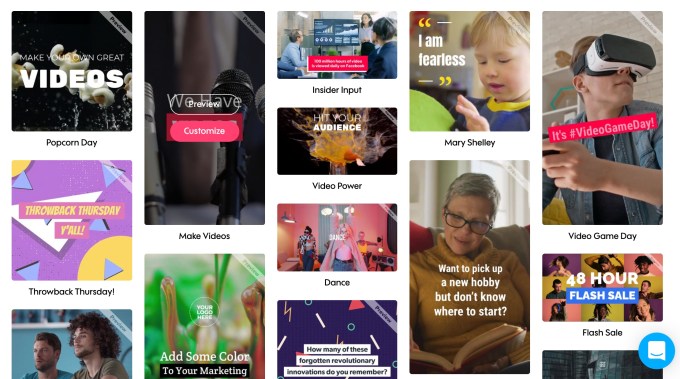
Image Credits: Screenshot/Promo.com
Of course, Promo.com isn’t the only show in town. Video creation platform Biteable raised $7 million of its own in December, and similarly allows companies to make bright, bite-sized video content for social. The super streamlined graphic design platform Canva also supports video editing with its own library of stock images. Vimeo offers its own video template service too, known as Vimeo Create, which grew out of the company’s acquisition of the AI-powered video editor Magisto.
Powered by WPeMatico
Earlier this year, Turntable.fm’s founder Billy Chasen dusted off the old site and resurrected it for the pandemic age. I know I wasn’t the only one feeling a wistful pang of nostalgia for the service during the long, dull days of sheltering in place. And while March 2020 would have been the best time for a relaunch, March 2021 was pretty good, too.
Today Chasen announced that the service has received a nice little slice of VC backing to help the service (which has thus far been invite/password only) take the next step. Andreessen Horowitz led the $7.5 million round a decade after the site’s original launch. Funding had thus far been limited to fans through services like Patreon and Venmo. He notes that he will be turning off the service’s Patreon.
Chasen is staying mum as far as where the funding will go, stating, “And now with the new fundraising, we can continue to innovate and truly explore the cross section of social + music. I have a lot of ideas for the space and I’m excited to start building them.”
Though, a blog post does note that the company is hiring engineers and designers. Understandable, though as someone who’s been enjoying the site these last few months, I’m actually pretty surprised at how fresh the whole thing feels.
The team found a clever loophole around music rights in the form of YouTube videos, but perhaps a future version of the service will involve more direct music licensing or ties to popular apps like Spotify. A mobile app would be nice, if I’m just spitballing here.
Turntable.fm initially shut down back in 2013, stating at the time, “It was a tough decision to make because we love this community so much, but the cost of running a music service has been too expensive and we can’t outpace it with our efforts to monetize it and cut costs.” The service added that it was focusing on a live events platform instead.
Notably, Turntable.fm is not the only Turntable service looking to relaunch in 2021. There’s also Turntable.org (confusingly located at TT.fm), which is seeking fan funding, as well as looking toward a subscription fee. It announced that it had raised $500,000 in March and was aiming for an April launch for a mobile and desktop version. The site currently reads, “We’re building a new version just as much fun as the original.”
The two Turntables are not affiliated.
Powered by WPeMatico

Whatnot exists with one primary goal in mind: to give people a place to buy and sell collectibles (like Pokémon cards, sports cards, pins, etc.) in a safe, authenticated way.
The company started out with intentions of being a GOAT/StockX-style resale marketplace, where the products up for sale lived on neat little pages with row after row of static images. As they started experimenting with other formats, they found one that really seemed to catch on: livestream sales. Think QVC or the Home Shopping Network… but instead of hosts in huge studios selling jewelry and patio furniture, it’s users with smartphones selling Charizard cards and Yoda figurines.

Image Credits: Whatnot
I first wrote about Whatnot last year. In the short time since, the company has raised three increasingly large rounds: $4 million in December, $20 million in March and, as of this morning, another $50 million.
While Whatnot still offers the more standard product pages to give sellers a 24/7 presence on the site, the livestreaming side of things has become the primary driver — by far. Co-founder Grant LaFontaine tells me that livestreaming is currently “95% of the focus”; it’s where most of their sales are happening, and what users seem to care most about.
Another thing users seem to care about? Sports cards. Whatnot opened up the site to sports card sellers in January, and it almost immediately took over as the site’s best-selling category. The one category now accounts for “millions of dollars” in sales each month, the company says.
The Whatnot team itself is growing quickly as well. When I first spoke to them, it was just a handful of employees; by January of this year, they were up to 10. Today it’s 45 full-timers. By the end of the year, says Grant, they expect to be nearing 100.
While anyone can sell on Whatnot’s marketplace, only users that have been vetted/invited can sell via livestream. This helps to keep fraud low; sellers know that if they try to sneak in fake cards or rip anyone off, their access to livestreaming — and thus their audience — could vanish.
The company tells me that this Series B round was led by Anu Hariharan of Y Combinator Continuity fund, and backed by Andreessen Horowitz, Animal Capital and a number of angels.
Powered by WPeMatico
Salesforce dominates the world of CRM today, but while it’s a popular and well-used tool for organizing contacts and information, it doesn’t have all the answers when it comes to helping salespeople and marketers sell better, especially when meetings are not in person. Today, one of the startups that has emerged to help fill the gap is announcing a round of growth funding on the back of a huge year for its business.
Qualified — which builds better interactions for B2B sales and marketing teams that already use Salesforce by tapping into extra data sources to develop a better profile of those visiting your website, in aid of improving and personalizing the outreach (hence the name: you’re building “qualified” leads) — has picked up $51 million in funding. The startup will be using the Series B to continue building out its business with more functionality in the platform, and hiring across the board to expand business development and more.
Led by Salesforce Ventures, the funding round also included Norwest Venture Partners and Redpoint Ventures, both previous backers, among others. As with so many rounds at the moment — the venture world is flush with funding at the moment — this one is coming less than a year after Qualified’s last raise. It closed a $12 million Series A in August of last year.
Qualified was co-founded by two Salesforce veterans — ex-Salesforce CMO Kraig Swensrud and ex-SVP of Salesforce.com Sean Whiteley — serial entrepreneurs who you could say have long been hammering away at the challenges of building digital tools for sales and marketing people to do their jobs better online. The pair have founded and sold two other startups filling holes to that end: GetFeedback, acquired by SurveyMonkey, and Kieden, acquired by Salesforce.
The gap that they’re aiming to fill with this latest venture is the fact that when sales and marketing teams want to connect with prospects directly through, say, a phone call, they might have all of that contact’s information at their disposal. But if those teams want to make a more engaged contact when someone is visiting their site — a sign that a person is actually interested and thinking already about engaging with a company — usually the sales and marketing teams are in the dark about who those visitors are.
“We founded Qualified on the premise that a website should be more than a marketing brochure, but not just a sales site,” Swensrud, who is the CEO, said in an interview.
Qualified has built a tool that essentially takes several signals from Salesforce as well as other places to build up some information about the site visitor. It then uses it to give the sales and marketing teams more of a steer so that when they reach out via a screen chat to say “how can I help?” they actually have more information and can target their questions in a better way. A sales or marketing rep might know which pages a person is also visiting, and can then use the conversation that starts with an online chat to progress to a voice or video call, or a meeting.
If a person is already in your Salesforce Rolodex, you get more information; but even without that there is some detail provided to be slightly less impersonal. (Example: When I logged into Qualified to look around the site, a chat popped up with a person greeting me “across the pond”… I’m in London.)
Qualified also integrates with a number of other tools that are used to help source data and build its customer profiles, including Slack, Microsoft Teams, 6sense, Demandbase, Marketo, HubSpot, Oracle Eloqua, Clearbit, ZoomInfo and Outreach.
Additional data is part and parcel of the kinds of information that sales and marketing people always need when reaching out to prospective customers, whether it’s via a “virtual” digital channel or in person. However, in the last year — where in-person meetings, team meetings and working side-by-side with those who can give advice have all disappeared — having extra tools like these arguably have proven indispensable.
“Sales reps would heavily rely on their ‘road warrior’ image,” Swensrud said. “But all that stuff is gone, so as a result every seller is sitting at an office, at home, expecting digital interactions to happen that never existed before.”
And it seems some believe that even outside of COVID-19 enforcing a different way of doing things, the trend for “virtual selling”, as it’s often called, is here to stay: Gartner forecasts that by 2025, some 80% of B2B sales interactions will take place in digital channels. (So long to the expense account lunch, I guess.)
It’s because of the events of 2020, plus those bigger trends, that Qualified has seen revenues in the last year grow some 800% and its net customer revenue retention rate hover at 175%, with funding rounds come in relatively close succession in the wake of that.
There is something interesting to Qualified that reminds me a bit of more targeted ad retargeting, as it were, and in that, you can imagine a lot of other opportunities for how Qualified might expand in scenarios where it would be more useful to know why someone is visiting your site, without outright asking them and bothering them with the question. That could include customer service, or even a version that might sell better to consumers coming to, say, a clothes site after reading something about orange being the new black.
For now, though, it’s focused on the B2B opportunity.
There are a number of tools on the market that are competing with Salesforce as the go-to platform for people to organise and run CRM operations, but Swensrud is bullish for now on the idea of building specifically for the Salesforce ecosystem.
“Our product is being driven by and runs on Salesforce,” he noted, pointing out that it’s through Salesforce that you’re able to go from chatting to a phone call by routing the information to the data you have on file there. “Our roots go very deep.”
The funding round today is a sign that Salesforce is also happy with that close arrangement, which gives it a customization that its competitors lack.
“Qualified represents an entirely new way for B2B companies to engage buyers,” said Bill Patterson, EVP of CRM Applications at Salesforce, in a statement. “When marketing and inbound sales teams use this solution with Sales Cloud… they see a notable impact on pipeline. We are thrilled about our growing partnership with Qualified and their success within the Salesforce ecosystem.”
Powered by WPeMatico